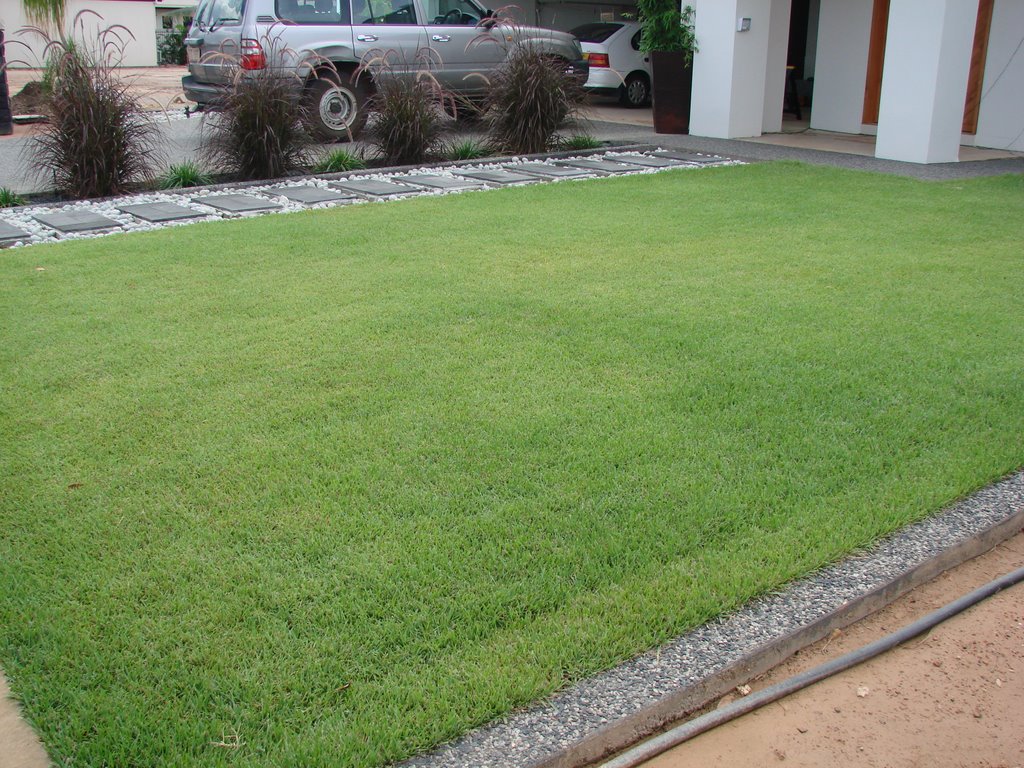
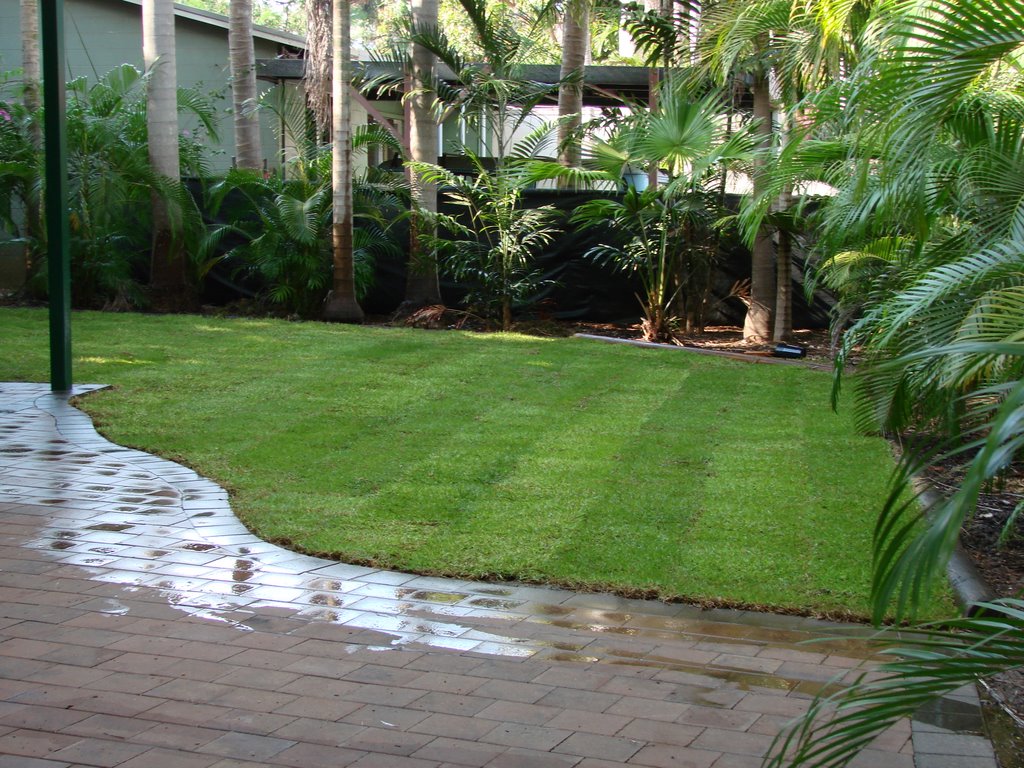
Partially completed in December 2006 - grandstand and main pitch plus an aerial view [ from Steve Allen] in late November 2006.
Football in the Northern Territory is finally getting it’s own home ground!
Football NT has been working with the NT Government over a number of years to develop the funding and concept for a specific football facility. As elsewhere in Australia, Northern Territory football has a huge junior playing base, and has sought to develop high quality playing facilities. The main stadium in the Marrara sporting precinct – Marrara Oval – already has a superb ‘Legend” couch domed oval, perched water table profile, playing surface. This facility has hosted international daylight cricket and AFL games in both daylight and at night, and is leased to AFLNT for the local Australian Rules competition. This precludes regular use by soccer, although with corporate boxes, extensive media facilities and an international grade playing surface, it still may be used for major matches by football.
The new football facility to meet a regional demand, will initially comprise two full size pitches [and enough space for additional satellite pitches over the next few years], plus a large covered grandstand with the usual facilities below the seating decks for team dressing rooms, officials facilities, some administration areas and refreshment facilities, rest rooms etc. There is also development of car parking, access and fencing. The main pitch is lit to enable night matches.
The one thousand seat grandstand will have a translucent roof, an unusual option, to reduce shading of the grass on the pitch. The two main pitches are oriented north-south which avoids most issues with unsighting of players due to the sun. The main pitch is also protected from the setting sun in the west by the bulk of the grandstand. This N-S orientation in the low latitude tropics [where the sun travels overhead from tropic to tropic] avoids issues of shade affecting grass growth, as there are no structures north or south of the grassed areas. There are raised areas around the pitches giving good viewing for non grandstand spectators.
The concept of the pitches are that they will allow soccer play within about an hour following a major storm event of 100mm of rain falling within one hour, rather than allowing play under virtually all conditions. In relation to the historical storm frequency locally in Darwin, this effectively means that only the very heaviest storm events would delay any match.
The pitches are designed as sand profiles, with a 300mm profile depth over a 4-6mm angular gravel underlay of 75mm deep. Below that are a series of gravel lined 150mm wide and 300mm deep slot drains with 100mm diameter agricultural drainage pipe cores. The drains were cut into the laterite surface, and link into a much larger drainage system of both pipes and gravel drains. Extensive investigations on the characteristics of the local sand sources were carried out during the design phase, to ensure suitable profile characteristics. Darwin is isolated, and does not have the luxury of access to high quality quartz sand, making the development of the profile more difficult than usual. To complicate the issue, major sand suppliers [normally supplying the construction industry] radically modified production processes between design and construction phases of the project. This caused further extensive sand testing and profile adjustment during the construction phase to ensure a suitable sand structure of the profile, to meet infiltration, particle size and performance criteria. The final profile design has been a blended mix of 90% coarse and 10% fine sand, and adjusted with 12% cocopeat to provide adequate moisture capacity, while still allowing a high infiltration rate. The need to hold moisture in the profile is an absolute must – with daily evaporation rates of 7-10mm per day common for 9-10 months of the year, except the cooler months of June and July.
Sand was blended off site, kept damp and laid with low profile flotation tyre construction machinery over the gravel layer. The sand profile was kept to a low 1% final slope to each side, from a central midline along the long dimension, a flatter surface better suited to soccer than the usual domed multi- purpose oval. Micro laser technology was used to fix the final grades.
To provide initial stability, and after the sand was laid, a fibre matrix was blended into the top 150mm of the profile. This was considered a desirable option with a high percentage of the softer, coarse sand in the profile to ensure infiltration in heavy rain, for what is essentially a soccer playing surface, requiring a degree of ball bounce not commonly needed for most other football oval surfaces.
The turf is zoysia……….
The turf species for top line ovals in the low latitude tropics has traditionally been couch grass. It is not always the best option agronomically with couch often suffering from poor performance due to low light levels in wet, overcast conditions, and slow regrowth in the shorter cooler days of the dry, cool season. The majority of FIFA World Cup 2002 pitches in Korea / Japan were seeded zoysia turf, and intensive development of zoysia turf for horse racing and golf in Singapore as well as the major National Stadium in Vientiane, Laos which are all zoysia, influenced the thinking that a seeded zoysia would be cost effective and successful, and the original choice was to seed “Compadre” [formerly Companion] zoysia. It is believed that this would be the first significant zoysia turf pitch development on a stadium in Australia.
During construction, the builder sought a change to a vegetative zoysia variety, and the pitches were eventually sprigged with “Empire” zoysia, at considerable extra cost, in comparison to a seeded zoysia, although the argument was made that development of the surface may be quicker. Full surface development to playing condition is expected to take 12 – 16 weeks from establishment.
Sprigging was a major exercise, and completed on both pitches in December 2006. November and December in Darwin in 2006 were both dry and hot, without much rain until late December 2006, which brought lower temperatures and a relief from the difficult high temperature establishment conditions. The sprigged grass was slowly greening up by January 2007.
Irrigation is using overhead pop up sprinklers, and unfortunately will have to be with potable water from the main Darwin supply. This is likely to be a problematical issue, especially the cost, as all other stadia in the precinct currently use low cost recycled effluent, supplied via a dedicated system to the precinct area from local effluent treatment ponds. However the holding dam cannot adequately cope with the additional demand and so the new soccer pitches had to be reluctantly designed with using a potable supply for dry season irrigation. Using recycled effluent may be feasible in future years.
The facility will be operated by Football NT and first major events on the playing surface are expected to be the soccer matches of the Arafura Games in early May 2007. The NT Football Association hopes the modern facility can attract teams for national tournaments and acclimatization training, while allowing development of local soccer on a first class, purpose built, soccer pitch.
Project details
Project tendered cost - $6.55 million, but final cost likely to be greater
Builder – Sitzler Brothers , Darwin
Architect – Jackman Gooden Architects, Darwin
Landscape Architects – Clouston and Associates, Darwin
Irrigation – Allied Irrigation, Pslmerston
Pitch Designer – Above Capricorn Technologies – Agricultural & Environmental, Darwin
Landscape Contractor – Paradise Landscaping, Berrimah, NT using specific sub-contractors Maneuver Mow for profile development; Evergreen Turf for the fibre matrix.