skip to main |
skip to sidebar
The article below came from a recent NAB Agribusiness newsletter and highlights the opportunity in agribusiness for shrewd operators.
The emphasis is on quality and differentiation of the product, a trait that seems to be increasing in Australian agriculture. With large organisations such as Australian Agriculture Company - AACo - marketing their own branded beef through supermarkets, mango growers marketing single variety products sourced from a range of areas to the wheat group highlighted here, ways are being found to differentiate products formerly thought of as mass market products. And creating significant value along the way.
Can you as a rural producer do something similar or create a group that could?
While not for everyone, it certainly has a place in today and tomorrow's rural product mix, particularly to urban consumers who are often brand focused.
It is important to also note the emphasis on traceability - a big issue for food products.
Here is the NAB article - with acknowledgement to the NAB Agribusiness Newsletter [electronic].
-------------------------------------------
Run by four families, Flinders Ranges Premium Grain in South Australia has an expanding grain and flour export business that sells itself on the location and soil it’s grown in, in the same way wine does. Their specialised Katana wheat is acclaimed by frozen dough producers in India and the Middle East as much as it is by artisan bakers in Australia.
It’s taken 15 years, but Flinders Ranges Premium Grain (FRPG) in South Australia is riding an export boom for their flour made from low-yield hard wheat called Katana.
The Ranges’ low rainfall and limestone rich soil give their specialised wheat an elastic protein profile that gives it an extended frozen shelf life without the inclusion of preservatives or additives. This has made it popular among frozen dough producers in India and the Middle East as well as artisan bread producers in Australia. “We knew that doing well as a business meant moving away from producing a soft commodity where we were at the wrong end of the pricing chain,” says FRPG CEO Peter Barrie. “We looked at what food producers in different markets required as well as what our four family-run properties in the Flinders Ranges could best produce. We started experimenting with hard wheat. While not as high yield as many grains, the elastic, high protein qualities of the grains opened up premium markets to us – abroad and at home.”
Understand your product’s role in the food industry
Ongoing research and development (R&D) is a hallmark of FPRG’s business strategy. From early on, they formed a solid relationship with Adelaide TAFE to test how the flour grown on their farms performed for different segments of the food industry. “Discovering how our wheat performed as a baking ingredient led us to identify our niche export market,” says Barrie. “Once we knew what we needed to provide to frozen dough producers, we continued testing wheat varieties until we found our best for purpose grain.”
This emphasis on R&D coupled with ‘paddock-to-plate’ traceability helped FRPG secure the Bakers Circle India and the Middle East contracts to supply the flour for frozen dough for the regions’ Subway stores.
Even with the Indian contract well established, Barrie still travels to India, and now Dubai, to check how his flour performs within its production environment and as an end product in the local Subway stores. “It’s satisfying being part of the whole production process in all these different places,” he adds.
Consistent quality demands full traceability
Quality, consistency and traceability are equally important for FRPG’s large overseas clients. The company has a fully auditable path from farm to shipping that guarantees the clean and green standards of their produce. This traceability involves having their own storage silos and mill, so there is no risk of contamination with inferior grain from other farms.
Australia’s reputation as clean and green is a big drawcard internationally. The National Residue Testing Standards are a good base. However, Barrie points out that most countries and big food manufacturers have their own strict standards. This makes meeting individual customer protocols time-consuming. “It’s another reason single origin grain and flour from small family owned farms holds an international advantage,” he says. “We can provide the traceability and quality control. The low rainfall on our properties means fewer chemicals.
We don’t need fungicides, and we select varieties that are disease resistant. Being a family farm is a definite marketing advantage. Companies and consumers like to know where their flour has come from and have the security of knowing who produced it.”
Find your niche and you find your future
Barrie is excited about the future of Australian agriculture and FRPG in particular. While acknowledging that the falling dollar helps, he doesn’t shy away from the need to continuously explore new markets and tailor wheat for their needs, saying: “It’s a non-stop learning curve for everyone involved”.
FRPG is currently working with the University of Adelaide’s School of Chemical Engineering to try and double the shelf life of wholemeal wheat and, if international demand is high enough, set up a wholemeal mill. “We keep one step ahead of the market by identifying and then solving a problem for the food industry,” he says.
FRPG went on three government trade missions in 2015. So far, they’ve steered clear of China because the margins were too low. However, that market is opening up for premium primary produce. “We’re looking to diversify into three or four countries plus develop our domestic artisan sourdough flour market,” says Barrie.
He sees great opportunities for young farmers today. The export market is opening up in exciting ways – if farmers become part of the food industry instead of suppliers of a soft commodity.
“Accept the challenges, and life on and off the farm gets more interesting,” advises Barrie.
---------------------------------------------------
More on the business here - www.flindersgrain.com.au
The sustained increase over the past three years in Indian buffalo (carabeef) exports is projected to continue, according to a report recently commissioned by Meat and Livestock Australia (MLA) analysing the industry and its impact on the world beef market over the next five years.
Shipments of approximately 2.2 million tonnes carcass weight equivalent (cwe) Indian carabeef are forecast for 2020.
This assertion is based on the projected growth of India’s dairy sector, of which carabeef is a by-product, continued demand in international markets, and the abundant supply of water buffalo throughout the Indian subcontinent.
Beef consumption is shunned on religious grounds by Hindus, who account for approximately 80 per cent of the Indian population, leaving a substantial surplus from the routine culling of unproductive and dry buffalo cows for export.
Carabeef exporters have established a strong foothold in markets that are expected to expand under the combined power of population growth and higher per capita incomes, like China, Malaysia, Vietnam and Saudi Arabia.
According to the report, Indian carabeef is currently trading below Australian beef in global markets, yet it is apparent that carabeef prices are rising to follow trends for Australian and Brazilian product.
Forecasts for growth in the Muslim and Christian segments of the Indian population are expected to underpin an increase in domestic disappearance by around 900,000 tonnes cwe, which would mean approximately 14 kilograms per capita consumption among that cohort by 2020.
Additionally, assuming no changes in the status of the current grey channel trade via Vietnam and Thailand, exports to China are expected to reach 1.375 million tonnes cwe, and account for about 60pc of India’s carabeef exports.
Importantly, the report indicates that India is unlikely to supply Australia’s traditional markets within the short to medium term.
Furthermore, the modelling suggests that while increased supply of carabeef will put downward pressure on world beef prices, the current market is sufficiently flexible to redistribute product to different markets in response to relatively small changes in price.
This demand for buffalo and buffalo meat should also have a positive effect on Australian export of buffalo for live export markets, as well as some modest potential for improved export of boxed carabeef meat into some markets.
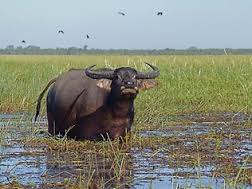 |
| Australian buffalo |
Australia cannot match the supply from Indian sub continent sources, but with some markets requiring foot and mouth disease freedom assurances there is a place for our export products.
While the export of live cattle to indonesia and even elsewhere is slowing [ and it is the wet season too], there are some very significant increases occurring in sales of Australian beef to China.
Probably more importantly, it is in less expensive cuts, and not necessarily in the highest priced cuts eg scotch fillet or rump steak which often dominate boxed beef often sold to Asian markets.
It augurs well for potential sales from new abbattoirs in north Australia, especially the one near Darwin, which will hope to process some animals that may have gone to Indonesia.
China is showing an appetite for Australian beef that is rivaling its desire for our mineral resources.
A surge in exports to the Asian giant in the first two months of 2013 on the back of spectacular growth last year is causing Meat and Livestock Australia to step up promotion of our red meat products, mainly through the food service and restaurant trade, and beyond Beijing and Shanghai to other lesser know cities here in Australia such as Tianjin, Hangzou and Shenzen. MLA marketing manager Micheael Edmonds said China's beef buying patterns were beginning to show real promise for Australian exporters, who are still struggling to lift volumes in the sluggish Japanese and Korean markets. "There's been a lot of talk about the opportunities in Asia but now we're really starting to see significant growth and some runs being put on the board," Mr Edmonds said. "We saw it over 2011 and 2012 where China was without a doubt the shining light in the Asian region. "And there are opportunities at both ends of the market for both grass-fed and grain-fed product, with manufacturing beef and shin-shank filling the bulk commodity cuts and significant movements of brisket, once traditionally bound for Japan, now heading to China where they are fetching better prices."
Data released by MLA last Friday shows China flexing its buying muscle in February, with beef exports estimated to go close to exceeding the 10,000 tonne shipped weight mark by the end of this past week.
The MLA forecast for 2013 was 35,000 tonnes, but this could easily be exceeded based on current sales. MLA chief economist Tim McRae said the growth was even more extraordinary given that prior to last year, which saw 32,900 tonnes exported, the largest calendar year total to China was only 7200 tonnes.
AAco had been making noises about a surge in sales to China, prior to the finalisation of the plans for the local processing facilities, and they may well be correct.
BUT....... could we also see the fickle nature of big sales to China, similar to mineral sales. Or will they produce enough red meat, both beef and lamb, from land purchased in Australia by sovereign companies, bypassing any Australian profit, in a type of vertical integration system??
While one door closes another may be opening. Australia is having difficulties selling beef or live cattle to Indonesia, but it seems another market for meat might be lamb sales to India.
Will not help northern cattle producers, but this could be an interesting option for sheepmeat producers.
It is understood that Australia is planning to sell boxed lamb meat.
The fairly dry media release follows -
Trade Minister Craig Emerson and Agriculture Minister Joe Ludwig announced today that Australia had secured market access for Aussie lamb to India. Australian lamb is being allowed into India free of quotas, based on Australia's compliance with India's food safety requirements.
"I am advised that Indians are fast developing a taste for our world renowned lamb, and that a number of Australian exporters are looking to this growing market," Dr Emerson said. "India's economic growth is creating a rapidly expanding middle class that is looking for quality products of the sort Australia readily provides." "India already has a middle class of around 170 million," he said.
 |
selected lamb meat cuts
|
As the Government has highlighted in its White Paper on Australia in the Asian Century, Asia will soon be home to the majority of the world's middle class. "Working with India to have our lamb enter this massive market is exactly the sort of cooperation we are seeking with the countries of Asia to drive Australia's prosperity," Dr Emerson said.
Minister for Agriculture, Fisheries and Forestry, Senator Joe Ludwig, said it was great news for Australian farmers. "Australian farmers produce high quality lamb," Minister Ludwig said. "The Gillard Government is committed to helping them take their product to the world and India is an important new growth market. "I look forward to continuing to work with Australian producers and the Trade Minister to get the best results for Australian exporters."
Dr Emerson was in India last month for talks with his counterpart on the trade and investment relationship between the two countries.
India is Australia's fourth largest export market and the two-way trading relationship currently stands at around $18 billion.
So if visiting India and staying in hotel accomodation your next lamb korma curry might be Australian meat.


