Showing posts with label urban horticulture. Show all posts

Wednesday, July 11, 2018

Will Your Next Tomato Be Grown Indoors by Robots?


If you were inventing the farm today, why would you put it outside, on a giant plot of land?
OK, there’s the sunlight thing, but then you get droughts and frosts and plant-munching insects that have to be battled with harmful pesticides. And because outdoor farms need so much acreage, they’re usually far from most of their customers — which means that by the time a tomato gets to you in a city, it tastes like a baseball.
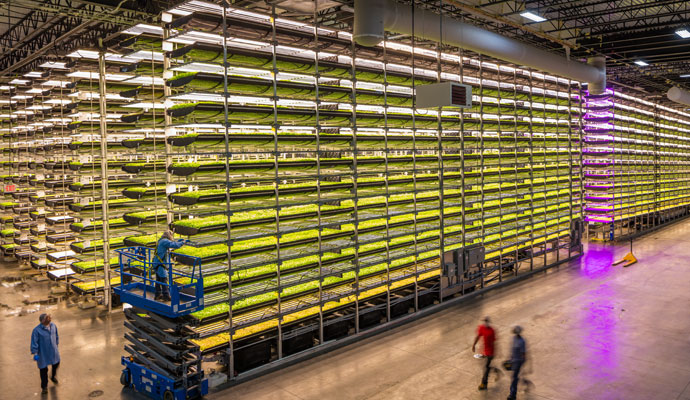
But now, upstarts in the US such as Bowery Farming, AeroFarms, and Lettuce Networks are doing something different. They’re growing food indoors. They’re using data and artificial intelligence to operate more efficiently than traditional farms. And they’re staying small and close to population centers. The new generation of farming promises to feed more people while doing less environmental damage.
This kind of distributed farming fits with a larger 21st-century movement that venture capitalist Hemant Taneja and I call “unscaling.” We document the economic trend in our book, Unscaled: How AI and a New Generation of Upstarts Are Creating the Economy of the Future.
Massive scale was the goal throughout the 20th century. Mechanization and technologies such as the truck and telephone made it possible. Mass production, mass markets, and economies of scale ruled in every sector. So we ended up with giant companies, huge hospitals, big universities — and corporate mega-farms.
Today, industry after industry is unscaling. The cloud, mobile devices, big data, AI, and new technologies such as blockchain and 3D printing are making it possible to profitably customize products for smaller and smaller niches. Netflix is an unscaled version of mass-market cable networks like HBO, using data to make programs that appeal to specific types of viewers. Airbnb is a distributed hotel company. In an unscaled era, businesses can operate at smaller, more focused levels and beat giant enterprises.
So farms are unscaling, too. Bowery and AeroFarms both operate inside old industrial buildings in New Jersey and are a short drive from New York City. Inside these buildings, LED lights mimic natural sunlight. The crops grow in nutrient-rich water beds on trays stacked floor to ceiling. And sensors constantly monitor the plants and send data back to AI-driven software, which can learn what’s best for the plants and tweak lighting, water, and fertilizer to improve yields. Much of the “farming” is done by robots. “We get productivity hundreds of times greater than a traditional farm,” says AeroFarms CEO David Rosenberg. “And we use less water and no pesticides — because we’re indoors — and can grow 365 days a year.”
These unscaled farms can give consumers a better product than mega-farms, too. Food grown nearby doesn’t need to endure shipping — so it can ripen the way it’s supposed to. In the middle of winter, indoor-grown, local tomatoes will taste like tomatoes. As you can imagine, that’s what consumers prefer.

Since 2013, about US$2 billion has been invested in hundreds of agricultural technology startups, according to CB Insights senior analyst Zoe Leavitt, who spoke about the future of food at a recent Techonomy conference in New York. AeroFarms has raised more than $100 million and sells to Whole Foods and FreshDirect. Boston-based Freight Farms is growing food in container cargo vessels, often selling to restaurants, hotels, and college campus eateries. New York–based BrightFarms says it “finances, designs, builds, and operates” indoor farms close to food retailers and has raised $11 million in funding. Edenworks is operating rooftop greenhouses that grow produce fertilized by ground tilapia and prawns, which are also grown at the mini-farm.
Lettuce Networks is trying another approach. It is using cloud and mobile technology to create a network of urban farms. Founder Yogesh Sharma calls it an Airbnb for farming. The company contracts with owners of small plots throughout a city and installs sensors that can monitor crops and the surrounding environment. Nearby residents can subscribe to the Lettuce service to get food delivered. The system knows what’s being grown all around the city and, from that network, assembles a basket of local produce for delivery. Owners of the plots make some money off their harvest, while subscribers get an assortment of fresh food grown nearby.

Whether unscaled farming is a net economic benefit remains to be seen. It’s a new industry, with techniques and business models that are works in progress. Analyst firm Market Research Future
 notes that urban farms cost a lot to start (a warehouse in New Jersey is more expensive than a plot of land in Saskatchewan) and don’t yet work for a lot of crops, such as corn or bananas. Sunlight is free and sustainable; LED lights require energy. But proponents believe that because these indoor farms are far more productive and are closer to consumers, once there are a lot of them and the techniques and technology get honed, more people will be fed for less cost than ever before.Distributed, indoor, AI-assisted farming should be good news for the environment. Scaled-up farming was the right answer for the past century, feeding a burgeoning population while making food relatively cheap. The percentage of disposable income used for food is lower today than it was in the 1970s, according to Pew Research Center. But by 2050, the planet is projected to have 2.2 billion more people to feed, just as global warming is expected to make weather less predictable and dry up previously fertile regions. If food can be grown indoors, in a cost-effective way, in or near cities, climate will be less of a concern, and far less carbon will be burned moving food thousands of miles via trucks, trains, and ships.
As investment pours in and environmental conditions drive a need for new solutions, unscaled farming looks a lot more like the future of food than does a massive field baking under the sun.
Thoughtful or foolish?
from an article originally written by Kevin Maney in Strategy + Business 

Tuesday, March 05, 2013

Urban Stormwater Management – Smarter Solutions and Better Stormwater Use


While almost no urban sewerage system in Australia is designed to also handle stormwater, as is the case in some older cities, particularly in the USA, the management of stormwater productively is quite a challenge.  With our increasingly hard surfaced cities, the stormwater system has grown, usually channelling away water that previously would have often dissipated within the landscape where it was generated, often even into the ground, or at least nearby.
While there are places around Australia where the stormwater is planned to move and actually recharge local aquifers, with Mawson Lakes near Adelaide a good example, as is some stormwater even around Palmerston, recharging the aquifer under the city in the wet season.  Normally, most stormwater runs off, and is lost to local use.


With about 80% of contaminants on hard surfaces, being moved with the first flush of rain [even more in the tropics with the first break storms of the wet season], colleting that and filtering through land and used by plants is a major and distinct improvement to the quality of stormwater discharged into nearby rivers, creeks and ultimately the harbours and oceans.  Most of the pollutants are remediated by soil borne organisms.
But driving that change is difficult as engineering has dominated how urban stormwater has been managed and the usual method has been pipe, or surface hard channel it, away.

More localities are reconsidering this however, through design modification to use plant based drains and detention areas before excess water flows elsewhere.  Volumes handled by expensive engineered solutions are often decreased as is cost, and water is used productively near where it is produced.
Better design can actually increase volumes handled by bioengineering approaches, so often even reducing overall costs.  This type of approach may even be retro fitted at modest cost or with little disruption to existing facilities.

It is more difficult in monsoonal areas with major differences in urban water between the wet and dry seasons, but it is possible to modify designs to at least allow a reduction in irrigation in the early and late wet seasons by better using locally generated surface waters locally with better design of roads and local parklands.
Some projects have been finished in Sydney as well as overseas. There are some smart designs on the web site of www.atlantiscorp.com.au  used in Sydney, an Australian company in this design space.  See more here -  http://www.atlantiscorp.com.au/solutions/civil-engineering/road-solution-drainage .

More are being planned, with some further details here –
http://e360.yale.edu/feature/to_tackle_runoff_cities_turn_to_green_initiatives/2613/

And then there are green roofs, aimed at collecting and using water that falls on buildings and preventing much of that getting to street level – it helps cool buildings too, reducing heat load on concrete roofs.  More of these options are developing.

 
We just do not do enough of these more appropriate solutions here in the NT. 

Wednesday, February 23, 2011

Agriculture and Innovation

Agriculture and horticulture often get some bad publicity as being stuck in using ancient ideas and that people in these industries are old fuddy duddies without much innovation.

I would say that is probably the exact opposite of real world situations. Innovation is alive and very well in these two industries, and seems to have been around for well over a hundred years. While it is often true that farmers are older on average than the population, they still embrace new ideas.

Whether it has been mechanisation and machinery development, application of technology in plant breeding or use of new products including herbicides and pesticides, satellite navigation and related use in yield mapping of paddocks, driverless machinery, use of RFID systems for animal identification and management..............the list can go on, and on!!

This recent snippet reinforces the view that agriculture is VERY progressive, and has been for a very long time. I am sure that even today, the same story can be repeated about Australia, Canada, Brazil, and Argentine, as well as the USA.


February 1911 - Scientific American Magazine

Inventors and Farmers

“In all the history of empire building there is no chapter to compare with that which tells the story of the development of the great West from a vast stretch of prairie, desert and primeval forest into the richest and most extensive agricultural empire in the world.

The rapidity and completeness with which this transformation has been effected are chiefly due to the invention of agricultural machinery of wonderful precision and capacity. The mechanical engin­eer has at once simplified work and increased output from the farm.”


It is still taking place across all the major agricultural producing countries today.............2011!

Tuesday, February 22, 2011

Origin of Insecticides

In browsing Scientific American magazine of February 2011, the following brief note appeared in the highlights of 150 years ago - February 1861.

Modern agriculture and horticulture does have a degree of reliance on both herbicides and insecticides, although some would say that is changing as biotechnology makes advances and GM crops advance.

Whether true or not, pyrethrin was one of the very earliest insecticides. And the snippet below provides some interesting thoughts from 150 years ago.

February 1861 - Scientific American Magazine

Pyrethrin Insecticides


“A vegetable powder, under the name of ‘Persian Insect Powder,’ has lately been introduced into the drug market, for the extermination of insects, vegetable parasites, &c.

Until recently, the botanical source of this powder has not been known, except to its maker. For a number of years it was erroneously considered to be a native of Persia, but it has been traced beyond question by Dr. Koch, as having its origin in the Caucasian provinces, and to the contused blossoms and flowers of Pyrethrum roseum and Pyrethrum carneum.

It is of a yellowish, gray color, perfectly odor­less, yet slightly irritating to the nostrils; at first almost tasteless, but afterwards leaving a burning sensation upon the tongue.

As its effects for the destruction of bugs, roaches, parasites on delicate plants, &c. have been fully established, and it being otherwise harmless, its introduction into general use would be of great importance to families and horticulturists.”


Thursday, November 18, 2010

Composting in Australia - More Action Needed

Breaking down the benefits of composting
Tuesday, 16 November 2010

A press release worth reading.......


Increasing the use of organic compost to intensive agriculture industries such as citrus could save 30% of irrigation water and deliver millions of dollars of extra income through increased crop yields to regions such as the Riverina as well as providing significant carbon abatement and sequestration opportunities for the nation, according to the Waste Management Association of Australia (WMAA).

CEO of the WMAA, Val Southam. believes greater investment in the utilisation of organic materials in agriculture may be part of the solution to restoring health to the Murray-Darling Basin without jeopardising the livelihoods of farmers and regional communities.“The economic and environmental benefits of composting are enormous. In addition to improving water use efficiency, there are significant environmental benefits accrued through carbon abatement and sequestration.


Organic material diverted from landfill could abate 2 million tonnes of CO2 equivalent every year- approximately 461,893 cars off the road annually.


“Around 420,000 tonnes of compost is used in our intensive agricultural industries per year. Compost improves soil condition by adding organic matter, and a 5% increase in soil organic material will result in the quadrupling of a soil’s water holding capacity. It also suppresses weed growth thus reducing the need for chemicals.” Southam said composting also prevents the loss of valuable top soil and reduces the damaging effects of erosion - savings of between 2.3 and 17 tonnes per hectare of soil loss due to erosion can be achieved. “Our industry is calling on all levels of government to provide R&D funding to fully evaluate the economic and environmental benefits of composting and fund programs which promote awareness of the benefits of compost use in our agricultural industries and wider community,” she said.


Chair of Compost Australia (a division of WMAA), Peter Wadewitz believes there’s much more government, industry and the community can do to increase the use of compost. “At least 20 million tonnes of organic material is available for recycling through composting. Composting organic material such as cardboard and food scraps can reduce the amount of waste going to landfill by as much as 50%. “The Recycled Organics Industry is already processing over 5 million tonnes of organic material annually but the benefits to our environment and economy from increasing this amount are significant,” Wadewitz said. “In addition to increased R&D funding and raising awareness of the benefits of composting, one option may be to establish tax incentives for producers of recycled organic products in more sustainable agricultural production systems,” he added.


Compost for Soils reported that SARDI (South Australian Research and Development Institute) citrus trials (composted green organics, grape marc, animal manure) showed a positive return on the initial investment.An application of 40 m3ha-1 of composted green organics in Loxton North produced the highest benefit at 5.38 – that is, for every dollar invested around $5 is returned to the grower.


---------------------


While this information is not new, in our current debate about carbon, and improved productivity in Australian agriculture, this is a very timely press release and should be heeded around the country.


There is so much wasted food and recyclable organics available. There is technology available to do a lot more, from very simple systmes to quite complex operations. Other countries see this as a valuable resource for agriculture, yet we in australia with relatively poor soils and low moisture holding capacity in soils, really do need this material to improve productivity of the land.


And that applies especially so in the tropics, with higher temperatures driving a faster turnover of the soil carbon as well as a faster soil moisture cycle........and even poorer soils in general.


There are structural issues, with local government [or their contractors] often the handler of organic wastes, yet it must have better leadership at State or National level to achieve serious change.


Yes, there are skilled people that could achieve more.........let there be some action along the lines proposed in terms of R and D!!


Thursday, June 03, 2010

Downtown Agriculture - Can it Succeed

While increasing agriculture and horticulture in urban areas has been mulled over for some time, and is thought to be necessary if food production is to increase, most ideas have revolved around vertical farming.

A recent serious development has involved using urban wastelands or abandoned factory sites, with Detroit in the US seen as a model.

Property values have fallen dramatically, where leasing old sites may just be a profitable way to develop high value crops, especially for horticulture, using modern approaches.

Read the article below..............some interesting options to ponder.

May not be relevant for Australia, as our land and property values are rising, but it would certainly have potential for many areas around the world.


http://qcl.farmonline.com.au/news/nationalrural/agribusiness-and-general/general/downtown-detroit-looks-to-factory-farming/1845591.aspx?storypage=0