Showing posts with label energy efficiency. Show all posts

Tuesday, January 06, 2015

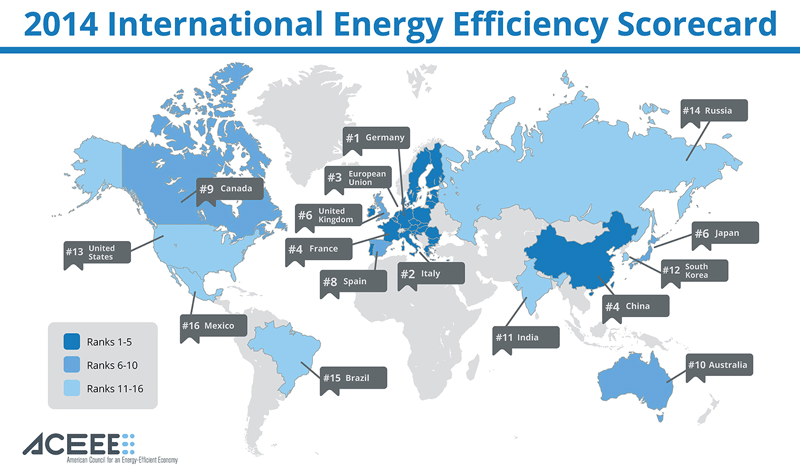
Energy Efficiency - Where Do YOU Rank?

Guess Which Countries Rank the Highest in Energy Efficiency

Quite interesting reading and most do not quite believe the high level achieved by China [BTW - also very significant user of wind energy].

Australia is okay, but could be better.


From: JonesOil
which-countries-rank-highest-in-energy-efficiency

Tuesday, November 25, 2014

Deep Carbon Cuts - Pathway to US Lower Greenhouse Emissions

Recently the Yale Environment 360 blog recently reported that the United States can reduce greenhouse gas emissions by 80 percent by 2050, using existing or near-commercial technologies, according to researchers with the Deep Decarbonization Pathways Project.

The study analyzed scenarios with four types of decarbonised electricity: renewable energy, nuclear energy, fossil fuel with carbon capture and storage, and a mixed case. The scenarios achieved reductions of 83 percent below 2005 levels and 80 percent below 1990 levels, according to the study, which was released ahead of next month’s climate talks in Lima, Peru, and negotiations in Paris in December 2015.

The energy efficiency of buildings, transportation, and industry would need to increase through the use of smart materials and energy-efficient designs, and vehicles will need to be fueled with electricity generated from wind, solar, or nuclear, as opposed to coal, the researchers said. They project the net costs would be on the order of 1 percent of gross domestic product per year.

The 80-percent reduction by 2050 is a long-standing goal of the Obama administration, in line with the global commitment to limit global warming to less than 2 degrees Celsius. “One important conclusion is that investment opportunities in clean technologies will arise during the natural rollover and replacement of infrastructure,” said lead author Jim Williams. “The plan calls for non-disruptive, sustained infrastructure transitions that can deeply decarbonise the U.S. by 2050, and enhance its competitive position in the process.”

This is a significant move and one that seems a highly logical pathway to successful outcomes.  

There is more emphasis on energy efficiency, especially retro fitting to buildings, an area that has not greatly been explored in Australia.

While the study outcomes have not yet been included in US government policy, it does seem to point to a solid and logical route for progressing the gains required.

What is the program for Australia?  We seem to be stuck on 5% reduction by 2020, yet more is possible.  It also seems that individuals are also doing more outside of government policies - notably with the development of household PV systems around Australia. The transport fuel issue is a big problem in Australia with vast distances and a small population, but gas would seem to be part of the mix in this case.

I do not yet see a lot of confidence among people with the current direct action program of the federal government, that it could achieve the scale of reductions needed to get to 80% below 2005 levels, especially while most electricity seems to be generated by coal.  However, if these plants were replaced [ even if through old age] by gas or new thorium nuclear plants then much greater reductions might be achievable.  With both India and China developing thorium reactors - that could be an option within 15 years or so.


Sunday, July 20, 2014

Germany Best at Energy Efficiency while Australia and USA Very Poor

Germany tops a new energy efficiency ranking of the world’s major economies, followed by Italy, China, France, and Japan, according to the American Council for an Energy-Efficient Economy (ACEEE). 
The United States ranked 13th out of 16 nations, behind countries such as India, China, and Canada, although new carbon pollution standards proposed this June for existing power plants in the USA would be a major stride in the right direction, the ACEEE said.

The group also admonished Australia, which ranked 10th, for demonstrating “a clear backward trend” in implementing energy efficiency measures. 

Germany took the top spot largely due to regulations it has imposed on commercial and residential buildings. 

And China, despite lax enforcement of building codes, uses less energy per square foot than any other country, the analysis found.

The rankings are based on 31 energy efficiency indicators — including national policies and energy-saving programs — in 16 major economies representing over 70 percent of global energy consumption.

It seems that Australia needs to do a lot more in energy efficiency measures, but how will this rate among the hotch potch of what will be the new energy landscape in Australia in late 2014, following recent changes in parliament.

Energy efficiency measures cover such a wide range of actions - from shading of buildings, to using newer energy efficiency electric motors, sun reflecting films and windows through to better insulation and less draughty doors and higher efficiency air conditioners.  Simple stuff..........and it works! 

See the infographic for more details and full report at http://www.aceee.org/press/2014/07/germany-italy-eu-china-and-france-to 


Thursday, July 03, 2014

Why Rush to Repeal Australia's Carbon Laws?

In an op-ed piece published today John Connor of the Climate Institute makes the plea to not rush and repeal Australia's climate management laws.

Full text is here - http://www.abc.net.au/news/2014-07-02/connor-dont-rush-to-repeal-our-effective-carbon-laws/5561638

I somehow think this will fall on deaf ears.......but it is a reasonable proposition!

As he points out, they are actually working.  And the broad swath of society is now more comfortable with the system.  Yes, energy intensive industries - think aluminium smelting - is suffering, but there are also other factors at work here including overall issues about metal demand and labour costs.  Maybe further measures are warranted if it is worthwhile saving.

I have no doubt that if repealed consumers will not get back the so called additional costs incurred because of a carbon tax - we will get diddled - absolutely sure to happen.  And already some commentators are saying maybe only 50% reduction of current energy costs from law repeal.

Australia is progressing well with distributed solar PV rollout around the country, adding to more low carbon energy production.  Fossil fuel generation of power is down, but that is associated with lower demand generally, and a small contribution from distributed power production [ local PV, hydro, wind etc] as well as a better focus on energy efficiency in buildings and similar areas.  These latter changes are still ongoing and offer much more options for reducing energy consumption in buildings especially - a major user of energy. Industry is also reducing water use - and in water there are considerable energy costs associated with distribution and use of that water.  More can be done, I am sure, in these areas.

There is more coming too, as manufacturers are forced or voluntarily, adjust processes to have more efficient appliances eg recent new appliance and air conditioner energy standards in the US and Australia., and as way of example, less energy consumption in newer TV sets.

The real issue may be not their repeal...........but whether there are the numbers to do so in Parliament, whatever!

It will be interesting.  

And - I agree, it is sensible to leave them alone at least for a while as they are working -  and much of the rhetoric coming from the Australian government is muddying the issue - many countries and regions we trade with  are developing systems similar to what we have already.  Why change now?

Friday, May 31, 2013

Greenhouse Emissions Decline in the EU

COPENHAGEN, Denmark (AP) -- The EU's environmental agency says the 27-nation bloc's greenhouse emissions in 2011 were the lowest since it began monitoring them in 1990.

The European Environment Agency says greenhouse gas emissions dropped 3.3 percent compared to 2010, and were 18.4 percent below 1990 levels. It cited a milder winter in 2011 as the main reason for the drop.

Agency director Jacqueline McGlade said Wednesday the European Union was 'making clear progress towards its emission targets.'

The agency said nearly two-thirds of the emission reductions came from Britain, France and Germany, while the largest increases were in Romania, Bulgaria and Spain.
Press release from EU environment Agency


Some might question the statement that the European Union was 'making clear progress towards its emission targets.' and put up the thesis that declines in manufacturing due to economic turmoil and a less ardous winter were really the major factors in the decline in major economies emission.  That said, the overall declines over 20 odd years is the key metric, and that is very significant.

This data is for 2011.  Will 2012 also show further declines?  You might think so, if the factors highlighted are major issues, as Europe continues to be mired in low economic activity.

This region is one that has invested in less carbon intensive energy production, and major efforts to improve the energy management of its citizens.  Think solar panels, energy efficiency, better use of public transport and many, many more tweaks, both larger and smaller, and this is paying off.

For that congratulations are in order.  But do not stop now...........

Saturday, April 13, 2013

Big Reductions in US CO2 Emissions are Continuing - Good Stuff!


A report released earlier in 2013 attributed much of the emissions decline to new energy-saving technologies and a doubling in the take-up of renewable energy.
 A revolution is transforming how Americans produce, consume, and even think about energy. Traditional sources are in decline, while natural gas, renewables and energy efficiency are on the rise.

These changes, which seem to show no sign of abating so far, have major implications for US economic / national security interests and are increasing the diversity of the country's energy mix, improving energy security, and rapidly shrinking the US 'carbon footprint' - a major positive development for addressing climate change.
A copy of the article with further links in it is available here - http://www.environmental-expert.com/news/us-co2-emissions-fall-to-lowest-level-since-1994-366452?utm_source=News_Air_11042013&utm_medium=email&utm_campaign=newsletter&utm_content=feattextlink

There are also geo-economic and geopolitical implications for energy policy, relating to the Middle East energy supplies, and has intensified debate in Australia a major gas exporter, about gas reservation policies for local industry……with US domestic industry a major beneficiary of cheap gas especially, because of US policy on that issue.

Monday, October 15, 2012

Energy Efficiency in the US is Going Up


Many look at the US and gas guzzling cars and wonder about energy use.  It is not all doom amd gloom, with energy efficiency seemingly a positive issue, due to significant improvements over the past few years, and more coming it seems.
The American Council for an Energy-Efficient Economy talked about this unique positioning last week when it released its annual state ranking for energy efficiency. True, the top states are blue: Massachusetts, California, New York, Oregon, and Vermont. But look at the states moving up the line most quickly.
“These findings show that energy efficiency is being embraced by Republicans and Democrats alike at the state level,” said Steven Nadel, ACEEE executive director. “That nonpartisan status is crucial because too many conversations about U.S. energy policy begin with the false premise that the only way to safeguard our reliable energy future is to expand our supply. While some supply investments will be needed, the truth is that step one should always be energy efficiency, our cheapest, cleanest, and fastest energy resource.”
The use of combined heat and power systems are also increasing.  This is of interst to Australia as the BluGen system, which uses a gas powered fuel cell and is ultra efficient based on European testing, was developed here and is trying to break into significant domestic markets around the world.  There is some success in Europe already.

“The issues related to CHP on both political tickets are the same when you look at energy independence, clean energy, energy security – all the things that CHP brings to the energy debate. So regardless of how the election turns out, we should continue to see a bright future for CHP,” said Joe Allen, USCHPA chairman and Solar Turbines director of government affairs.  This is now of more interest in the US given moderately abundant national gas supplies, and much lower prices, and a widespread need for many months for heating.
Perhaps energy efficiency escapes partisan titles because it is technology neutral – we can save any kind of energy. Massachusetts is number one for the second year in ACEEE’s ranking largely because of its Green Communities Act, legislation enacted in 2008 that boosted renewable energy and sustainable practices. In contrast, Oklahoma is rising quickly in the ranking, partly because of its natural gas efficiency programs. Oklahoma also significantly increased its electric energy efficiency budget and upped its energy savings, as did Montana and South Carolina.

Other policies that are neither green nor blue also boosted efficiency in states. For example, 24 states now have portfolio standards, targets to achieve a certain amount of energy savings by a prescribed date. Arizona, Hawaii, Maryland, Massachusetts, Minnesota, New York, Rhode Island and Vermont have the most aggressive portfolio standards, according to ACEEE. (On the national level, various pieces of legislation propose national efficiency portfolio standards, but Congress has taken no action on them.)
While the nation may face a stalemate on many issues, it does not on energy efficiency. The resource is growing rapidly. Utility energy efficiency budgets were $7 billion in 2011, a 27% increase over the previous year. Meanwhile, energy savings increased 40% from customer-funded efficiency programs to 18 million MWh, roughly equivalent to the electricity Wyoming uses each year, according to ACEEE.

Massachusetts’ held the top position for the second year because many parties sat at the table and worked together, according Jeremy McDiarmid, Massachusetts director for Environment Northeast, an organization that has played a key role helping the state develop energy efficiency policies.
Such cooperation is hard to find on the national energy scene. Still, energy efficiency, at least, appears to be welcome at almost any table, when and if, the parties finally gather.

Thursday, July 26, 2012

Energy Efficiency - More Effort Needed

While not the best, Australia has done reasonably well in a recent world wide study on energy efficiency rankings, with the US not doing too well.  BUT......the authors conclude all could do better!

I am surprised at how poorly Canada seems to have done, while all should note the achievements of China.

The United Kingdom topped an energy efficiency ranking of the world’s 12 largest economies, while the United States placed a disappointing ninth overall, according to the American Council for an Energy-Efficient Economy (ACEEE).

The International Energy Efficiency Scorecard, the first-ever of its kind, analyzed nations collectively representing 78 percent of global gross domestic product, 63 percent of global energy consumption, and 62 percent of global carbon dioxide emissions. Countries could have scored a total of 100 points spread across four categories: buildings, industry, transportation, and national efficiency.

ACEEE from the US, awarded the U.K. 67 points for its energy efficiency efforts, ranking the country first among all nations with 18 of 24 possible industry points and 14 of 23 possible transportation points. Germany ranked a close overall second with 66 points, followed by Italy with 63 points, and Japan with 62 points.

France led the second tier with 60 points, while Australia, China, and the European Union rounded out the group tied at 56 points.

The U.S. sat atop the bottom tier with 47 points, followed only by Brazil with 41, Canada with 37, and Russia with 36 points. ACEEE pulled no punches when it came to America’s poor rank, focusing on low scores in public transportation, vehicle fuel-efficiency, national energy efficiency goals, and industrial efficiency. Beyond higher energy bills and greater emissions, this overall inefficiency could drag down the national economy.

“Across most metrics analyzed, in the past decade the United States has made limited or little progress toward greater efficiency at the national level…(other) countries may have an economic advantage over the United States because using less energy to produce and transport the same economic output costs less. Their efforts toward efficiency likely make their economies more nimble and resilient.”

The entire energy efficiency story for America wasn’t negative, however. ACEEE did credit some areas of improvement, namely in building codes, appliance standards, government-industry partnerships, and recent vehicle fuel economy standards.

One overall message stands out from ACEEE’s scorecard – every nation should be taking steps to improve their overall energy efficiency efforts. The average score for analyzed countries was only 54 points and “every country has serious weaknesses,” even though the conditions required for a perfect score are currently achievable and in practice, found the report’s authors.

More at - http://www.aceee.org/research-report/e12a

Thursday, June 07, 2012

Renewable Energy IS Getting Cheaper

A series of reports published on 6 June 2012 by the International Renewable Energy Association  [IRENA] [See www.irena.org ] shows some detailed figures in the publications about the costs of renewable energy form various sources, and the expected costs over the next few years.

Solar energy in various formats seems to be trending strongly lower in costs, while hydro power is already about the lowest cost around for renewable energy.

Cost of solar has reached very attractive costs for domestic use in a number of countries, with Germany among the lowest cost countries.

The reports are free and easily downloadable from their web site, and provide a fairly non partisan view of renewable energy costs in various forms, covering a rang eof solar types, hydropower, wind energy, biomass and similar.  It is interesting to note that biomass can be an attractive option cost wise in areas where residuals exist and can be converted to energy.  The reports are separate for the various energy forms.


Monday, September 12, 2011

More Energy from Wind Turbines - Focus the Wind

Wind turbines are a common enough device today, and produce significant amounts of energy world wide.

The Japanese are claiming a new modification can increase output energy by 2x to 3x with some modest modifications.

Essentially a wind lens that focuses the wind to improve performance. Read more here:
http://www.triplepundit.com/2011/09/wind-lens/

It consists of a focusing ring around the outside of the turbine blades, which creates a low pressure area and subtly then pushes more air over the turbine blades. The youtube video at the link is a positive endorsement, and if able to be scaled up, the technology would be a very significant enhancement.

It might be that more effort could be directed at the smaller domestic to mid scale turbines used in cities and small rural areas eg farms. These models have notoriously performed well below nominal output ratings as stated by the manufacturer, although the "cleanliness" of the wind flow can be a big issue in urban areas. It has been turbid flow, so the wind turbine performs badly.

I can see more rapid development in these smaller units with this design option, allowing development of larger ones over time.

If it works at a larger size, it would be a very big move in increasing turbine efficiency.

Friday, July 08, 2011

Renewable Energy Gets a Boost in Australia

Announced today, Australia is to get a new major renewable energy entity. The Australian Renewable Energy Authority, ARENA. See the major news channels for more details.

see here - http://www.abc.net.au/news/stories/2011/07/08/3264589.htm

There has also been some very interesting comments on the whole approach, by experienced commentators.

see here - http://www.abc.net.au/unleashed/2787108.html
and here - http://www.electronicsnews.com.au/news/engineer-s-perspective--what-limits-distributed-re?utm_source=20110708&utm_medium=email&utm_campaign=newsletters

These are very early days, but with a carbon price set to be announced in a few days, maybe the wheel is turning a few more cogs.

There are a lot of renewable energy technologies - going far past the wind and solar thinking, to wave and tidal power, into algal biomass for fuels, weed and waste plant biomass for energy, anaerobic digestion, composting and many more.

Watch the performance of the new ARENA with interest. It has a clear mandate - renewable energy.

Wednesday, May 04, 2011

Less Water Use Reduces Energy Too

Water use and water loss is a major energy cost in many countries.

If just 1% of US homes replaced older, inefficient toilets with dual flush models, the country would save more than 38 million kWh of electricity, the equivalent of 43,000 households’ monthly electrical supply.

While in Australia, dual flush and reduced flush toilets are very common, they are much less common in other countries. As an example, 25 years ago most Australian toilets were single flush, 12L per flush. Best models today are 6L/3L flush with a redesigned efficiently flushed pan, or the more common 9L/4.5L dual flush models. Practically, volumes less than these levels can create congestion problems in sewer lines as the liquids level has diminished so much..........but most countries are nowhere close to the reduced flush volumes now common in Australia.

Big water use reductions are possible, and an important issue, rarely considered is that less water used means much less energy is used. Think electricity for pumping and purifying water as the most obvious point.

Solving leakage is also important in reducing energy use, as a side benefit of reducing water losses. Same issues as above.

Switching to dual flush low volume toilets is a big factor in driving reducing energy use.


More information here -http://www.waterefficiency.net/march-april-2011/detecting-the-unaccountable-1.aspx

Friday, April 08, 2011

Sustainability - Great Disruption

In sustainability terms, as well as ecological, a population can grow, reach the limits then decline. For various reasons. Jared Diamond wrote of this theme in his books in the 1990s, as did Paul Erlich to some degree in "Limits to Growth" [1970s].

A recent book by Paul Gilding, "The Great Disruption" adds to the debate about sustainability. The book was reviewed here [ http://www.environmentalmanagementnews.net/storyview.asp?storyid=2336764&sectionsource=s0 ] during the week, and is now available for sale in Australia. No doubt Amazon will have it also.

The reviewer reckons it is a good read. But maybe they are too similar in views for a dispassionate review. Maybe there cannot be a dispassionate review of the topic.

Read it and comment.

It should stir considerable controvesy.

Wednesday, March 02, 2011

Less Greenhouse Gas - Modest Steps and Tangible Actions Work

A lot of the debate around alternate energy, energy efficiency and even a carbon price or tax has focussed on climate change. That nebulous, end of century effect that no one is really sure about whether real or imagined, and which sceptics of climate change then have great delight in demolishing any argument to do anything about issues now. I am not a sceptic of man driven climate change, but for many it is just a difficult concept.

The ex Governator - or maybe the ex Terminator - has had quite a bit to say over the past few days, while delivering a very well received address at a conference in the US. And it offers some common sense about effecting change.

His premise is that climate change is just too abstract for most people to conceive [ apparently especially Americans] and that those wishing to effect change at grass roots level and in society need to be focussing more on real effects now, tangible things. These include:

  • job creation from green jobs related to mandated renewable energy use,
  • reductions in oil use and hence dependence on other countries for energy,
  • energy efficiency that offers real benefits in reduced costs due to efficency improvements in homes and businesses,
  • health benefits from reduced use of oil,
  • vehicle efficiency improvements to reduce fuel use,

among a range of issues.

http://news.cnet.com/8301-11128_3-20037752-54.html?tag=nl.e703

offers a reporters view of the address.

This seems a very pragmatic approach, well wrapped in some humour too, and does offer a way forward at even local levels. Getting back to the old cliche - "act locally, think globally' a catch cry slogan of the environment movement. And implies a degree of personal responsibility, in California's case also in some areas offering state support.

There have been a number of reports available of business case studies that created quite substantial real $$ savings by embracing energy efficiency, for example and many jurisdictions do have programs to assist in taking this approach and actions.

Also read an earlier post - http://abovecapricorn.blogspot.com/2011/02/how-to-effect-climate-change-now.html