In Australia, the State Government of South Australia intends to ban plastic bags from 2010 [ I think that is the date]. I wrote something recently that took a swipe at that policy........plastic are visible litter but really are relatively less damaging to the environment than some other options.
Now there has been a serious examination of the life cycle impact of various shopping bags here in Australia. The "green bag" is widely used, and I have seen them in many places in SE Asia as well, being used by locals, who probably got them while holidaying in Australia. I used two tonight for some shopping myself. They are great.......but you need to remember to take them with you!
The precis of the report is below. It is VERY interesting reading and sure to be controversial, and I have no doubt will incur the ire of the great unwashed greenies.
Hey fellas, get real........there are a few sides to the story!
---------------------------------------------------
Plastic bags better than underused reusable bags
Monday, 20 April 2009
Reusable shopping bags could be worse for global warming than single use plastic bags if they aren’t reused as often as they could be. But single use paper bags have the highest impact across all environmental categories, said a life cycle assessment for Woolworths on the environmental impact of shopping bags.
It also found that, regardless of material, all shopping bags could be diverted from landfill depending on available infrastructure and consumer behaviour.The environmental impacts of shopping bags by the Sustainable Packaging Alliance and RMIT University researchers assessed the impacts of seven different types of shopping bags including single use plastic bags, two types of reusable bags and degradable plastic bags.The bags fared differently according to the environmental impact being considered. For example, although single use paper bags were the overall worst offender, they have “the lowest impact in litter”.
The study examined the impact of the bags through their life cycle over eight categories including land use, water use, solid waste, global warming and fossil fuel use. “The life cycle which was modelled includes the environmental impacts associated with raw material sourcing and production, manufacture of the bags and their disposal at end of life (i.e. landfill, recycling, compost or litter),” the study’s authors say. “A qualitative review of disposal and recovery options for each bag was also undertaken.”
In support of the obvious point that a reusable bag isn’t a greener option unless the consumer actually repeatedly uses it, the study found the benefits of a reusable bag was “highly sensitive” to the number of times it is used because of the resources it consumes in its life cycle.The study assumes reusable bags are durable for use 104 times, or once weekly for two years. If it is only used half that number of times, it’s worse for global warming than single use plastic bags.
“The implication for retailers is that consumers should be encouraged to reuse existing bags rather than continuously buying new bags,” it says.
The researchers said about 3.9 billion single-use plastic shopping bags were consumed in the country in 2007 and many were reused “for shopping and alternative uses, such as bin liners and food storage”. Only some 16% are recycled and most of those that aren’t end up in landfill, but it is “not necessarily an environmental problem, because most landfills are designed to minimise degradation by compressing waste and removing leachate”.
The bags make up less than about 1% of litter, but attract much attention because they are “highly visible and persistent in the environment” and pose a potential hazard to wildlife.
------------------------
So........if you really want to make difference, use your reusable bag! This report also seriously undermines the SA Government position. The whole approach is a bit odd, as SA has been a great user of recycled plastics for making "plastic timber" - for fence posts, and similar uses as a replacement for some CCA treated pine posts, which now seem less attractive environmentally. Plastic waste including plastic bags went into that process. Surely we can improve recycling of plastic bags!
This whole issue has a long way to go yet!
Thursday, April 23, 2009


Saturday, April 11, 2009
Turf Management - Two for One
Older turf areas often need some serious renovation. Typically, one uses verticutting, coring, top dressing, even close mowing, as typical operations to remove excess organic matter, a common problem in the tropics particularly.
There are many pieces of equipment which can do some of this work.
Recently, our local council has purchased a new piece of equipment which seems to be very capable of adding two of these operations together.
With verticutting and a flail mower, it seems to do an excellent job of removing excess organic matter in a single pass.

Thursday, March 26, 2009
Food Waste is a Blight - for Producers and Users
A while back I published a blog about food waste and the enormous lost cost of all that waste [February 26, 2009].
Lo and behold, figures for Australia have come to light today. This waste is $5.3 billion per year. Holy Toledo.........that is a big bucket of $$. What do you waste? Do you compost your organic waste? Use the leftovers? If not why not?
--------------
Australians bin $5.3 billion of food each year
Australians love their food. Strangely enough, we also love throwing it out. According to a 2005 study by the Australia Institute, Australians bin a staggering $5.3 billion of food a year, including $630 million of uneaten takeaway, $876 million of leftovers and $241 million of frozen food.
In my mother's day, that would have made an awful lot of bubble'n'squeak.
It seems in the 21st century, though, we can imagine no better use for this food than as landfill.
"When people or restaurants throw away their food, they also waste all the resources, fuel and energy that went into getting that food from paddock to plate," chef Kylie Kwong says. "I use a lot of rice in my cooking but I need to be careful with how much I cook, because if I throw out a kilo of white rice, I'm also wasting the 2385 litres of water that it took to grow that rice."
If it makes you feel any better, Australians are hardly alone.
The British chuck out 15.7 million tonnes of food annually while, in the US, more than $100 billion of food goes to landfill every year. US food blogger Jonathan Bloom describes this as a double disaster, since food rotting in landfill is a major producer of methane, a greenhouse gas scientists estimate to be 20 times more damaging than carbon dioxide.
So what to do? In the US, food chain TGI Friday's has responded with the unthinkable - cutting back on portion sizes. New York's Hayashi Ya Japanese restaurant has even introduced a gluttony surcharge, with customers paying 3pc extra for not finishing their food.
Australian restaurants have yet to be so bold but the local industry has nevertheless made great leaps since the 1980s, when greenwaste recycling was unheard of. "Back then, only the very biggest businesses recycled anything," says John Hart, chief executive of Restaurants and Catering Australia. "And even then, it was just the basic stuff like paper and glass." Last year, Hart unveiled Green Table Australia, a nationwide scheme intended to help restaurants and catering businesses lower their environmental footprints by, among other things, a smarter approach to food waste. "Where there are clusters of food businesses, say, in a mall, we are trying to get them to share greenwaste disposal by putting their scraps into a Biobin that turns it all into compost," Hart says.
Some chefs, though, such as Detlef Haupt, are attacking the problem from the other end. As the executive chef at the Sydney Convention Centre, Haupt oversees the production of 1.3 million meals a year. Now, food wastage is a fraction of what it was when he arrived 10 years ago, thanks, in the first instance, to accurate ordering. "We order by grammage per person," Haupt says. "If you have lunch for 1000 people, you don't order for 1100 or 1200 - you order for 1000. "But to do this you must be confident in your capabilities: you have to make sure you have the talent in the kitchen to deliver 1000 portions, which means not overcooking or undercooking a single steak."
Haupt takes a different approach in the convention centre's freestanding restaurant, Bayside Lounge, where it's harder to predict numbers. Here, all protein items - fish, poultry and meat - are individually Cryovaced upon their arrival, then labelled and dated, thereby extending the food's life span by up to a week. Such measures require considerable capital outlay - Cryovac machines don't come cheap - not to mention a certain Teutonic gift for precision. "It helps that I am a complete control freak," Haupt says. Yet even Haupt has waste, mainly in the form of deli products such as packaged sandwiches. In this instance he makes a call to the good people at OzHarvest.
Launched four years ago, OzHarvest is a food charity that acts like a kind of culinary SWAT team, rescuing meals that would otherwise be chucked out and delivering them to people in need. "My background is in hospitality, I have my own events company," OzHarvest founder Ronni Kahn explains.
"I put on special events and through all my years there was always food going to waste, gorgeous food that cost lots of money to produce, like smoked salmon, chocolate mousse, canapes, it would all be thrown out at the end of the day. "And so I decided to do something about it."
OzHarvest now operates five vehicles that pick up leftover food from all over Sydney every day and deliver it to 148 charities. "So far, we have delivered 3.3 million meals to charity in the last four years," Kahn says. There is a particular pleasure, Kahn says, in seeing a homeless man eating a plate of stuffed mushrooms and lemon tarts. "It's like Christmas when our van turns up," he says.
Most of the food is donated by corporations, big city law and accountancy firms, plus a smattering of restaurants. For legal reasons, private homes can't contribute. So, what should you and I do with that bunch of wilted fennel and bowl of old rice? "Get creative!" Kwong says. "Cooking with leftovers is the most original form of recycling and you shouldn't always feel you have to cook to a specific recipe." Kwong recommends cutting up leftover vegetables and throwing them in a salad or a pasta dish, or cooking them in a stir-fry, sauteing, or even braising or blanching them.
Fruit that is spoiling makes great smoothies. Leftover rice is perfect for fried rice: "All you need is onion, eggs, some bacon and soy."
When it comes to food, revisiting old values such as moderation and thrift won't just save you money: it will also make a real difference to the environment. "In today's world, there has become a real disconnect between the food we buy and the impact it has on the environment when we waste it," Kwong says. "We need to change that."
How to avoid leftovers
When shopping, make a list and stick to it. Never shop hungry.
Apart from eggs, many things can be eaten after their "best before" date.
Freeze leftovers rather than let them go off in the fridge.
Get creative: soft avocados become guacamole, while old fruit becomes jam, juice or smoothies. For recipe ideas, see lovefoodhatewaste.comor wastedfood.com.
Cook in bulk. Cook twice as much as you need and freeze the extra portions. This will use ingredients that might otherwise be left over.
Learn what a portion is so you don't unintentionally overcook: an average portion of rice for an adult is 50g (or a quarter of a mug); for pasta it is 100g.
COMPOSTING
Even the most efficient kitchen will produce some waste, particularly if you use lots of fresh produce.
However, plate scrapings and leftovers that are beyond rescue should not be thrown in the bin; instead, start a compost heap. Virtually anything can be composted, from fruit and vegies to bread and tea bags. Meat, dairy, fat, grease, oil or lard should be avoided.
After a couple of months, your food scraps become a fantastic soil dressing.
[partially sourced from Qld Country Life]
Lo and behold, figures for Australia have come to light today. This waste is $5.3 billion per year. Holy Toledo.........that is a big bucket of $$. What do you waste? Do you compost your organic waste? Use the leftovers? If not why not?
--------------
Australians bin $5.3 billion of food each year
Australians love their food. Strangely enough, we also love throwing it out. According to a 2005 study by the Australia Institute, Australians bin a staggering $5.3 billion of food a year, including $630 million of uneaten takeaway, $876 million of leftovers and $241 million of frozen food.
In my mother's day, that would have made an awful lot of bubble'n'squeak.
It seems in the 21st century, though, we can imagine no better use for this food than as landfill.
"When people or restaurants throw away their food, they also waste all the resources, fuel and energy that went into getting that food from paddock to plate," chef Kylie Kwong says. "I use a lot of rice in my cooking but I need to be careful with how much I cook, because if I throw out a kilo of white rice, I'm also wasting the 2385 litres of water that it took to grow that rice."
If it makes you feel any better, Australians are hardly alone.
The British chuck out 15.7 million tonnes of food annually while, in the US, more than $100 billion of food goes to landfill every year. US food blogger Jonathan Bloom describes this as a double disaster, since food rotting in landfill is a major producer of methane, a greenhouse gas scientists estimate to be 20 times more damaging than carbon dioxide.
So what to do? In the US, food chain TGI Friday's has responded with the unthinkable - cutting back on portion sizes. New York's Hayashi Ya Japanese restaurant has even introduced a gluttony surcharge, with customers paying 3pc extra for not finishing their food.
Australian restaurants have yet to be so bold but the local industry has nevertheless made great leaps since the 1980s, when greenwaste recycling was unheard of. "Back then, only the very biggest businesses recycled anything," says John Hart, chief executive of Restaurants and Catering Australia. "And even then, it was just the basic stuff like paper and glass." Last year, Hart unveiled Green Table Australia, a nationwide scheme intended to help restaurants and catering businesses lower their environmental footprints by, among other things, a smarter approach to food waste. "Where there are clusters of food businesses, say, in a mall, we are trying to get them to share greenwaste disposal by putting their scraps into a Biobin that turns it all into compost," Hart says.
Some chefs, though, such as Detlef Haupt, are attacking the problem from the other end. As the executive chef at the Sydney Convention Centre, Haupt oversees the production of 1.3 million meals a year. Now, food wastage is a fraction of what it was when he arrived 10 years ago, thanks, in the first instance, to accurate ordering. "We order by grammage per person," Haupt says. "If you have lunch for 1000 people, you don't order for 1100 or 1200 - you order for 1000. "But to do this you must be confident in your capabilities: you have to make sure you have the talent in the kitchen to deliver 1000 portions, which means not overcooking or undercooking a single steak."
Haupt takes a different approach in the convention centre's freestanding restaurant, Bayside Lounge, where it's harder to predict numbers. Here, all protein items - fish, poultry and meat - are individually Cryovaced upon their arrival, then labelled and dated, thereby extending the food's life span by up to a week. Such measures require considerable capital outlay - Cryovac machines don't come cheap - not to mention a certain Teutonic gift for precision. "It helps that I am a complete control freak," Haupt says. Yet even Haupt has waste, mainly in the form of deli products such as packaged sandwiches. In this instance he makes a call to the good people at OzHarvest.
Launched four years ago, OzHarvest is a food charity that acts like a kind of culinary SWAT team, rescuing meals that would otherwise be chucked out and delivering them to people in need. "My background is in hospitality, I have my own events company," OzHarvest founder Ronni Kahn explains.
"I put on special events and through all my years there was always food going to waste, gorgeous food that cost lots of money to produce, like smoked salmon, chocolate mousse, canapes, it would all be thrown out at the end of the day. "And so I decided to do something about it."
OzHarvest now operates five vehicles that pick up leftover food from all over Sydney every day and deliver it to 148 charities. "So far, we have delivered 3.3 million meals to charity in the last four years," Kahn says. There is a particular pleasure, Kahn says, in seeing a homeless man eating a plate of stuffed mushrooms and lemon tarts. "It's like Christmas when our van turns up," he says.
Most of the food is donated by corporations, big city law and accountancy firms, plus a smattering of restaurants. For legal reasons, private homes can't contribute. So, what should you and I do with that bunch of wilted fennel and bowl of old rice? "Get creative!" Kwong says. "Cooking with leftovers is the most original form of recycling and you shouldn't always feel you have to cook to a specific recipe." Kwong recommends cutting up leftover vegetables and throwing them in a salad or a pasta dish, or cooking them in a stir-fry, sauteing, or even braising or blanching them.
Fruit that is spoiling makes great smoothies. Leftover rice is perfect for fried rice: "All you need is onion, eggs, some bacon and soy."
When it comes to food, revisiting old values such as moderation and thrift won't just save you money: it will also make a real difference to the environment. "In today's world, there has become a real disconnect between the food we buy and the impact it has on the environment when we waste it," Kwong says. "We need to change that."
How to avoid leftovers
When shopping, make a list and stick to it. Never shop hungry.
Apart from eggs, many things can be eaten after their "best before" date.
Freeze leftovers rather than let them go off in the fridge.
Get creative: soft avocados become guacamole, while old fruit becomes jam, juice or smoothies. For recipe ideas, see lovefoodhatewaste.comor wastedfood.com.
Cook in bulk. Cook twice as much as you need and freeze the extra portions. This will use ingredients that might otherwise be left over.
Learn what a portion is so you don't unintentionally overcook: an average portion of rice for an adult is 50g (or a quarter of a mug); for pasta it is 100g.
COMPOSTING
Even the most efficient kitchen will produce some waste, particularly if you use lots of fresh produce.
However, plate scrapings and leftovers that are beyond rescue should not be thrown in the bin; instead, start a compost heap. Virtually anything can be composted, from fruit and vegies to bread and tea bags. Meat, dairy, fat, grease, oil or lard should be avoided.
After a couple of months, your food scraps become a fantastic soil dressing.
[partially sourced from Qld Country Life]
Friday, March 13, 2009
Biotech Crops CAN and DO Make a Difference for Many Farmers
While many people in the developed world rail against the use of biotechnology in crops and plants generally, they seem to accept that same technology in medicine. Yet, in many parts of the world now, biotechnology influenced crops are making a major challenge to older style varieties and offering a substantial boost to farm incomes. In India alone, the use of GM cotton has been an outstanding success http://abovecapricorn.blogspot.com/2008/01/white-gold-raises-rural-fortunes-in.html.
The following article provides a summary of their current range, and it is generally a very positive impact on users.
--------------------------------------------
In agricultural-based developing countries, biotech crops are an engine of rural economic growth that, in turn, can contribute substantially to national economic growth.
Global adoption of plant biotechnology continues to grow, according to a recent report released by the International Service for the Acquisition of Agri-Biotech Applications showing that 13.3 million farmers in 25 countries grew biotech crops on 125 million hectares in 2008 - a 9.4pc increase over global acreage in 2007.
Notably, 90pc, or 12.3 million, were small and resource-poor farmers in developing countries.
More than half (55pc) of the world's population lives in these 25 countries, equivalent to 8pc of the 1.5 billion hectares of all cropland in the world.
In 2007, biotech crops saved 14.2 billion kg of carbon dioxide, equivalent to 6.3 million fewer cars.
The increase in approvals and adoption demonstrates that countries around the world, especially developing countries, recognise the benefits of plant biotechnology.

Allen Van Deyzne, senior scientist at the University of California-Davis, said the report makes it clear that biotechnology "can be useful for everyone regardless of economic status, with 15 of the 25 countries studied being from developing nations". "The report shows the continued interest in using advanced tools for sustainable food production worldwide and that innovation in biotechnology is no longer limited to a few countries and corporations," Dr Van Deyzne said.
Denise Dewar, executive director for plant biotechnology at CropLife International, said the increase was a testament to the fact that, "when given the opportunity to choose between conventional or biotech seed, farmers will plant biotech crops". "In 2008, our industry saw incredible adoption of the technology in many parts of the world, especially in Africa, Latin America and Asia, where farmers stand to gain the most," she said. "Worldwide, farmers are seeing the tangible benefits of biotech crops, such as increased crop productivity and income and decreased impact on their land."
The table provides a graphical image of the extent of biotechnology influenced crop plants. And there is more coming. In the NT, where Panama disease is an emerging problem, biotechnology may offer solutions and enable development of new resistant types.
The following article provides a summary of their current range, and it is generally a very positive impact on users.
--------------------------------------------
In agricultural-based developing countries, biotech crops are an engine of rural economic growth that, in turn, can contribute substantially to national economic growth.
Global adoption of plant biotechnology continues to grow, according to a recent report released by the International Service for the Acquisition of Agri-Biotech Applications showing that 13.3 million farmers in 25 countries grew biotech crops on 125 million hectares in 2008 - a 9.4pc increase over global acreage in 2007.
Notably, 90pc, or 12.3 million, were small and resource-poor farmers in developing countries.
More than half (55pc) of the world's population lives in these 25 countries, equivalent to 8pc of the 1.5 billion hectares of all cropland in the world.
In 2007, biotech crops saved 14.2 billion kg of carbon dioxide, equivalent to 6.3 million fewer cars.
The increase in approvals and adoption demonstrates that countries around the world, especially developing countries, recognise the benefits of plant biotechnology.
Allen Van Deyzne, senior scientist at the University of California-Davis, said the report makes it clear that biotechnology "can be useful for everyone regardless of economic status, with 15 of the 25 countries studied being from developing nations". "The report shows the continued interest in using advanced tools for sustainable food production worldwide and that innovation in biotechnology is no longer limited to a few countries and corporations," Dr Van Deyzne said.
Denise Dewar, executive director for plant biotechnology at CropLife International, said the increase was a testament to the fact that, "when given the opportunity to choose between conventional or biotech seed, farmers will plant biotech crops". "In 2008, our industry saw incredible adoption of the technology in many parts of the world, especially in Africa, Latin America and Asia, where farmers stand to gain the most," she said. "Worldwide, farmers are seeing the tangible benefits of biotech crops, such as increased crop productivity and income and decreased impact on their land."
The table provides a graphical image of the extent of biotechnology influenced crop plants. And there is more coming. In the NT, where Panama disease is an emerging problem, biotechnology may offer solutions and enable development of new resistant types.
Wednesday, March 11, 2009
If Permanent Grasslands are Cropped the Soil Carbon Does Not Change

The headline is provocative but it seems this is the case, at least in temperate areas of north America.
And one major point to emerge is that some of the earlier modelling assumed the areas would be ploughed.........which might just NOT be the case in many areas today. This is a seemingly critical flaw being used in calculations about the potential for carbon to be emitted from grassland converted to farming.
And one major point to emerge is that some of the earlier modelling assumed the areas would be ploughed.........which might just NOT be the case in many areas today. This is a seemingly critical flaw being used in calculations about the potential for carbon to be emitted from grassland converted to farming.
Farming practices have moved on, but the climate scientists have failed to rejig their algorthims!
http://www.environmental-expert.com/resulteachpressrelease.aspx?cid=4301&codi=45558&loginemail=peterh@abovecapricorn.com.au&logincode=85645
is a direct link to a media release about the research findings, recently published in Soil Science.
In the NT, and much of northern Australia, it is likely that any conversion of pasture land to cropping would be done under a no-till system, or at worst with minimum tillage. It is also likely that cropping / faming would not occur continuously for a number of years but rather have some alternation between farming and a pasture phase of several years. An exception to this would probably be the development of irrigated areas in the Ord Irrigation Area, where native vegetation is typically annual savannah grasslands.
http://www.environmental-expert.com/resulteachpressrelease.aspx?cid=4301&codi=45558&loginemail=peterh@abovecapricorn.com.au&logincode=85645
is a direct link to a media release about the research findings, recently published in Soil Science.
In the NT, and much of northern Australia, it is likely
 that any conversion of pasture land to cropping would be done under a no-till system, or at worst with minimum tillage. It is also likely that cropping / faming would not occur continuously for a number of years but rather have some alternation between farming and a pasture phase of several years. An exception to this would probably be the development of irrigated areas in the Ord Irrigation Area, where native vegetation is typically annual savannah grasslands.
So it seems that ploughing is the culprit, not cropping per se.
It all adds to the conundrum that is soil carbon storage.
It all adds to the conundrum that is soil carbon storage.
Sunday, March 08, 2009
Soil Carbon Storage
Many are of the view that just by using no-till or some form of conservation tillage you can store enormous amount of carbon in your soil. Not so.......or at least it might not be as clear cut as it seems.
The article below summarises recent research from Canada. The gist of it is that it might have to be very much local research to really get answers.
This has big implications for the Northern Territory. We will need to get this work done locally, not rely on answers from elsewhere. Our combination of a range of factors even probably make it more critcal to understand the local situation, especially as there are not too many similar environments around the world to even compare.
So far the NT has done little to understand the issue.
------------------------------
Soil carbon storage is not always influenced by tillage practices
Source: Soil Science Society of America Published Feb. 27, 2009
The practice of no-till has increased considerably during the past 20 yr. Soils under no-till usually host a more abundant and diverse biota and are less prone to erosion, water loss, and structural breakdown than tilled soils. Their organic matter content is also often increased and consequently, no-till is proposed as a measure to mitigate the increase in atmospheric carbon dioxide concentration. However, recent studies show that the effect of no-till on carbon sequestration can be variable depending on soil and climatic conditions, and nutrient management practices.
Researchers at Agriculture and Agri-Food Canada (Québec City) investigated the impacts of tillage (no-till vs. moldboard plowing) and N and P fertilization on carbon storage in a clay loam soil under cool and humid conditions in eastern Canada. Corn and soybean had been grown in a yearly rotation for 14 yr. The results of the study were reported in the 2009 January-February issue of the Soil Science Society of America Journal.
The authors concluded that their investigation indicates “…no-till enhanced soil organic carbon (SOC) content in the soil surface layer, but moldboard plowing resulted in greater SOC content near the bottom of the plow layer. When the entire soil profile (0-60 cm) was considered, both effects compensated each other which resulted in statistically equivalent SOC stocks for both tillage practices”.
The effects of tillage and N fertilization varied depending on the soil depth considered. When considering only the top 20 cm of soil, the lowest C stocks were measured in the plowed soil with the highest N fertilizer level, whereas the highest SOC stocks were observed in the NT treatment with the highest N rate. The authors hypothesized that while N fertilization favored a greater residue accumulation in the top 20 cm of no-till soils, mixing of crop residue with soil particles and N fertilizer by tillage stimulated the mineralization of residue and native soil carbon.
However, when accounting for the whole soil profile, these variations in the surface 20 cm of soil were counterbalanced by significant SOC accumulation in the 20- to 30-cm soil layer of tilled soils, resulting in statistically equivalent SOC stocks for all tillage and N treatments. This study further emphasizes the importance of taking into account the whole soil profile when determining management effects on SOC storage, especially when full-inversion tillage is involved. The authors conclude that “only considering the top 20 cm of soil would have led us to an erroneous evaluation of the interactive effects of tillage and N fertilization on SOC stock”.
Field studies of the impact of tillage and fertilization on carbon storage have yielded contrasting results in various parts of the world. An explanation of the high intersite variability of the influence of no-till on soil carbon storage will require that we understand the impacts of no-till and fertilizer management on SOC sequestration for various soil and climatic conditions.
Further, researchers at Agriculture and Agri-Food Canada are pursuing their investigations to understand the factors that control the accumulation of soil carbon at depth under moldboard plowing. Specifically, they now focus their efforts on the role of clay particles and soil aggregation in stabilizing carbon.
-----------------------------------------------
So, back to the drawing board!
The article below summarises recent research from Canada. The gist of it is that it might have to be very much local research to really get answers.
This has big implications for the Northern Territory. We will need to get this work done locally, not rely on answers from elsewhere. Our combination of a range of factors even probably make it more critcal to understand the local situation, especially as there are not too many similar environments around the world to even compare.
So far the NT has done little to understand the issue.
------------------------------
Soil carbon storage is not always influenced by tillage practices
Source: Soil Science Society of America Published Feb. 27, 2009
The practice of no-till has increased considerably during the past 20 yr. Soils under no-till usually host a more abundant and diverse biota and are less prone to erosion, water loss, and structural breakdown than tilled soils. Their organic matter content is also often increased and consequently, no-till is proposed as a measure to mitigate the increase in atmospheric carbon dioxide concentration. However, recent studies show that the effect of no-till on carbon sequestration can be variable depending on soil and climatic conditions, and nutrient management practices.
Researchers at Agriculture and Agri-Food Canada (Québec City) investigated the impacts of tillage (no-till vs. moldboard plowing) and N and P fertilization on carbon storage in a clay loam soil under cool and humid conditions in eastern Canada. Corn and soybean had been grown in a yearly rotation for 14 yr. The results of the study were reported in the 2009 January-February issue of the Soil Science Society of America Journal.
The authors concluded that their investigation indicates “…no-till enhanced soil organic carbon (SOC) content in the soil surface layer, but moldboard plowing resulted in greater SOC content near the bottom of the plow layer. When the entire soil profile (0-60 cm) was considered, both effects compensated each other which resulted in statistically equivalent SOC stocks for both tillage practices”.
The effects of tillage and N fertilization varied depending on the soil depth considered. When considering only the top 20 cm of soil, the lowest C stocks were measured in the plowed soil with the highest N fertilizer level, whereas the highest SOC stocks were observed in the NT treatment with the highest N rate. The authors hypothesized that while N fertilization favored a greater residue accumulation in the top 20 cm of no-till soils, mixing of crop residue with soil particles and N fertilizer by tillage stimulated the mineralization of residue and native soil carbon.
However, when accounting for the whole soil profile, these variations in the surface 20 cm of soil were counterbalanced by significant SOC accumulation in the 20- to 30-cm soil layer of tilled soils, resulting in statistically equivalent SOC stocks for all tillage and N treatments. This study further emphasizes the importance of taking into account the whole soil profile when determining management effects on SOC storage, especially when full-inversion tillage is involved. The authors conclude that “only considering the top 20 cm of soil would have led us to an erroneous evaluation of the interactive effects of tillage and N fertilization on SOC stock”.
Field studies of the impact of tillage and fertilization on carbon storage have yielded contrasting results in various parts of the world. An explanation of the high intersite variability of the influence of no-till on soil carbon storage will require that we understand the impacts of no-till and fertilizer management on SOC sequestration for various soil and climatic conditions.
Further, researchers at Agriculture and Agri-Food Canada are pursuing their investigations to understand the factors that control the accumulation of soil carbon at depth under moldboard plowing. Specifically, they now focus their efforts on the role of clay particles and soil aggregation in stabilizing carbon.
-----------------------------------------------
So, back to the drawing board!
Friday, March 06, 2009
Earth's Soils

Always remember that - "man's continued existence depends on a thin 150mm layer of soil and the fact that it rains"
I have had that quote displayed in my office in just about all offices occupied over many years. A poignant reminder of how fragile our very existence is on this planet. Soil is critical and certainly not all that well mapped, described or understood in relation to management and nutrients in many parts of the world. It is abused in others, from poor physical management methods in cropping often seen in semi arid tropical areas , to over saturation with nutrients such as phosphorus and nitrogen in some of the naturally good quality soils of the eastern USA.

There is now to be a co-ordinated and expanded effor to increase understanding and mapping of soils on this planet earth. This is also currently topical for the Northern Territory, with many land owners actively researching land and soil data as part of the new management regime in the Top end of the NT.
The media release is appended below.
-----------------------------
Scientists to map out earth`s soil
Some of the answers to the world’s greatest challenges -- such as climate change, food security, and water scarcity -- lie right beneath our feet. Responding to these and other critical issues, a group of scientists from around the world have announced an ambitious new plan to digitally map the Earth’s soil and its properties. Scientists, industry leaders, and government officials gathered at Columbia University to launch GlobalSoilMap.net, a pioneering new tool that will shape future policy making, especially in those regions of the world most vulnerable to environmental shocks.
Knowledge of the world’s soil resources is fragmented and dated. GlobalSoilMap.net will provide accurate soil information in real-time as well as state of the art analysis of soil properties, meeting the needs of various stakeholders, including policymakers, the climate change community, farmers, other land users, and scientists.
“On the current trajectory we will not meet our Millennium Development Goal to cut hunger by half by 2015,” said Jeffrey Sachs, director of the Earth Institute at Columbia University. “We need to speed up, and fortunately can do so if we mobilize much greater global cooperation. Today’s meeting speaks to the MDG hunger challenge and many others as well, including climate change, agriculture deficiency, nutrition, and water availability. Soil mapping is one of the pillars to the challenge of sustainable development and the Earth Institute is proud to be a founding partner in this undertaking.”
Work has already started in sub-Saharan Africa, through an $18 million grant awarded to the International Centre for Tropical Agriculture (CIAT) from the Bill & Melinda Gates Foundation and the Alliance for a Green Revolution in Africa (AGRA) to create Africa Soil Information Service (AfSIS). AfSIS will be the first-ever, detailed digital soil map of that region’s 42 countries. The Nairobi-based Tropical Soil Biology and Fertility Institute of CIAT will lead this effort.
“The best science and technology available must be deployed immediately if Africa’s soils are to be managed in a sustainable manner,” said Kofi Annan, chairman of AGRA and former UN Secretary-General, in a pre-written statement. “Fortunately, this is exactly what is happening. I refer to the Africa Soil Information Service –AfSIS for short. AfSIS is a most welcome addition to the arsenal of tools deployed against the scourge of hunger in Africa, and I heartily congratulate the scientists who developed the project.”
The global digital soil map will use enormous advances in technologies for accurate collection and prediction of soil properties. Conventional soil maps, which are based on technology that existed before the computer, only provide descriptive, static information and are difficult to decipher for those outside the soil science community. Digital soil maps, which are essentially a spatial database of soil properties, are quantitative, dynamic, and will be comprehensible to scientists, policy makers, and government officials.
“Improved soil management for better crop productivity is crucial for providing food security – an intensifying challenge in the context of population growth, increasing numbers of hungry people, and the impacts of climate change on agriculture,” explained Pedro Sanchez, director of AfSIS and director of Tropical Agriculture and Rural Environment Program of the Earth Institute at Columbia University. “This initiative will provide farmers, policy makers, and scientists crucial information on how to address declining soil fertility in regions such as sub-Saharan Africa,” Sanchez continued.
Part of the funding will also provide initial support for the formation of the global consortium that is developing the methodology and raising funds for GlobalSoilMap.net. The consortium, which is led by World Soil Information (ISRIC), also includes the Earth Institute at Columbia University, the US Department of Agriculture - Natural Resources Conservation Service, the Brazilian Agricultural Research Corporation, the Joint Research Centre of the European Commission, the Commonwealth Scientific and Industrial Research Organization (Australia), the University of Sydney, the Chinese Academy of Sciences, and the French Research Institute for Development.
The information system will be freely accessible on the Internet. A ministry of agriculture, for example, can access GlobalSoilMap.net to anticipate fertilizer needs for farmers. Government officials will draw on the information to understand the extent of soil erosion and costs for addressing it. Scientists will utilize the data to forecast the effects of climate change. The Center for International Earth Science Information Network (CIESIN), a center at the Earth Institute, will work with regional partners around the world to integrate and deliver the data using rapidly developing information and communication technologies.
Wednesday, March 04, 2009
A Sign of the Times??
Is this a sign of the times? Is the China tale over, with issues of quality and cost now rapidly appearing. Even Australian manufacturers such as Fisher and Paykel opted to use Thailand rather than China in recent times for off shore manufacturing.
Manufacturers bringing die casting back home
3 March 2009
A RECENT survey conducted in the US shows American manufacturers are turning their backs on Chinese die casters and bringing their work back home.
The North American Die Casting Association (NADCA) reports that a recent survey of its members reveals a significant majority, 78%, have evidence that buyers of their products are shifting to domestic sources for diecast components. The survey identifies three reasons for these shifts: buyers’ concerns about the product quality, supplier proximity, and overseas logistics.
Daniel L. Twarog offered examples from NADCA’s survey of diecasters’ indications that their businesses are benefiting from broad-scale changes in the industrial supply chain.
Milwaukee-based Stroh Die Casting sales manager Andy Stroh indicated to NADCA that OEMs want to locate domestic suppliers because they have trouble with the quality of imported diecastings. "One company has talked to us about bringing some parts back — particularly plated or painted parts," he said. "Poor packaging results in parts getting damaged during shipment." Stroh also confirms the observation that domestic manufacturers increasingly prefer nearby suppliers. "We are tooling up an aluminium diecast part for a company in Green Bay, WI, that was previously made in China," Stroh explained. "The customer had quality issues with the part and difficulties relaying part changes effectively. That's why we got the work -- because of our proximity to the customer, understanding of their needs and our willingness to build the new tool quickly."
Proximity to suppliers may be a determining factor for OEMs because delivery raises cost and production time. Together, these increases may eliminate any savings from offshore production.
Chicago White Metal Die Casting president and COO Eric Treiber confirmed both trends. He indicated to NADCA that his company was awarded some contracts both because of quality issues and proximity concerns with offshore diecasters. "We have, within the last year, produced castings that were previously sourced offshore," according to Treiber. "It is our understanding that two magnesium castings we produce, which were previously sourced offshore, were brought back to the U.S. for reasons of quality and proximity of the supply base."
Another diecaster revealed that his company is now producing an order for about 500,000 zinc components that had been manufactured in China.
The reason, "Metal costs fluctuated in China, and suppliers would not take orders at prices that had previously made them competitive. Adding increased transportation costs, you can see how the trend changed. At our plant, we remained tooled and had machine capacity at our U.S. plant to be able to absorb the work without any capital outlay."
While acknowledging that the diecasting industry “is facing its share of challenges during these economic times,” and that diecasters must take necessary steps “to maintain a profit and stay afloat,” NADCA president Twarog concluded from these and other examples that “good news seems to be on the horizon.”
Manufacturers bringing die casting back home
3 March 2009
A RECENT survey conducted in the US shows American manufacturers are turning their backs on Chinese die casters and bringing their work back home.
The North American Die Casting Association (NADCA) reports that a recent survey of its members reveals a significant majority, 78%, have evidence that buyers of their products are shifting to domestic sources for diecast components. The survey identifies three reasons for these shifts: buyers’ concerns about the product quality, supplier proximity, and overseas logistics.
Daniel L. Twarog offered examples from NADCA’s survey of diecasters’ indications that their businesses are benefiting from broad-scale changes in the industrial supply chain.
Milwaukee-based Stroh Die Casting sales manager Andy Stroh indicated to NADCA that OEMs want to locate domestic suppliers because they have trouble with the quality of imported diecastings. "One company has talked to us about bringing some parts back — particularly plated or painted parts," he said. "Poor packaging results in parts getting damaged during shipment." Stroh also confirms the observation that domestic manufacturers increasingly prefer nearby suppliers. "We are tooling up an aluminium diecast part for a company in Green Bay, WI, that was previously made in China," Stroh explained. "The customer had quality issues with the part and difficulties relaying part changes effectively. That's why we got the work -- because of our proximity to the customer, understanding of their needs and our willingness to build the new tool quickly."
Proximity to suppliers may be a determining factor for OEMs because delivery raises cost and production time. Together, these increases may eliminate any savings from offshore production.
Chicago White Metal Die Casting president and COO Eric Treiber confirmed both trends. He indicated to NADCA that his company was awarded some contracts both because of quality issues and proximity concerns with offshore diecasters. "We have, within the last year, produced castings that were previously sourced offshore," according to Treiber. "It is our understanding that two magnesium castings we produce, which were previously sourced offshore, were brought back to the U.S. for reasons of quality and proximity of the supply base."
Another diecaster revealed that his company is now producing an order for about 500,000 zinc components that had been manufactured in China.
The reason, "Metal costs fluctuated in China, and suppliers would not take orders at prices that had previously made them competitive. Adding increased transportation costs, you can see how the trend changed. At our plant, we remained tooled and had machine capacity at our U.S. plant to be able to absorb the work without any capital outlay."
While acknowledging that the diecasting industry “is facing its share of challenges during these economic times,” and that diecasters must take necessary steps “to maintain a profit and stay afloat,” NADCA president Twarog concluded from these and other examples that “good news seems to be on the horizon.”
Clearing for Clearing
Amendments to the Interim Development Control Order 17 which had prohibited land clearing in the Daly Basin area of the Northern Territory were gazetted today. Approval will be given for modest clearing in the Daly Basin of the Northern Territory, with 2000 ha in total likely to be approved in 2009.
Work has been taking place behind the scenes in developing the now extensive requirements to meet the new criteria established for this modest clearing.

It is something many property owners have been hoping would occur and a lot of effort has been expended to develop sound criteria that satisfy the interests of the multitude of interested parties across the environmental, pastoral, fishing, rural and government areas.
The hard part now will be getting it all together to actually have clearing occur before soil conditions become too dry for effective clearing - around May / June.
There are still quite a few hurdles to negotiate for land owners, before the bulldozers start.
Work has been taking place behind the scenes in developing the now extensive requirements to meet the new criteria established for this modest clearing.

It is something many property owners have been hoping would occur and a lot of effort has been expended to develop sound criteria that satisfy the interests of the multitude of interested parties across the environmental, pastoral, fishing, rural and government areas.
The hard part now will be getting it all together to actually have clearing occur before soil conditions become too dry for effective clearing - around May / June.
There are still quite a few hurdles to negotiate for land owners, before the bulldozers start.
Thursday, February 26, 2009
Food Waste - Western Society Should be Ashamed
How much food does your household waste that is prepared and not consumed? How much do you buy and then throw out without using each week? How much is prepared and wasted in restaurants and food halls?
These are serious issues relating to world food availability.
To add to this issue much of this dumped food around the world is then deposited in landfills, to produce methane gas and add to global warming. Relatively modest volumes go into composting or anaerobic digestion and similar options that can allow recycling of the organic residuals and save the mineral components for reuse, in further horticulture and agriculture.
I do not subscribe to the view that organic agriculture will feed the world.........but the addition of carbon to soil via waste recycled organics is a real benefit to all agriculture.
Read the article and media release.
Stop wasting food and ask your local government services to improve their performance.
In Australia a big change is occurring now, and will accelerate under a new carbon emissions scheme. Curiously, waste is included, agriculture and horticulture are not. And we will pay significantly for waste in the carbon emissions scheme.
There are many options available to do better, but often the major supermarkets are not trying too hard. Some are investigating the use of small in-vessel composting systems [ http://www.esplimited.co.nz/], some others are using a Biobin [ see http://www.biobin.net/]. We see the latter as a very useful simple to deply option for many food handling sites, and strongly advocate the former for larger sites such as hotels and resorts. In Australia the coming CPRS will help drive this rethink of practices as waste is included from the beginning.
-----------------------------------------------------
UN calls for food waste revolution
Report calls for global crackdown on food waste and expansion of organic farming to help tackle impending shortages
The world could easily feed its growing population if farmers, businesses and government's simply stepped up efforts to curtail food waste, according to a major new study from the United Nations Environment Programme (UNEP).
The report, which was published at last week's meeting of the UNEP Governing Council in Nairobi, Kenya, warned that without "a green revolution" across the food industry the combination of population growth and climate change will lead to severe food shortages over the coming decades that could see food prices climb by between 30 and 50 per cent.
"We need a Green revolution in a Green Economy but one with a capital G", said UN Under-Secretary-General and UNEP Executive Director Achim Steiner. "We need to deal with not only the way the world produces food but the way it is distributed, sold and consumed, and we need a revolution that can boost yields by working with rather than against nature."
The report, entitled The Environmental Food crises: Environment's role in averting future food crises, calls on food producers, businesses and governments to prioritise efforts to cut food waste as the most effective means of addressing future shortages.
It found that up to 50 per cent of food produced in the US is wasted, while a third of food purchased in the UK is never eaten. Meanwhile, food losses in developing world are similarly high with an estimated 20 to 40 per cent of potential harvests lost as a result of pests and pathogens.
Moreover, 30m tonnes of fish are reportedly discarded at sea each year – enough to sustain a 50 per cent increase in fish farming and aquaculture production, which the UNEP calculates is needed to maintain per capita fish consumption at current levels by 2050 without increasing pressure on an already stressed marine environment.
"Over half of the food produced today is either lost, wasted or discarded as a result of inefficiency in the human-managed food chain," said Steiner. "There is evidence within the report that the world could feed the entire projected population growth alone by becoming more efficient while also ensuring the survival of wild animals, birds and fish on this planet." The report calls for increased investment in agricultural R&D to help reduce waste during the production process, as well as increased efforts from government's to cut consumer food waste.
In addition, to targeting food waste the report calls for an end to agricultural subsidies, curtailing of the practice of using cereals to feed livestock, increased investment in developing second generation biofuels that do not impact on food supplies and improved water management regimes in drought affected areas.
It also calls for wider adoption of organic farming methods, citing a recent report by UNEP and the UN Conference on Trade and Development which studied 114 small-scale farms in 24 African countries and found that yields more than doubled where organic or near organic techniques were used.
"Simply ratcheting up the fertilizer and pesticide-led production methods of the 20th Century is unlikely to address the challenge", says Achim Steiner. "It will increasingly undermine the critical natural inputs and nature-based services for agriculture such as healthy and productive soils, the water and nutrient recycling of forests, and pollinators such as bees and bats."
The report warned that unless its recommendations are adopted up to 25 per cent of the world's food production could be lost by 2050 as a result of " environmental breakdown". For example, it said that the retreat of Himalayan glaciers as a result of climate change could put nearly half of Asia's cereal production at risk, while global water shortages could cut crop yields by 20 per cent.
In related news, UNEP released a second report which found that 40 per cent of civil wars fought since 1990 were a direct result of natural resource shortages, a situation that is likely to worsen as climate change accelerates. It warned that conflicts with a link to natural resources were twice as likely to relapse within five years as conflicts fought for other reasons, and called on the UN to take environmental and resource issues more seriously in its post-conflict planning.
This is very serious stuff ............but is anyone really listening?
The current economic woes around the world really mean all should be reducing wasted food, as a simple economic measure.
But are we?
[partially sourced from Business Green by James Murray 23 Feb 2009]
These are serious issues relating to world food availability.
To add to this issue much of this dumped food around the world is then deposited in landfills, to produce methane gas and add to global warming. Relatively modest volumes go into composting or anaerobic digestion and similar options that can allow recycling of the organic residuals and save the mineral components for reuse, in further horticulture and agriculture.
I do not subscribe to the view that organic agriculture will feed the world.........but the addition of carbon to soil via waste recycled organics is a real benefit to all agriculture.
Read the article and media release.
Stop wasting food and ask your local government services to improve their performance.
In Australia a big change is occurring now, and will accelerate under a new carbon emissions scheme. Curiously, waste is included, agriculture and horticulture are not. And we will pay significantly for waste in the carbon emissions scheme.
There are many options available to do better, but often the major supermarkets are not trying too hard. Some are investigating the use of small in-vessel composting systems [ http://www.esplimited.co.nz/], some others are using a Biobin [ see http://www.biobin.net/]. We see the latter as a very useful simple to deply option for many food handling sites, and strongly advocate the former for larger sites such as hotels and resorts. In Australia the coming CPRS will help drive this rethink of practices as waste is included from the beginning.
-----------------------------------------------------
UN calls for food waste revolution
Report calls for global crackdown on food waste and expansion of organic farming to help tackle impending shortages
The world could easily feed its growing population if farmers, businesses and government's simply stepped up efforts to curtail food waste, according to a major new study from the United Nations Environment Programme (UNEP).
The report, which was published at last week's meeting of the UNEP Governing Council in Nairobi, Kenya, warned that without "a green revolution" across the food industry the combination of population growth and climate change will lead to severe food shortages over the coming decades that could see food prices climb by between 30 and 50 per cent.
"We need a Green revolution in a Green Economy but one with a capital G", said UN Under-Secretary-General and UNEP Executive Director Achim Steiner. "We need to deal with not only the way the world produces food but the way it is distributed, sold and consumed, and we need a revolution that can boost yields by working with rather than against nature."
The report, entitled The Environmental Food crises: Environment's role in averting future food crises, calls on food producers, businesses and governments to prioritise efforts to cut food waste as the most effective means of addressing future shortages.
It found that up to 50 per cent of food produced in the US is wasted, while a third of food purchased in the UK is never eaten. Meanwhile, food losses in developing world are similarly high with an estimated 20 to 40 per cent of potential harvests lost as a result of pests and pathogens.
Moreover, 30m tonnes of fish are reportedly discarded at sea each year – enough to sustain a 50 per cent increase in fish farming and aquaculture production, which the UNEP calculates is needed to maintain per capita fish consumption at current levels by 2050 without increasing pressure on an already stressed marine environment.
"Over half of the food produced today is either lost, wasted or discarded as a result of inefficiency in the human-managed food chain," said Steiner. "There is evidence within the report that the world could feed the entire projected population growth alone by becoming more efficient while also ensuring the survival of wild animals, birds and fish on this planet." The report calls for increased investment in agricultural R&D to help reduce waste during the production process, as well as increased efforts from government's to cut consumer food waste.
In addition, to targeting food waste the report calls for an end to agricultural subsidies, curtailing of the practice of using cereals to feed livestock, increased investment in developing second generation biofuels that do not impact on food supplies and improved water management regimes in drought affected areas.
It also calls for wider adoption of organic farming methods, citing a recent report by UNEP and the UN Conference on Trade and Development which studied 114 small-scale farms in 24 African countries and found that yields more than doubled where organic or near organic techniques were used.
"Simply ratcheting up the fertilizer and pesticide-led production methods of the 20th Century is unlikely to address the challenge", says Achim Steiner. "It will increasingly undermine the critical natural inputs and nature-based services for agriculture such as healthy and productive soils, the water and nutrient recycling of forests, and pollinators such as bees and bats."
The report warned that unless its recommendations are adopted up to 25 per cent of the world's food production could be lost by 2050 as a result of " environmental breakdown". For example, it said that the retreat of Himalayan glaciers as a result of climate change could put nearly half of Asia's cereal production at risk, while global water shortages could cut crop yields by 20 per cent.
In related news, UNEP released a second report which found that 40 per cent of civil wars fought since 1990 were a direct result of natural resource shortages, a situation that is likely to worsen as climate change accelerates. It warned that conflicts with a link to natural resources were twice as likely to relapse within five years as conflicts fought for other reasons, and called on the UN to take environmental and resource issues more seriously in its post-conflict planning.
This is very serious stuff ............but is anyone really listening?
The current economic woes around the world really mean all should be reducing wasted food, as a simple economic measure.
But are we?
[partially sourced from Business Green by James Murray 23 Feb 2009]
Wednesday, February 18, 2009
Tipperary Station Has New Owners
Tipperary Station is one of the iconic large pastoral properties in the Northern Territory, and along with adjacent sister properties Elizabeth Downs and Litchfield [ all operated essentially as a single entity] is well developed and capable of running around 80ooo head of cattle.
The property is about 150km south of Darwin in a seasonally wet dry monsoon area with rainfall of about 1200 - 1500mm across the property, with more near the western coastline. It also has virtually all year round access to the main developed areas closer to the Stuart Highway.
Tieerary was the first of the large properties to be cleared in the late 1960s with over 30oooha cleared for cultivation. Sorghum and other crops have been grown over the years but it is true to say that overall, grain production was not successful on that scale. Some smaller areas have been used for grain and other cultivation since then, and some areas have enormous potential for continued use including irrigation of higher value crops, for example peanuts. Maybe even cotton too.
The buyer is Australia's largest cattle operation......Australian Agricultural Company or AACo, and the seller is Melbourne barrister Alan Myers.

The $105 million purchase of the famed Tipperary Station and Litchfield, as well as 60,000 cattle, will be funded by the sale of three of AACo's properties in Queensland - Clonagh, Kalmeta and Gregory Downs, which together cover 481,000 hectares and come with 62,000 cattle, ands are being sold for $152m.
The complex deal also includes the purchase of 19.9pc of AACo for $90m by Mr Myers, as part of Futuris Corporation’s sale of its 43pc stake in AACo. Futuris, parent company of Elders, will offer its remaining 23pc to the market.
"We have been looking at a number of options for disposal of our stake in AACo as we move Futuris away from passive investments to be fully focussed on being an owner/operator of core businesses in which we have demonstrable skill and market advantage and which match our cash operating earnings objectives," Futuris chief executive Malcolm Jackman said. "In that regard, the sale of a substantial part of our holding in AACo to a committed pastoral investor is an excellent fit with all stakeholders' interests." Futuris also is the principal owner of Elders, the major Australian pastoral supply business.
AACo CEO Stephen Toms said the company, by purchasing Tipperary and Litchfield, was acquiring a valuable and unique aggregation in the Northern Territory with unlimited tenure, excellent access to the Port of Darwin, reliable high rainfall patterns and a substantial infrastructure base.
"We have been conducting due diligence on the aggregation, off and on, over the past two years," Mr Toms said. "The likely trend, over the short to medium term, in consumer sentiment to beef will be toward lower cost products. "AACo needs to respond to that and stratify its sales and production programs for the changing market. "Accordingly the business will adapt its flexible pathway system to be weighted toward less costly grass fed production."
The property is about 150km south of Darwin in a seasonally wet dry monsoon area with rainfall of about 1200 - 1500mm across the property, with more near the western coastline. It also has virtually all year round access to the main developed areas closer to the Stuart Highway.
Tieerary was the first of the large properties to be cleared in the late 1960s with over 30oooha cleared for cultivation. Sorghum and other crops have been grown over the years but it is true to say that overall, grain production was not successful on that scale. Some smaller areas have been used for grain and other cultivation since then, and some areas have enormous potential for continued use including irrigation of higher value crops, for example peanuts. Maybe even cotton too.
The buyer is Australia's largest cattle operation......Australian Agricultural Company or AACo, and the seller is Melbourne barrister Alan Myers.

The $105 million purchase of the famed Tipperary Station and Litchfield, as well as 60,000 cattle, will be funded by the sale of three of AACo's properties in Queensland - Clonagh, Kalmeta and Gregory Downs, which together cover 481,000 hectares and come with 62,000 cattle, ands are being sold for $152m.
The complex deal also includes the purchase of 19.9pc of AACo for $90m by Mr Myers, as part of Futuris Corporation’s sale of its 43pc stake in AACo. Futuris, parent company of Elders, will offer its remaining 23pc to the market.
"We have been looking at a number of options for disposal of our stake in AACo as we move Futuris away from passive investments to be fully focussed on being an owner/operator of core businesses in which we have demonstrable skill and market advantage and which match our cash operating earnings objectives," Futuris chief executive Malcolm Jackman said. "In that regard, the sale of a substantial part of our holding in AACo to a committed pastoral investor is an excellent fit with all stakeholders' interests." Futuris also is the principal owner of Elders, the major Australian pastoral supply business.
AACo CEO Stephen Toms said the company, by purchasing Tipperary and Litchfield, was acquiring a valuable and unique aggregation in the Northern Territory with unlimited tenure, excellent access to the Port of Darwin, reliable high rainfall patterns and a substantial infrastructure base.
"We have been conducting due diligence on the aggregation, off and on, over the past two years," Mr Toms said. "The likely trend, over the short to medium term, in consumer sentiment to beef will be toward lower cost products. "AACo needs to respond to that and stratify its sales and production programs for the changing market. "Accordingly the business will adapt its flexible pathway system to be weighted toward less costly grass fed production."
This is an interesting development with an obvious trend seen by a very large operator back towards grass grown and presumably grass finished cattle. The export livestock business is thriving in nortern Australia, with expected numbers exported likely to increase from 600000 head a year in 2008 to over 1.2 million by 2012, according to industry projections. Most go to Indonesia, a short 7-10 day journey, with very very little in the way of transport problems.
It also opens speculation about future development on Tipperary, particularly in relation to cropping and related enterprises including hay production and even expansion of better quality pastures. Other adjacent properties have also been sold to agroforestry companies, so that enterprise would also be an option. And interestingly, the NT government is moving to allow some tenative further clearing in the Daly Basin for agriculture and property development.
The other significant isuse is - if AACo are expanding and want grass fed cattle, presumably for the domestic market too, what will be the situation in relation to an abbattoir locally or will they ship cattle out for slaughter to southern states?
Thursday, February 12, 2009
Are Plastic Bags Important in Waste Management Policy?
Plastic bags and their management have become a symbolic issue in Australian waste management. In doing so, waste management has largely become irrelevant, for it has meant that the large issues are being ignored. We all love to hate industry, those making a living from our waste, but in reality they perform a public good function. Some even argue they could do much better, if allowed to do so.
In northern and north west Australia we have tended to ignore waste issues. Afterall, plenty of space and relatively few people, so waste issues are of modest interest, except in relation to a kerfuffle over nuclear waste, where those emptier spaces around Australia could serve a useful role. And yes, plastic bags are noticeable here too........but that is largely a litter issue, not a major waste problem.
But waste issues are of pressing importance in relation to the coming changes over carbon management. Superior organics management could yield improved outcomes in carbon emissions and capture, while potentially improving agriculture [ see any of the posts on carbon management on this site], and of even greater relevance in a time of reduced jobs.......better waste management could create many new jobs, and these would be permanent ones too. Technology to do this is available right now.
The following article provides a decent overview of some of these issues. Are we focussing on an irrelevant issue in trying to ban plastic bags? I would agree with the author.
---------------------------
Increasingly, the humble plastic bag is being highlighted as “public evil number one” when it comes to waste and the environment. It seems all levels of government have got the demise of plastic bags firmly in their sights. Never was so much effort and political capital spent on such a marginal issue.
Don’t get me wrong – reducing plastic bags as part of a litter management scheme is an important place to start but from a waste management point of view it is symbolic at best. Plastic bags represent just one thousandth of the waste stream or 0.1%. 20,000 tonnes out of a landfill waste stream of 20 million tonnes.
Resource recycling and greenhouse gas emissions must be the waste policy priorities as we move into an era of climate change and a carbon constrained economy.
There is an enormous opportunity for the Australian recycling and waste sector to lead positively from the front on issues of emissions reductions and climate change. A study by Warnken ISE points to the potential to deliver nearly 35 million tonnes of greenhouse gas abatement through innovative resource recovery, organics processing and improved landfill gas capture practices. That adds up to a reduction of nearly 7 percent in Australia’s total greenhouse gas emissions – equal to taking all cars off Australian roads.
Doing so would see investment of around $4 billion in new infrastructure and the creation of 4000 new jobs.
Waste is one of those sectors where there is an alignment of Government policy on climate change and business opportunities for growth and diversification. I’m not advocating we ignore plastic bags but can we also focus on the big issues?
Gas capture from landfills
When organic waste, mainly wood, garden waste and food is disposed to landfill, it generates methane which is a significant greenhouse gas. While on the positive side it is estimated that 70% of household waste is disposed into landfills with gas capture systems, capture inefficiencies taken with the 30% of landfills without capture and importantly the massive amounts of organics sent to Commercial and Inert landfills, amount to a landfill emission profile of 15 million tonnes CO2e/year.
Landfills will always have a role to play in an integrated waste framework so it is important that we get the landfill platform operating with the lowest carbon footprint possible.
The Carbon Pollution Reduction Scheme will go some way to address this by putting a cost on methane emissions from landfill. For the first few years of the scheme the price is likely to be $25-40 /tCO2e. That could see landfill gate prices rise by anywhere from $10-$50 /t of waste across the weighbridge depending on whether the landfill has a gas capture system and the organic loading of the waste.
At a particular carbon pollution price, landfill operators will install new and improved gas capture systems.
Alternatives for organics treatment
At a particular carbon pollution price (taken with rises in landfill levies), waste generators will seek out alternatives to landfill and those alternatives become commercially viable. The main treatment options for organics are “clean stream composting” and “residual processing” through an Advanced Waste Treatment (AWT) plant.
Clean stream composting is widely practiced in Australia and growth in carbon costs (taken with the potential for some form of carbon storage benefit) will see this sector flourish. In 2008 there were 12 “residual processing” AWT plants either operating or under construction across Australia, up from 1 in 1994. AWT has been taken up for different reasons in different states – sometimes government policy and targets driven through regional waste boards (e.g. Perth), sometimes price signals via landfill levies (e.g. Sydney) and sometimes local Councils have taken the lead (and the cost burden) (e.g. Cairns, Port Macquarie, Port Stephens).
More than 30% of Sydney Councils are now using AWT to process their waste. Tenders for the processing of residual/organic waste are expected for another 40% in 2009. By mid 2009 with two new plants coming on stream, NSW will have one of the highest concentrations of AWT’s per head of population in the world, with 7 AWT’s between Coffs Harbour and Campbelltown (3 anaerobic digesters and 4 MBT composters).
Perth is similarly fast tracking towards low emission and high resource recovery options with 4 AWT’s operating or being constructed. Adelaide has Australia’s premier timber treatment technology turning a greenhouse gas liability in landfill, into an alternative fuel source with outstanding greenhouse gas benefits. Melbourne has signaled its intention to start aggressively down the path of 12 new AWT and organics processing facilities.
Resource recovery
The third key action is to rapidly ramp up resource recovery and recycling. Australia recycles only 48% of the total waste stream. Recovering the embodied energy in recycled materials reduces energy consumption in other manufacturing sectors of the economy. But this benefit is given limited recognition by governments.
There is a desperate need for improved infrastructure and programs to support commercial and industrial, construction and residential recycling.
Getting Australia’s recycling rate up toward 70 or 80% will deliver massive greenhouse gas benefits, as well as generally lower costs of production to manufacturers. It will also generate huge numbers of jobs.
If a company was closing up shop today and taking 4000 jobs with it, it would be front page news. But the waste sector can create 4000 new jobs with significant environmental and economic benefits, and at very low cost.
What is required is a change of perspective on the role of waste within a carbon constrained economy. We need to move past old images of the waste sector as garbos in trucks and dumping at the local tip, toward a view of waste as an integrated part of resource reuse in the economy.
Toward an understanding of the role recycling, resource recovery and waste management can have in helping to solve Australia’s (and the world’s) climate change problems.
These are the key issues from a waste policy perspective.
The campaigns for politicians to ban plastic bags are understandable given that plastic bags are such a visible waste stream, but from a strategic waste perspective, a ban on plastic bags is symbolic at best and distracting at worst.
written by Mike Ritchie, President NSW Branch of the Waste Management Association of Australia and General Manager, Marketing & Communications, SITA Environmental Solutions.
----------------------
While these views may be quite in your face and definitely confronting.........they are logical and deserve more thought from the NT and Darwin City politicians.
One of our major issues in the NT is construction and demolition waste, and most goes straight to landfill. Other jurisdictions have made major attempts to reduce and manage that material, but not here. A simple one would be to use all the waste gyprock/ dry wall in the compost. Grind it and add to the green waste, and there is a lot of dry wall wasted!
And in Darwin the MRF avoids many useful grades of plastic - they are banned from recycling, yet are widely reused in many types of new plastic products, even as co-mingled materials.
Can the NT do better than it is now?
In northern and north west Australia we have tended to ignore waste issues. Afterall, plenty of space and relatively few people, so waste issues are of modest interest, except in relation to a kerfuffle over nuclear waste, where those emptier spaces around Australia could serve a useful role. And yes, plastic bags are noticeable here too........but that is largely a litter issue, not a major waste problem.
But waste issues are of pressing importance in relation to the coming changes over carbon management. Superior organics management could yield improved outcomes in carbon emissions and capture, while potentially improving agriculture [ see any of the posts on carbon management on this site], and of even greater relevance in a time of reduced jobs.......better waste management could create many new jobs, and these would be permanent ones too. Technology to do this is available right now.
The following article provides a decent overview of some of these issues. Are we focussing on an irrelevant issue in trying to ban plastic bags? I would agree with the author.
---------------------------
Increasingly, the humble plastic bag is being highlighted as “public evil number one” when it comes to waste and the environment. It seems all levels of government have got the demise of plastic bags firmly in their sights. Never was so much effort and political capital spent on such a marginal issue.
Don’t get me wrong – reducing plastic bags as part of a litter management scheme is an important place to start but from a waste management point of view it is symbolic at best. Plastic bags represent just one thousandth of the waste stream or 0.1%. 20,000 tonnes out of a landfill waste stream of 20 million tonnes.
Resource recycling and greenhouse gas emissions must be the waste policy priorities as we move into an era of climate change and a carbon constrained economy.
There is an enormous opportunity for the Australian recycling and waste sector to lead positively from the front on issues of emissions reductions and climate change. A study by Warnken ISE points to the potential to deliver nearly 35 million tonnes of greenhouse gas abatement through innovative resource recovery, organics processing and improved landfill gas capture practices. That adds up to a reduction of nearly 7 percent in Australia’s total greenhouse gas emissions – equal to taking all cars off Australian roads.
Doing so would see investment of around $4 billion in new infrastructure and the creation of 4000 new jobs.
Waste is one of those sectors where there is an alignment of Government policy on climate change and business opportunities for growth and diversification. I’m not advocating we ignore plastic bags but can we also focus on the big issues?
Gas capture from landfills
When organic waste, mainly wood, garden waste and food is disposed to landfill, it generates methane which is a significant greenhouse gas. While on the positive side it is estimated that 70% of household waste is disposed into landfills with gas capture systems, capture inefficiencies taken with the 30% of landfills without capture and importantly the massive amounts of organics sent to Commercial and Inert landfills, amount to a landfill emission profile of 15 million tonnes CO2e/year.
Landfills will always have a role to play in an integrated waste framework so it is important that we get the landfill platform operating with the lowest carbon footprint possible.
The Carbon Pollution Reduction Scheme will go some way to address this by putting a cost on methane emissions from landfill. For the first few years of the scheme the price is likely to be $25-40 /tCO2e. That could see landfill gate prices rise by anywhere from $10-$50 /t of waste across the weighbridge depending on whether the landfill has a gas capture system and the organic loading of the waste.
At a particular carbon pollution price, landfill operators will install new and improved gas capture systems.
Alternatives for organics treatment
At a particular carbon pollution price (taken with rises in landfill levies), waste generators will seek out alternatives to landfill and those alternatives become commercially viable. The main treatment options for organics are “clean stream composting” and “residual processing” through an Advanced Waste Treatment (AWT) plant.
Clean stream composting is widely practiced in Australia and growth in carbon costs (taken with the potential for some form of carbon storage benefit) will see this sector flourish. In 2008 there were 12 “residual processing” AWT plants either operating or under construction across Australia, up from 1 in 1994. AWT has been taken up for different reasons in different states – sometimes government policy and targets driven through regional waste boards (e.g. Perth), sometimes price signals via landfill levies (e.g. Sydney) and sometimes local Councils have taken the lead (and the cost burden) (e.g. Cairns, Port Macquarie, Port Stephens).
More than 30% of Sydney Councils are now using AWT to process their waste. Tenders for the processing of residual/organic waste are expected for another 40% in 2009. By mid 2009 with two new plants coming on stream, NSW will have one of the highest concentrations of AWT’s per head of population in the world, with 7 AWT’s between Coffs Harbour and Campbelltown (3 anaerobic digesters and 4 MBT composters).
Perth is similarly fast tracking towards low emission and high resource recovery options with 4 AWT’s operating or being constructed. Adelaide has Australia’s premier timber treatment technology turning a greenhouse gas liability in landfill, into an alternative fuel source with outstanding greenhouse gas benefits. Melbourne has signaled its intention to start aggressively down the path of 12 new AWT and organics processing facilities.
Resource recovery
The third key action is to rapidly ramp up resource recovery and recycling. Australia recycles only 48% of the total waste stream. Recovering the embodied energy in recycled materials reduces energy consumption in other manufacturing sectors of the economy. But this benefit is given limited recognition by governments.
There is a desperate need for improved infrastructure and programs to support commercial and industrial, construction and residential recycling.
Getting Australia’s recycling rate up toward 70 or 80% will deliver massive greenhouse gas benefits, as well as generally lower costs of production to manufacturers. It will also generate huge numbers of jobs.
If a company was closing up shop today and taking 4000 jobs with it, it would be front page news. But the waste sector can create 4000 new jobs with significant environmental and economic benefits, and at very low cost.
What is required is a change of perspective on the role of waste within a carbon constrained economy. We need to move past old images of the waste sector as garbos in trucks and dumping at the local tip, toward a view of waste as an integrated part of resource reuse in the economy.
Toward an understanding of the role recycling, resource recovery and waste management can have in helping to solve Australia’s (and the world’s) climate change problems.
These are the key issues from a waste policy perspective.
The campaigns for politicians to ban plastic bags are understandable given that plastic bags are such a visible waste stream, but from a strategic waste perspective, a ban on plastic bags is symbolic at best and distracting at worst.
written by Mike Ritchie, President NSW Branch of the Waste Management Association of Australia and General Manager, Marketing & Communications, SITA Environmental Solutions.
----------------------
While these views may be quite in your face and definitely confronting.........they are logical and deserve more thought from the NT and Darwin City politicians.
One of our major issues in the NT is construction and demolition waste, and most goes straight to landfill. Other jurisdictions have made major attempts to reduce and manage that material, but not here. A simple one would be to use all the waste gyprock/ dry wall in the compost. Grind it and add to the green waste, and there is a lot of dry wall wasted!
And in Darwin the MRF avoids many useful grades of plastic - they are banned from recycling, yet are widely reused in many types of new plastic products, even as co-mingled materials.
Can the NT do better than it is now?
Friday, February 06, 2009
Compadre Zoysia - First in the Park Too
In late December The Darwin City Council committed to the establishment of a modest sized park in the Stuart Park area of Darwin with Compadre Zoysia. While the park in Duke street had been talked about for sowing earlier in the year, seed was not available until December to actually sow the area. This late sowing had some issues to be concerned about as it was very close to the monsoon period, and the potential for a major wash out from heavy rain.

The grassed areas of the park were sown just prior to Christmas, 2008, using hydroseeding, with Gimbell's, a locally based experienced contractor from Darwin doing the job. The hydroseeding included a normal mix of shredded paper and tackifiers, along with Compadre seed at recommended rates. A very even cover of hydroseed material was achieved, and germination was quite prompt, with seedlings seen after about seven days, and a good green tinge in about 10-12 days.
The hydroseeding provided some help in preventing erosion and wash outs in a parkland area with a slight slope, although a small area was adversely affected. Some rectification of that was achieved using a compost berm above the area, slowing water flow across the slope, and most of the area now has grass seedlings. Compost berms are excellent in achieving water flow reductions in tropical areas where most of the rain comes from heavy episodic storms that can dump a large volume in a short period. They are not used as regularly as they could be in this region......so that in itself is a big plus.
Germination and emergence continued with regular application of small amounts of additional water by the irrigation system to ensure the surface remained moist in the critical first 3-4 weeks, even though there was regular rain, but not necessarily every day. Some weed control was also carried out by hand to pull small grass weeds, by the parks staff of the Darwin City Council. These weeds were relatively few, but it important to ensure the zoysia seedlings are not swamped by grass weeds in its early stage.
Adequate fertiliser was applied in the first two weeks, and some additional slow release turf fertiliser will be applied to ensure there is adequate nutrition in the establishment phase.
Now, at about seven weeks from sowing the area looks very good. There is a very small wash area, identified above, but considering the heavy and prolonged rainfall over the past seven weeks, the area is in terrific condition after this time. Seedlings are just showing signs of lateral growth and the area would be expected to now develop a strong lateral network and thoroughly bind the topsoil. Thickening of the stand will develop over the next 7-8 weeks, with complete cover probably by about 16 weeks.
This has been a well executed project and shows the potential for Compadre zoysia in urban parks across north Australia, and consolidates the concept of using this variety. Many parks are designed to have shrubs and trees and ultimately, shade. Common options such as couch and even bahia grass, do not tolerate shade well, whereas zoysia will tolerate 50% shade, maybe even more if the turf area is not excessively used. It is also capable of remaining as a good turf surface with reduced irrigation amounts and lower nutrition, particularly in comparison to couch. That ultimately saves local councils quite a lot of money.
So far, so good with this evaluation project. It augers well for the variety. And congratulations to those involved from the Darwin City Council and Gimbells for a job well done.
For more information on Compadre zoysia.............
contact Above Capricorn Technologies office@abovecapricorn.com.au or read more on this blog, or look at other photos.
Germination and emergence continued with regular application of small amounts of additional water by the irrigation system to ensure the surface remained moist in the critical first 3-4 weeks, even though there was regular rain, but not necessarily every day. Some weed control was also carried out by hand to pull small grass weeds, by the parks staff of the Darwin City Council. These weeds were relatively few, but it important to ensure the zoysia seedlings are not swamped by grass weeds in its early stage.
Adequate fertiliser was applied in the first two weeks, and some additional slow release turf fertiliser will be applied to ensure there is adequate nutrition in the establishment phase.
Now, at about seven weeks from sowing the area looks very good. There is a very small wash area, identified above, but considering the heavy and prolonged rainfall over the past seven weeks, the area is in terrific condition after this time. Seedlings are just showing signs of lateral growth and the area would be expected to now develop a strong lateral network and thoroughly bind the topsoil. Thickening of the stand will develop over the next 7-8 weeks, with complete cover probably by about 16 weeks.
This has been a well executed project and shows the potential for Compadre zoysia in urban parks across north Australia, and consolidates the concept of using this variety. Many parks are designed to have shrubs and trees and ultimately, shade. Common options such as couch and even bahia grass, do not tolerate shade well, whereas zoysia will tolerate 50% shade, maybe even more if the turf area is not excessively used. It is also capable of remaining as a good turf surface with reduced irrigation amounts and lower nutrition, particularly in comparison to couch. That ultimately saves local councils quite a lot of money.
So far, so good with this evaluation project. It augers well for the variety. And congratulations to those involved from the Darwin City Council and Gimbells for a job well done.
For more information on Compadre zoysia.............
contact Above Capricorn Technologies office@abovecapricorn.com.au or read more on this blog, or look at other photos.


These two photos show the sown area after about two weeks with an obvious green seedling tinge, and the compost berm used for erosion protection
 < Seedling density at 7 weeks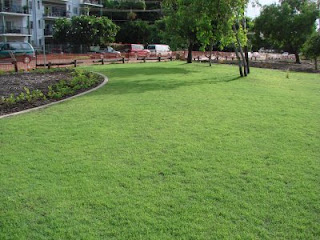
Green parkland appearance at 7 weeks>
It is developing very well, and should be really great in another 7-8 weeks.
Friday, January 23, 2009
Compadre Zoysia - NOW AVAILABLE as SOD in NORTHEN AUSTRALIA
Great news...........our single grower of Zoysia Compadre turf now has a modest amount of quality turf sod available.
The project to develop a viable area of Compadre sod for turf sales has taken longer than expected, after a few minor setbacks, and the development of suitable operational techniques. But the area is likely to expand over the next year to meet projected demands, especially in the new construction market, where Compadre zoysia can be a serious competitor to other vegetatively propagated species in the instant turf market, on both quality and price. The aim is superior quality at a better price. That is very achievable. End users do like what they see.
 Seed sowing will remain a major market, especially for larger areas in both construction projects and new dwellings, but turf sod does have a special niche market in some segments of the new home construction market.
And of course, seed remains an option to sow for an expanded quality sod production area.
In this region especially, the shade tolerance of Compadre zoysia is particularly important, as most new house areas quickly develop shrubs and trees. Most other turf options then fade away in the shaded or semi shaded areas, leaving bare soil, whereas Compadre zoysia continues to thrive in modest shade.
Go for it ...........use Compadre zoysia.
It is a great lawn, low maintenance, low [but not nil] fertiliser option that continues to look good. For best results use a slow release turf type fertiliser 2-3 times in the first year at recommended rates then only once or twice a year, and reduce the rates by about 50%, after that. We recommend Multigreen slow release turf fertiliser[ available from Elders], but other brand options are also suitable. Mow at 25 - 35mm. Mowing frequency would normally be about every 2 weeks in the warmer and wetter half year; every 3-4 weeks in the dry season. Weeds are not usually a major problem but if they do appear, we can assist with cost effective solutions.
Remember.......Compadre zoysia will not normally make your skin itchy, as can happen with most paspalums [bahia grasses]. The ideal turf for a quick game of touch footy for shirtless kids!
The project to develop a viable area of Compadre sod for turf sales has taken longer than expected, after a few minor setbacks, and the development of suitable operational techniques. But the area is likely to expand over the next year to meet projected demands, especially in the new construction market, where Compadre zoysia can be a serious competitor to other vegetatively propagated species in the instant turf market, on both quality and price. The aim is superior quality at a better price. That is very achievable. End users do like what they see.
 Seed sowing will remain a major market, especially for larger areas in both construction projects and new dwellings, but turf sod does have a special niche market in some segments of the new home construction market.
 And of course, seed remains an option to sow for an expanded quality sod production area.
In this region especially, the shade tolerance of Compadre zoysia is particularly important, as most new house areas quickly develop shrubs and trees. Most other turf options then fade away in the shaded or semi shaded areas, leaving bare soil, whereas Compadre zoysia continues to thrive in modest shade.
Go for it ...........use Compadre zoysia.
It is a great lawn, low maintenance, low [but not nil] fertiliser option that continues to look good. For best results use a slow release turf type fertiliser 2-3 times in the first year at recommended rates then only once or twice a year, and reduce the rates by about 50%, after that. We recommend Multigreen slow release turf fertiliser[ available from Elders], but other brand options are also suitable. Mow at 25 - 35mm. Mowing frequency would normally be about every 2 weeks in the warmer and wetter half year; every 3-4 weeks in the dry season. Weeds are not usually a major problem but if they do appear, we can assist with cost effective solutions.
Remember.......Compadre zoysia will not normally make your skin itchy, as can happen with most paspalums [bahia grasses]. The ideal turf for a quick game of touch footy for shirtless kids!
Thursday, January 22, 2009
Save Water - Saves Energy Too
A recent report by CSIRO and the Water Services Association of Australia (WSAA) gives a clearer picture of water and energy use in Australia and New Zealand and highlights areas offering potentially significant water and energy savings. The report: Energy Use in the provision and consumption of urban water in Australia and New Zealand, shows a strong nexus between water and energy.
“Ensuring a reliable water supply for our cities into the future will require more energy due to increasing populations and the trend to develop new, more energy-intensive water sources like desalination plants, reuse and more distance sources,” CSIRO scientist and project leader Steven Kenway says. “However, the provision of urban water services uses relatively little energy compared to heating water for residential and non-residential purposes. A 15 per cent reduction in residential hot water use could offset all energy used by water utilities in 2006/07. “Saving hot water represents a real win-win-win: it cuts energy and water use for consumers, reduces energy demand for utilities and helps households and utilities save money on energy and water bills.”
Looking forward to 2030, the project team considered three water consumption scenarios ranging from 150 through to 300 litres per person per day for residential water use, based on a population of 15.8 million for Australia’s major cities, which is currently at 12.5 million.
“Under Australia’s current average consumption, which is 217 litres per person per day, total energy use to provide water could increase by up to 130 per cent above 06/07 use, if a mix of desalination, recycling and new surface water sources is used to meet the expected demand,” Mr Kenway says. "Even with this increase, urban water utilities would only account for 0.3 per cent of the total energy used by Australia’s major cities in 2030.”
WSAA Executive Director, Ross Young, says the scenarios reinforce the need for the water industry to continue to implement energy-saving initiatives, but also to plan water resources with a clear understanding of where energy and water savings can be made most effectively. “The urban water industry will continue substantial initiatives already implemented to generate green energy from biogas and hydro-electricity generators and measures to increase energy efficiency. These initiatives have already delivered substantial energy savings in the urban water industry,” Mr Young says.
“This report demonstrates where the ‘low hanging fruit’ may be in terms of reducing energy use and the greenhouse gas footprint of the urban water industry and households.
“Analysis showed that installing a Water Efficiency and Labelling Standard (WELS) 3-star shower rose would cut by 45 per cent both water and hot-water-system energy consumption in households with high water use,” he says. “Replacing an old WELS 2-star washing machine with a 4-star front loading model would cut energy use by more than half and save 10 kilolitres of water annually, assuming 250 washes a year; 50 per cent of washing on cold-wash cycle and 44.5 kWh/year electrical consumption by pumps and motors.”
Copies of the report are available at:
www.clw.csiro.au/publications/waterforahealthycountry/2008/wfhc-urban-water-energy.pdf
---------------
This has clear implications for many areas of Australia. It is NOW that a change to efficient water heating is needed. Solar, heat exchange systems [especially for hotels, industrial use and large buildings] and even gas are relatively efficient. Much of Australia could benefit by using solar water heating.......and even though some token efforts are being made, it is obvious that more effort is needed.
Capital costs are higher, but with short payback periods solar water heating is a desirable option for almost all of Australia. Yet, builders often pick the cheap and nasty option......in low capital cost options that are not a good choice for the user, over even a few years.
“Ensuring a reliable water supply for our cities into the future will require more energy due to increasing populations and the trend to develop new, more energy-intensive water sources like desalination plants, reuse and more distance sources,” CSIRO scientist and project leader Steven Kenway says. “However, the provision of urban water services uses relatively little energy compared to heating water for residential and non-residential purposes. A 15 per cent reduction in residential hot water use could offset all energy used by water utilities in 2006/07. “Saving hot water represents a real win-win-win: it cuts energy and water use for consumers, reduces energy demand for utilities and helps households and utilities save money on energy and water bills.”
Looking forward to 2030, the project team considered three water consumption scenarios ranging from 150 through to 300 litres per person per day for residential water use, based on a population of 15.8 million for Australia’s major cities, which is currently at 12.5 million.
“Under Australia’s current average consumption, which is 217 litres per person per day, total energy use to provide water could increase by up to 130 per cent above 06/07 use, if a mix of desalination, recycling and new surface water sources is used to meet the expected demand,” Mr Kenway says. "Even with this increase, urban water utilities would only account for 0.3 per cent of the total energy used by Australia’s major cities in 2030.”
WSAA Executive Director, Ross Young, says the scenarios reinforce the need for the water industry to continue to implement energy-saving initiatives, but also to plan water resources with a clear understanding of where energy and water savings can be made most effectively. “The urban water industry will continue substantial initiatives already implemented to generate green energy from biogas and hydro-electricity generators and measures to increase energy efficiency. These initiatives have already delivered substantial energy savings in the urban water industry,” Mr Young says.
“This report demonstrates where the ‘low hanging fruit’ may be in terms of reducing energy use and the greenhouse gas footprint of the urban water industry and households.
“Analysis showed that installing a Water Efficiency and Labelling Standard (WELS) 3-star shower rose would cut by 45 per cent both water and hot-water-system energy consumption in households with high water use,” he says. “Replacing an old WELS 2-star washing machine with a 4-star front loading model would cut energy use by more than half and save 10 kilolitres of water annually, assuming 250 washes a year; 50 per cent of washing on cold-wash cycle and 44.5 kWh/year electrical consumption by pumps and motors.”
Copies of the report are available at:
www.clw.csiro.au/publications/waterforahealthycountry/2008/wfhc-urban-water-energy.pdf
---------------
This has clear implications for many areas of Australia. It is NOW that a change to efficient water heating is needed. Solar, heat exchange systems [especially for hotels, industrial use and large buildings] and even gas are relatively efficient. Much of Australia could benefit by using solar water heating.......and even though some token efforts are being made, it is obvious that more effort is needed.
Capital costs are higher, but with short payback periods solar water heating is a desirable option for almost all of Australia. Yet, builders often pick the cheap and nasty option......in low capital cost options that are not a good choice for the user, over even a few years.
Tuesday, January 20, 2009
Could Farming in the Tropics Promote a Killer Disease?
This is the premise being actively promoted in a new study of the disease meliodosis, based on results from the Northern Territory of Australia. Meliodosis is deadly........without active and well managed treatment you die. At least in the NT, there is a good quota of experience with the disease and mortality rates are now around 20%. Still, that is very high.
The disease also occurs in SE Asia in the tropics - Thailand, Laos, Malaysia etc, and is something to be mindful of when involved in agriculture in these areas.
Read the press release.........
Gardening and farming in the Australian tropics creates an environment "ideal" for the spread of a killer bacteria, a scientist has warned. Darwin-based researchers have worked to identify the soil types favoured by the bug Burkholderia pseudomallei, which is now at the centre of an outbreak of a pneumonia-like illness in the NT capital. Ten people have been infected, and two have died, from the illness Melioidosis since the wet season began late last year.
Dr Mirjam Kaestli says the bacteria was thought to favour damp soil and areas where there was standing water, but her research also found it thriving in household lawns and dry paddocks across rural Darwin. "These findings raise concerns that pseudomallei actually might spread due to the influence of our land management changes," says Dr Kaestli, who is a research fellow at the Tropical & Emerging Infectious Diseases Division at the Menzies School of Health Research. "Residential gardening and farming generates conditions which are ideal for the proliferation of these pseudomallei.
"We primarily found the bacteria in irrigated lawn areas like on residential properties ... also soil disturbance caused by livestock animals seem to increase survival chances for pseudomallei in areas otherwise not favourable."
It is thought the constant aeration of paddock soils from hoofs, along with raised acid levels from urine, encourage the growth of the bacteria.
The Royal Darwin Hospital treats up to 40 cases of melioidosis every wet season and, while it has a 20 per cent mortality rate this has halved over the past 15 years because of improved diagnosis and treatment. It is listed as an emerging disease, with cases rising in Thailand, and Dr Kaestli warns there were concerns the number would also increase in Australia.
Melioidosis cases have been detected as far down the eastern seaboard as Brisbane.
"Because we have seen this association with disturbed soil, and because there are more and more developing of previously undisturbed area, I would not be surprised if we are seeing higher numbers in the future," she said. People with type-2 diabetes, chronic lung and renal disease, heavy alcohol consumers or those who use of immunosuppressant drugs are known to carry an increased risk of contracting Melioidosis. Dr Kaestli said people in the tropical areas should take precautions by wearing shoes when working in the garden, washing their hands later with an anti-bacterial and taking extra care to keep cuts dirt free.
Her study is published in the journal PLoS Neglected Tropical Diseases.
The disease also occurs in SE Asia in the tropics - Thailand, Laos, Malaysia etc, and is something to be mindful of when involved in agriculture in these areas.
Read the press release.........
Gardening and farming in the Australian tropics creates an environment "ideal" for the spread of a killer bacteria, a scientist has warned. Darwin-based researchers have worked to identify the soil types favoured by the bug Burkholderia pseudomallei, which is now at the centre of an outbreak of a pneumonia-like illness in the NT capital. Ten people have been infected, and two have died, from the illness Melioidosis since the wet season began late last year.
Dr Mirjam Kaestli says the bacteria was thought to favour damp soil and areas where there was standing water, but her research also found it thriving in household lawns and dry paddocks across rural Darwin. "These findings raise concerns that pseudomallei actually might spread due to the influence of our land management changes," says Dr Kaestli, who is a research fellow at the Tropical & Emerging Infectious Diseases Division at the Menzies School of Health Research. "Residential gardening and farming generates conditions which are ideal for the proliferation of these pseudomallei.
"We primarily found the bacteria in irrigated lawn areas like on residential properties ... also soil disturbance caused by livestock animals seem to increase survival chances for pseudomallei in areas otherwise not favourable."
It is thought the constant aeration of paddock soils from hoofs, along with raised acid levels from urine, encourage the growth of the bacteria.
The Royal Darwin Hospital treats up to 40 cases of melioidosis every wet season and, while it has a 20 per cent mortality rate this has halved over the past 15 years because of improved diagnosis and treatment. It is listed as an emerging disease, with cases rising in Thailand, and Dr Kaestli warns there were concerns the number would also increase in Australia.
Melioidosis cases have been detected as far down the eastern seaboard as Brisbane.
"Because we have seen this association with disturbed soil, and because there are more and more developing of previously undisturbed area, I would not be surprised if we are seeing higher numbers in the future," she said. People with type-2 diabetes, chronic lung and renal disease, heavy alcohol consumers or those who use of immunosuppressant drugs are known to carry an increased risk of contracting Melioidosis. Dr Kaestli said people in the tropical areas should take precautions by wearing shoes when working in the garden, washing their hands later with an anti-bacterial and taking extra care to keep cuts dirt free.
Her study is published in the journal PLoS Neglected Tropical Diseases.
Monday, January 19, 2009
Africa Saved by Organic Food - Really??
In the 1970s and 80s, two well renowned CGIAR Centres - IITA and ICRISAT had major programs originally in India and then in Africa to examine crop production. A focus of much of the work was plant establishment and performance in the heavy but erratic rains of the monsoonal and similar tropical areas. Crucial issues to improved performance and crop yield were the use of soil mulches [often legumes] to reduce erosion and lower soil temperatures to mangeable ranges in which seeds could germinate and establish. Mulch also enabled soil moisture to be retained and thus allowed better establishment. Without satisfactory establishment and early growth, crops would fail to perform.
This system was very successful, and similar modified large scale systems have been developed for the tropics in Australia and Brazil, for example. Part of the Australian system involved a ley farming phase in which tropical pastures were used for animal grazing with the leguminous residuals aiding the next crop establishment, in the manner above.
This is not organic farming, although undoubtedly, using organic residuals over time will build soil carbon and enhance soil quality. In Africa, the tropical soils are often nutrient deficient, and yields are restricted by poor plant nutrition. Finding and adding those plant nutrients at low cost is near impossible, except for very small restricted areas - for example home gardens. Yes, it is undoubtedly true that soil mycorhiza can allow release of nutrients from otherwise non available sources, but the amounts are unlikely to be adequate to completely supply enough to grow good crops.
A new media release by the organic lobby in Australia uses a recent UNEP article that espouses the view that organic agriculture will radically improve African agriculture. Organic agriculture to be the saviour of Africa!
I am not so sure, except for those smaller areas. Yes, some of the soil carbon principles are important. BUT........this is not new for the tropics; it is nearly 40 years of old news, written up and published in eminent journals and as layman's reading, and acted on around the world in the tropics.
Read the media release and the link to the UNEP article.
It's Official: Organic farming provides answers to feeding Africa
A major study by the United Nations Environment Programme (UNEP) concludes organic farming offers Africa the best chance of breaking the long inherent cycle of poverty and malnutrition. (1)
Research conducted by UNEP suggests that organic, small-scale farming can deliver the increased yields which were thought to be the preserve of industrial high-tech farming, in addition to reversing environmental and social damages, leading to greater food security.
The head of the UN's Environment Programme, Achim Steiner, says the report "indicates that the potential contribution of organic farming to feeding the world may be far higher than many had supposed."(1)
Dr. Kristen Lyons is a senior lecturer at the School of Biomolecular and Physical Sciences at Griffith University (QLD) and the director of Mukwano Australia, a non-for-profit group supporting the development of health care services in African organic farming communities.
"Organic agriculture offers an alternative - and sustainable - future for African farmers," says Dr. Lyons. She says the report provides a clear direction for reducing the current crisis in agriculture and food systems in developing countries - organic, all the way. "It demystifies the assumption that genetic engineering and other high-tech approaches to farming are required to feed the world.
"In contrast, it is organic farming systems that have demonstrated the greatest potential to feed the world's one billion starving people, and to ensure the long term sustainability of global food production," she says
The UNEP report proposes that African communities need to look to alternative methods of farming as genetic engineering is prohibitively expensive and therefore out of reach for most African farmers. (1)
Organic farming in Africa has lead to benefits to the natural environment, with the UNEP report showing a 93 per cent of case studies reporting benefits to soil fertility, water supply, flood control and biodiversity. (1)
Also, when sustainable agricultural practices, which covered a variety of systems and crops, were adopted, average crop yields increased by 79 per cent. (1)
Overall, the report found an increase in organic farming in Africa could lead to savings on production costs (due to no expenditure on synthetic inputs), promote economic viability and encourage food self-reliance. (1)
Data: (1) United Nations Conference on Trade and Development United Nations Environment Programme, Report: UNEP-UNCTAD Capacity-building Task Force on Trade, Environment and Development, Organic agriculture and food security in Africa, Unite Nations, New York and Geneva, 2008
[media release by BFA Australia]
-----------------------
Of course this report is in contrast to recent publications about the need to boost food production, and fast in these areas.
The truth probably is somewhere in the middle. But I doubt, given the wide range of problems that interfere with accumulation of quality organic residuals in Africa, that enough can be accumulated to go totally organic. Embracing the work of the 70s and 80s to enhance establishment and reduce erosion is a vital start to improvement. The technology has been around for some time; getting it adopted widely is more difficult, and often social and machinery issues can interfere with adoption of promising technolgies.
BUT....it is not organic farming, as most people would define it.
This system was very successful, and similar modified large scale systems have been developed for the tropics in Australia and Brazil, for example. Part of the Australian system involved a ley farming phase in which tropical pastures were used for animal grazing with the leguminous residuals aiding the next crop establishment, in the manner above.
This is not organic farming, although undoubtedly, using organic residuals over time will build soil carbon and enhance soil quality. In Africa, the tropical soils are often nutrient deficient, and yields are restricted by poor plant nutrition. Finding and adding those plant nutrients at low cost is near impossible, except for very small restricted areas - for example home gardens. Yes, it is undoubtedly true that soil mycorhiza can allow release of nutrients from otherwise non available sources, but the amounts are unlikely to be adequate to completely supply enough to grow good crops.
A new media release by the organic lobby in Australia uses a recent UNEP article that espouses the view that organic agriculture will radically improve African agriculture. Organic agriculture to be the saviour of Africa!
I am not so sure, except for those smaller areas. Yes, some of the soil carbon principles are important. BUT........this is not new for the tropics; it is nearly 40 years of old news, written up and published in eminent journals and as layman's reading, and acted on around the world in the tropics.
Read the media release and the link to the UNEP article.
It's Official: Organic farming provides answers to feeding Africa
A major study by the United Nations Environment Programme (UNEP) concludes organic farming offers Africa the best chance of breaking the long inherent cycle of poverty and malnutrition. (1)
Research conducted by UNEP suggests that organic, small-scale farming can deliver the increased yields which were thought to be the preserve of industrial high-tech farming, in addition to reversing environmental and social damages, leading to greater food security.
The head of the UN's Environment Programme, Achim Steiner, says the report "indicates that the potential contribution of organic farming to feeding the world may be far higher than many had supposed."(1)
Dr. Kristen Lyons is a senior lecturer at the School of Biomolecular and Physical Sciences at Griffith University (QLD) and the director of Mukwano Australia, a non-for-profit group supporting the development of health care services in African organic farming communities.
"Organic agriculture offers an alternative - and sustainable - future for African farmers," says Dr. Lyons. She says the report provides a clear direction for reducing the current crisis in agriculture and food systems in developing countries - organic, all the way. "It demystifies the assumption that genetic engineering and other high-tech approaches to farming are required to feed the world.
"In contrast, it is organic farming systems that have demonstrated the greatest potential to feed the world's one billion starving people, and to ensure the long term sustainability of global food production," she says
The UNEP report proposes that African communities need to look to alternative methods of farming as genetic engineering is prohibitively expensive and therefore out of reach for most African farmers. (1)
Organic farming in Africa has lead to benefits to the natural environment, with the UNEP report showing a 93 per cent of case studies reporting benefits to soil fertility, water supply, flood control and biodiversity. (1)
Also, when sustainable agricultural practices, which covered a variety of systems and crops, were adopted, average crop yields increased by 79 per cent. (1)
Overall, the report found an increase in organic farming in Africa could lead to savings on production costs (due to no expenditure on synthetic inputs), promote economic viability and encourage food self-reliance. (1)
Data: (1) United Nations Conference on Trade and Development United Nations Environment Programme, Report: UNEP-UNCTAD Capacity-building Task Force on Trade, Environment and Development, Organic agriculture and food security in Africa, Unite Nations, New York and Geneva, 2008
[media release by BFA Australia]
-----------------------
Of course this report is in contrast to recent publications about the need to boost food production, and fast in these areas.
The truth probably is somewhere in the middle. But I doubt, given the wide range of problems that interfere with accumulation of quality organic residuals in Africa, that enough can be accumulated to go totally organic. Embracing the work of the 70s and 80s to enhance establishment and reduce erosion is a vital start to improvement. The technology has been around for some time; getting it adopted widely is more difficult, and often social and machinery issues can interfere with adoption of promising technolgies.
BUT....it is not organic farming, as most people would define it.
Subscribe to:
Posts (Atom)