This link will take you to the article published on 1 May 2019. It is a major new development in milk processing and now patented.
https://www.abc.net.au/news/rural/2019-05-01/fresh-milk-breakthrough-offers-60-day-fridge-shelf-life/11062284
A new method of ensuring milk is disease free has been developed and is touted as the biggest development in milk processing since pasteurisation.
Pasteurisation is if you think about it, the gold standard to ensure disease free milk is available for users. Heated to around 72C for a short time the milk is then bottled / packaged and sealed, and delivered to customers in a cold chain for use. Shelf life maybe is 2 weeks, if kept well refrigerated.
Or go for UHT milk - refrigeration not needed but shelf life is quite long, although does have a slightly different taste.
This new process is equal to or better than pasteurizing, and while requiring some cold storage gives a shelf life of 60 days. An enormous improvement.
AND an Australian development at that.
Opens up some major new opportunities in various areas including milk processing for speciality non pasteurised cheese manufacture using sea or road transport for the milk to make the downstream value added product. Especially relevant for export of fresh milk and cheese.
Suitable for most if not all milk - cow, sheep, goat, camel, buffalo all included.
Read the article - a massive step into some new industries over time.
Thursday, May 02, 2019


Tuesday, April 09, 2019
Yara Australia to Support Sustainable Management of Packaging Waste
Fertiliser manufacturer Yara Australia has partnered with
the Farm Waste Recovery program in a bid to sustainably manage their disposable
packaging waste.
Now in its fourth year, the program works in partnership
with manufacturers, associated industry and local councils to facilitate the
collection, recycling or disposal of plastic waste generated on farms in
Australia each year.
It is estimated that more than 80,000 tones of polypropylene
and polyethylene bags are delivered to Australian farms each year. These
include 10 million bulk bags and 200 million sacks used in the fertiliser and
stockfeed sectors. The majority of these bags are illegally burned on-farm or
end up in landfill.
Working in partnership with manufacturers, industry
associations and local councils, Farm Waste Recovery aims to recover as much of
this waste as possible. This year’s target is 600,000 bulk bags, which is the
equivalent of 2,000 tonnes of plastic and 5,000 cubic metres of landfill space.
This represents a potential saving of $1.25 million in
landfill costs, which has flow-on benefits for local government, the community
and the environment.
Rhaleigh Cereno, Yara Australia supply-chain manager, said
the company is delighted to support this important initiative. “Yara is a leading supplier of fertiliser to the
horticulture and broadacre sectors and a large portion of this is sold in
bags,” Cereno said. “Our overriding concern is to ensure these bags are removed
from the environment and ideally, to have them recycled. This is an opportunity
to demonstrate our genuine commitment to environmental sustainability.”
This is a early April press release on this topic from Yara. It is unclear where and how it will operate, and doubt it will in the NT.
But be aware - and ask if your Yara packaging will be collected! The numbers on fertiliser bag waste are certainly staggering!!
Friday, March 29, 2019
Can Soil Microbes Slow Climate Change?
One scientist has tantalizing
results, but others are not convinced.
This article was in Scientific American online but is worthy of being more widely dispersed into the wider agricultural and soil science community. Worth a read!
By John J. Berger on March
26, 2019
Can Soil Microbes Slow
Climate Change?
With global carbon emissions
hitting an all-time high in 2018, the world is on a trajectory that climate
experts believe will lead to catastrophic warming by 2100 or before. Some of
those experts say that to combat the threat, it is now imperative for society
to use carbon farming techniques that extract carbon dioxide from the air and
store it in soils. Because so much exposed soil across the planet is used for
farming, the critical question is whether scientists can find ways to store
more carbon while also increasing agricultural yields.
David Johnson of New Mexico
State University thinks they can. The recipe, he says, is to tip the soil’s
fungal-to-bacterial ratio strongly toward the fungi. He has shown how that can
be done. Yet it is not clear if techniques can be scaled up economically on
large commercial farms everywhere.
Johnson, a trim 67-year-old
microbiologist who is as comfortable using the latest metagenomics technology
as he is shovelling cow manure into a composter, thinks society can only
maximize carbon storage, increase soil’s water-holding capacity and grow
plentiful crops if it restores the soil microbiome. “We currently have very
degraded soils physically, chemically, but mostly biologically,” he says.
“Microbes restore this balance.”
Johnson conducts precise
soil-biology experiments into how to increase the capacity of agricultural
systems to absorb carbon from the atmosphere. In a recently completed
four-and-a-half-year field trial, Johnson planted fast-growing cover crops and
applied a microbe-rich solution derived from a vermiculture (worm) compost
produced in a low-tech composter of his own design. The bacteria, fungi and
protozoa fed a soil food web of nematodes, microarthropods and other beneficial
organisms.
Through photosynthesis, the
cover crops pulled CO2 from the air, sank roots deep into the earth, and
towered over the land. The results were unusual—and highly controversial.
Johnson reported a net annual increase of almost 11 metric tons of soil carbon
per hectare on his cropland. That’s equivalent to removing about 16 metric tons
of carbon dioxide per acre from the atmosphere annually—roughly 10 times the
increase that other scientists have reported in many different soils and
climates.
Johnson ascribes these
improvements, along with large increases in crop yields, to improved soil
health stemming from the application of the microbes from his vermiculture,
leading to an increase in the soil’s fungal-to-bacterial ratio.
Professor Rattan Lal of Ohio
State University, widely regarded as a leading authority on soil carbon
sequestration, says he was “intrigued” by Johnson’s outcome. “I want to
understand why he’s getting such exceptional results.” Lal thinks that further,
larger-scale trials are needed to validate Johnson’s work, of course.
Johnson is also conducting
meticulous laboratory studies. They focus on the correlations among
fungal-to-bacterial ratios and soil health, fertility and crop productivity. He
reports finding increases in fungal-to-bacterial ratio, plus large increases in
soil carbon and other nutrients as a result of his management practices.
In all this work, Johnson
maintains that as the ratio of fungi to bacteria increases, the soil biome
becomes more efficient in utilizing carbon and other nutrients and that the
soil therefore releases less CO2 to the atmosphere. The jury is still out,
however. Although peer-reviewed soil science literature contains some
confirmation, other findings in submerged, forested and subarctic
soils—admittedly different circumstances—failed to confirm the relation.
Keith Paustian, a professor
of soil and crop sciences at Colorado State University, says he has seen some
“quite high rates of carbon accrual” in degraded croplands that were converted
to productive perennial grass systems. But he has not seen strong evidence that
the same outcome can be produced by adding microbes.
EXTRAORDINARY CLAIMS
Johnson asserts that if his
approach were used across agriculture internationally, the entire world’s
carbon output from 2016 could be stored on just 22 percent of the globe’s
arable land. He says that would provide net benefits of $500 to $600 per acre
rather than net costs, if credits are provided for carbon capture and related
benefits are counted, such as reduced irrigation and increased soil fertility.
To arrive at his global
carbon-capture numbers, Johnson projected results from cropland plots of three
to 75 acres of various soil types in five states. That is still a fairly
limited sample. Henry Janzen, a research scientist at Lethbridge Research and
Development Center in Alberta and a professor at the University of Manitoba,
cautions that such a projection is risky. “Every ecosystem is unique,” he says.
“A practice that elicits soil carbon gain at one site may not be effective at
another. And always, the rate of carbon gain will depend on a host of
interactive factors, including soil properties, previous management practices,
climatic conditions and the vagaries of human whims.”
Janzen also points out that
soils do not absorb carbon indefinitely. After some years or decades, they
inevitably approach a new steady state. For that reason, he says, soil carbon
sequestration is rarely seen as a long-term solution to increased atmospheric
carbon dioxide concentrations.
Johnson acknowledges those
factors but says managing soil to improve the health of its microbial life can
provide strong carbon gains before the soil’s capacity levels off. He is in the
process of scaling up his experiments to try to replicate his results on even
larger plots in different geographies with a variety of cover and commodity
crops, “to assess the impact for the rest of the world.”
A NEW PARADIGM?
Johnson’s work is based on a
somewhat different paradigm from that of most conventional soil scientists.
They often seek to boost agricultural productivity in traditional ways by
adding fertilizer and using pesticides and herbicides as needed. This approach
is anathema to Johnson. He decries almost every conventional farming
practice—ploughing, bare fallowing, and the application of herbicides,
insecticides and fungicides. All these, he says, “assault soil microbiota.” He
claims that glyphosate (sold in commercial products such as Roundup) will kill
Aspergillus fungal species in soil. Aspergillus is often regarded as a marker
of fungal presence and is important in carbon and nitrogen cycling.
As for fertilizer, Johnson
believes he has demonstrated that microbially inoculated soil enriched with
tilled cover crops naturally accumulates more than enough nitrogen for vigorous
plant growth. (Nitrogen is the limiting nutrient in most agricultural
situations.) In one of his plots where he reports having increased net primary
productivity five times, the soil accumulated 770 pounds of nitrogen per acre
per year.
Much of this fixation is done
by free-living nitrogen-fixing bacteria. Because a normal crop only requires
about 180 pounds of nitrogen per acre, Johnson says it would be unnecessary to
add artificial fertilizer to a system like this.
As with all of Johnson’s work
to date, this result has appeared only in the form of reports and other “grey
literature.” Harold van Es, professor of soil and water management at Cornell
University’s School of Integrative Plant Science, is one of Johnson’s severest
critics.
“In science, we strongly
believe that research should be subjected to peer evaluation,” van Es says.
“His ideas should not be at all presented as scientific facts.”
The fungal-to-bacterial ratio
is indeed important, van Es says. “But there are many ways to increase that
ratio,” not just Johnson’s approach. “Reducing tillage has similar effects and
this has been much more widely documented.”
Although Johnson has irked
some soil scientists and even aroused some ire, as climate change intensifies
in speed and fury, many scientists believe it is important to leave no stone
unturned in the search for ways to limit carbon emissions quickly. Perhaps the
soil’s microbiome can be a powerful tool.
Rights & Permissions
ABOUT THE AUTHOR(S)
John J. Berger
John J. Berger is an
environmental science and policy specialist who has written numerous articles
and books about the environment and climate change. He is the author of Climate
Peril, The Intelligent Reader’s Guide to the Climate Crisis.
Recent Articles
Crisis in the Cryosphere,
Part 2
Crisis in the Cryosphere,
Part 1
Published online here on Blogger with acknowledgments to the author and Scientific American online
Friday, March 08, 2019
Future Farming in Singapore. Can it Be Done in Darwin Too?
SINGAPORE - With global warming heralding new threats, resource scarcity will be the new normal.
So the Government is throwing its weight behind efforts to protect and provide for the country's survival - in the areas of water, making the most of waste, food and climate change research - Environment and Water Resources Minister Masagos Zulkifli said on Thursday (March 7).
"Climate change is bringing new and wicked problems," he said in Parliament.
"It is no coincidence that we are building more desalination and Newater plants - we need to produce water almost at will, regardless of whether the rains come."
And just like the country's water success story, the same can be done in other areas, through long-term planning decades before a problem surfaces, he said, pointing out that Newater was more than two decades in the making.
"Faced with a challenge, we start small, learn from others, harness technology, invest in R&D. Keep on trying, until we get it right.
"Then we take our solutions and scale up to benefit the whole nation."
In terms of food, this means decreasing the dependence on the global food market, which accounts for over 90 per cent of Singapore's current food supply.
Announcing an ambitious target of producing 30 per cent of the country's food needs by 2030 - or 30 by 30 - Mr Masagos said that this would call for new paradigms in the sector, with a focus on state-of-the-art indoor farms.
They would incorporate climate control and automation, for instance, and in terms of fish - closed containment systems that keep algae blooms and oil spills at bay.
"Farmers of the future will operate computerised control systems in a pleasant environment."
It was time to break away from the "take, make, use and toss" mentality and embrace the circular economy instead, Mr Masagos added.
Promising technologies dealing with waste include Singapore Polytechnic's green chemistry technology to recover precious metals in e-waste, and Nanyang Technological University's method of turning food waste into high-grade fertilisers.
In addition, the National Environment Agency is working on turning incineration ash into construction material, called NEWSand, and has developed draft standards for using treated ash for building roads, for example.
When it comes to climate change, science will be key in guiding policies, he added, with the opportunity for Singapore to be a leader in the tropics, since there is limited knowledge on its effects there.
To this end, there will be more investment to build capability in the Centre for Climate Research Singapore, set up in 2013, and the local scientific community. This year, the centre will embark on the National Sea Level Programme to better understand sea levels around Singapore, so that robust projections and plans can be made for the long term.
Solar power will be stepped up. It could be harnessed at reservoirs, coastal areas and building facades to potentially power 40,000 four-room flats each year, an area half the size of Tampines.
At the same time, the water story is also not over.
The Research Innovation and Enterprise Council has allocated $200 million to national water agency PUB for research, and the Government has posed "Big Hairy Audacious Goals" to the scientists, he said, such as producing desalinated water with much less energy than currently needed.
Already, new technology which could potentially halve the energy required for desalination is set to be scaled up and deployed in the Tuas Desalination plant from 2020.
At the same time, people are saving more water, with domestic consumption falling from 148 litres per person per day in 2016 to 141 litres in 2018, with a target of further shaving it to 130 litres by 2030.
In all, the Government will spend almost $400 million on research and innovation in water, the circular economy, climate change and food, under the Research, Innovation, Enterprise Plan 2020 (RIE2020).
The challenges also bring with them opportunities, Mr Masagos stressed.
Pointing to Singapore's thriving water industry - with over 200 companies and more than 25 R&D centres, he said that investments in the sector in the past decade had created 14,400 good jobs and economic value-add of over $2.2 billion annually.
And plans for the water, food and environmental sectors would open up a variety of exciting opportunities for enterprises and jobs.
"We must do as our forefathers did, stay alert and nimble, and continue to plan and prepare for the long term," he said.
"We have ambitious plans for our water, waste and food sectors, but the road ahead is long and winding. We will persevere, for we are not done building a sustainable Singapore."
READ MORE STORIES ON CLIMATE CHANGE
This appeared today in the Straits Times in Singapore.
The issue of high tech food supply is one that could also be developed locally in the NT for many vegetables and food crops, allowing year round local supply and potential increased supply to other significant towns.
All it requires is a degree of ingenuity and effort.........and effort as the technology while not "fixed" is reasonably well understood and it could be powered by solar electricity and use much less water to grow the food. We will have farmed fish and prawns in numbers shortly from local supply, with further production forecast already.
A drive for a degree of self sufficiency and a need for efficiency in water use is driving these developments in Singapore. Sounds quite familiar on the NT scene as well.
Does Singapore have a message for future farming in Darwin too?
Thursday, March 07, 2019
NEW - Requirements to Spray 2,4-D: Reduce the Risk of Damage.
Spray application and spray drift management is critical in
using herbicide and pesticide products effectively and safely – for you as
operator, and both target areas being sprayed and non-target areas.
As
well, awareness of current or new label instructions for some products really
mean users must up their performance to use best practice to reduce the risk of
off-target spray drift and to incorporate the new label instructions for the
use of 2,4-D.
The Australian Pesticides and Veterinary Medicines Authority
(APVMA) suspended the labels of all products containing the active ingredient
2,4-D from October 4, 2018, replacing them with a permit.
Key changes for using 2,4-D under the permit include:
applicators must now use at least a Very Coarse (VC) spray quality; when using
a boom sprayer, boom heights must be 0.5 metres (or lower) above the target
canopy; and downwind buffers now apply (typically less than 50 metres, subject
to rate and product being applied) between application sites, and downwind of
sensitive crops and environmentally sensitive aquatic areas.
While new procedures are focused on 2,4-D, common sense
would indicate that related products also may need more appropriate care during
spraying. It might also lead to better
overall outcomes and improved success for the target plants.
Six videos have been developed and are worth looking at to
help users adapt to the changes.
Presented by respected spray consultant Bill Gordon, the new
series of six videos cover the topics :
• 2,4-D
label changes
• A spray
contractor’s experience
• Nozzle
selection for larger droplets
• Weather
conditions and the 2,4-D label
• Maximising
spray coverage
• Maximising
spray efficiency
More information and links to the media are on a few web
sites; this link should find the videos –
they are listed sequentially.
Useful for growers and spray users across many field crop
species, horticulture, pastures and turf to help effective spraying and prevent problems –
which could come back to hit you!
While specific to 2,4-D the principles really have wider ramifications and should improve overall herbicide spray operations. Good sensible operational practice pays off with better outcomes.
While specific to 2,4-D the principles really have wider ramifications and should improve overall herbicide spray operations. Good sensible operational practice pays off with better outcomes.
Thursday, February 28, 2019
How Do Trees Fare in Major Cyclones / Hurricanes?
If you are in those areas both a little north and south of the equator you probably experience major tropical storms variously called cyclones, hurricanes or typhoons, depending on where you are located.
In Australia we get cyclones while in the USA they are named hurricanes, and typhoons in much of East Asia. All are powerful, destructive storms and it seems, getting stronger.
Loss of the local vegetation is common - with lots of leaves shredded as an initial effect of the wind damage and often massive loss of tree cover, plus broken branches and destroyed and fallen trees.
The question is asked.....how do trees cope in these massive storms? What happens to them, and why are some much better survivors? Following Cyclone Marcus in 2018, the Darwin local government council, no stranger to these massive storms, sought to try and detail what trees fared best and why and to develop an improved list of suitable resilient trees, and to detail those of much lesser stability and resilience. Earlier work detailed outcomes of the major Cyclone Tracy in December 1974 in relation to tree resilience.
More recently, the February 2019 edition of The Scientist journal has explored this much more, even experimenting with "pseudo hurricane" damage to explore redevelopment of natural forest cover.
explore the link - some good graphics and information as well. Hyper link below.
https://www.the-scientist.com/features/how-trees-fare-in-big-hurricanes-65335
In Australia we get cyclones while in the USA they are named hurricanes, and typhoons in much of East Asia. All are powerful, destructive storms and it seems, getting stronger.
Loss of the local vegetation is common - with lots of leaves shredded as an initial effect of the wind damage and often massive loss of tree cover, plus broken branches and destroyed and fallen trees.
The question is asked.....how do trees cope in these massive storms? What happens to them, and why are some much better survivors? Following Cyclone Marcus in 2018, the Darwin local government council, no stranger to these massive storms, sought to try and detail what trees fared best and why and to develop an improved list of suitable resilient trees, and to detail those of much lesser stability and resilience. Earlier work detailed outcomes of the major Cyclone Tracy in December 1974 in relation to tree resilience.
More recently, the February 2019 edition of The Scientist journal has explored this much more, even experimenting with "pseudo hurricane" damage to explore redevelopment of natural forest cover.
explore the link - some good graphics and information as well. Hyper link below.
https://www.the-scientist.com/features/how-trees-fare-in-big-hurricanes-65335
Friday, February 22, 2019
Soil Moisture Monitoring by Drone
Australian stuff from Monash University. Very neat and very useful.

Monash University engineers are working with Australian farmers to help them improve irrigation practices by using autonomous drone technology. (Image source: Monash )
Autonomous Drones for Soil Moisture Mapping Help Farmers Use Water More Efficiently (Video)
Monash University engineers are working with Australian farmers to help them improve irrigation practices, reduce water use and maximise crop harvest by using autonomous drone technology.
As severe drought continues to devastate farmland and impact food supply across Australia, a Monash University research team, led by Professor Jeff Walker, has spent the past two years developing a drone-based autonomous soil moisture mapping system for irrigated paddocks.
Monash University engineers are working with Australian farmers to help them improve irrigation practices by using autonomous drone technology. (Image source: Monash )
The team has recently completed field experiments using optical mapping which can determine soil moisture levels in the near-surface. The data taken from the drone can be downloaded and used to produce a map of ground soil moisture levels to inform the farmer on how best to irrigate the paddock.
While equipped with optical mapping as a proof-of-concept, the drone has now advanced to passive microwave sensing technology using L-Band waves, with further research being conducted on the potential for using P-band waves. P-Band waves are expected to be able to measure up to 15cm into the soil unimpeded by vegetation and tillage features.
Drones have the capacity to analyse soil moisture at metre-level scales within a paddock, allowing farmers to focus on specific crop irrigation, and overcomes the challenges of aircraft or satellite mapping.
Testing has taken place across two farms in regional Victoria and Tasmania. One was at a dairy farm using a centre pivot irrigator and the other was a crop farm using a linear shift irrigator.
“We need to produce 60% more food with the same amount of land and water, and we can only achieve this by being more efficient with the water we use through irrigation,” Professor Walker, Head of Civil Engineering at Monash University, said.
“We need to know how much the crop needs, how much moisture is already there and apply just the right amounts of water in the correct places to avoid wastage while keeping the crop at its peak growth.”
Good soil moisture allows for the optimal growth and yield of crops, while at broader spatial scales also regulates weather, climate and flooding. The water levels in the soil controls evaporation over land and thus the energy fluxes into the atmosphere. This drives the atmospheric circulation, which drives climate.
“If the soil is too dry, crops can fail due to a lack of water. But if the soil is too wet, crops can not only fail but pests and diseases can flourish,” Professor Walker said.
Professor Walker said the farming industry has welcomed smarter and more automated practices, but there are few tools available to make the already difficult workloads of farmers more manageable.
“At best, farmers might have a single soil moisture sensor in a paddock, but this doesn’t allow for the optimal application of water, especially as this resource becomes scarcer. Plus it won’t take into account moisture variation levels across the individual paddocks,” Professor Walker said.
As crop failures due to a lack of water have enormous human and financial consequences, Professor Walker said Australian farmers need to become more efficient in soil moisture mapping by using ‘precision agriculture’ methods such as autonomous soil moisture mapping using drones.
“Farmers also need to cooperate; water conservation and efficiency is a collective responsibility. Everyone needs to do their part to use water more effectively or we’re at risk of running out completely,” Professor Walker said.
“As the world’s driest continent facing climate change, a growing population and a greater demand for food, water conservation should be one of Australia’s top priorities.”
This project is part of Monash University’s expanding interdisciplinary focus on the use of data and technology to solve real-world problems for today and in the future.
The Autonomous Drones for Soil Moisture Mapping project was funded by Monash Infrastructure through a seed funding scheme. This project forms part of Professor Walker’s wider research into soil moisture mapping and autonomous farming.
News source: Monash University
Video source: Posterboy Media on Vimeo
Thursday, February 21, 2019
Sulfate Boosts Ability of Plants to Handle Dry Conditions
Plants absorb the mineral sulfate from soil water. An international research team led by scientists from Heidelberg University has uncovered how sulfate controls the production of the drought stress hormone ABA in plants and thus contributes to their drought-resistance. These findings improve scientists' understanding of how the drought-stress signal travels from the roots to the leaves. The studies in Heidelberg were carried out at the Centre for Organismal Studies (COS).
Plants take in carbon dioxide for photosynthesis through pores in their leaves. When rainfall is low, however, these openings spell disaster for the plants because strong sunlight and active photosynthesis draw a lot of water through the open pores. Without fresh water from the roots, the plants wither and ultimately die. The hormone ABA [abscisic acid] controls how far the pores open in order to regulate the water loss of the plant.
Last year the researchers uncovered that the nutrient sulfate accumulates in the water transport pathways of the plants when the soil begins to dry out. Now the team led by Dr Markus Wirtz and Prof. Dr Rüdiger Hell has shown that the mineral actually known as sulfate plays a critical signalling role in supplying water to the plant. “Even we were surprised how efficiently sulfate triggers the synthesis of ABA and thus controls closure of the pores,” states Prof. Hell.
“The extremely dry European summer of 2018 was a preview of the imminent effects of global warming on the growth of plants and nutrient production,” stresses Dr Wirtz. “To be able to cultivate food crops that are more resilient during periods of water scarcity and drought, we need to understand how environmental factors regulate the formation of the hormone ABA”.
The results of the study were published in the journals “The Plant Cell” and “Plant Physiology” in late 2018.
The implications for turf could be most intriguing too and if your also add in the known effects of potassium on cell wall strengthening under dry conditions, could this explain or partially suggest an improved role for use of potassium sulfate as a summer fertiliser, or use of more complex mixes including slow release nitrogen?
Potassium sulfate is an often favoured means of supplying potassium and considered much superior to some alternate and cheaper forms, but is the real benefit the potassium or the sulfate in boosting drought resilience in many summer growing warm season turf grasses, especially in water deficit and /or hot stress conditions? Do similar issues arise if using potassium sulfate in hydroponics in hot conditions [ it is commonly used in hydroponic cultivation] ?
It is an intriguing outcome of the research.......with no doubt more to come.
[ some material used from a press release by COS]
[ some material used from a press release by COS]
Wednesday, February 20, 2019
SURPRISE - the Earth is Getting Greener!!
It seems there is always doom and gloom environment news - so here is some good news, as reported by CNN.
NASA satellite imagery reveals that China and India are leading the world in adding volumes of green foliage.
Also, since 2000, the Earth's overall green acreage has grown by 5%, an area equivalent to the Amazon's rainforests.
So.......maybe some positive news.
Monday, February 04, 2019
Banana Streak Disease May be Disabled
Bananas continue to be a target plant for breeding using new technologies.
The latest is a development that eliminates banana streak virus disease from the plant as well as preventing reinfection, using various gene editing options. This disease is a major problem in parts of west Africa.
Read the full story here - https://www.newscientist.com/article/2192461-virus-lurking-inside-banana-genome-has-been-destroyed-with-crispr/
Developments like this continue to be implemented and offer significant potential for food crops especially in areas where some crops are staple foods.......and lowered production can be devasting to the local population.
Yes, there are some scientific and policy issues to be considered but there seems to be a better understanding that maybe these approaches with genetic engineering [as a broad approach] offer a real way forward in better plant production.
We are likely to see expanded use of the CRISPR gene technology across many crops or even less well developed or unexploited species to develop newer varieties for modern agriculture and improve overall crop productivity.
The latest is a development that eliminates banana streak virus disease from the plant as well as preventing reinfection, using various gene editing options. This disease is a major problem in parts of west Africa.
Read the full story here - https://www.newscientist.com/article/2192461-virus-lurking-inside-banana-genome-has-been-destroyed-with-crispr/
Developments like this continue to be implemented and offer significant potential for food crops especially in areas where some crops are staple foods.......and lowered production can be devasting to the local population.
Yes, there are some scientific and policy issues to be considered but there seems to be a better understanding that maybe these approaches with genetic engineering [as a broad approach] offer a real way forward in better plant production.
We are likely to see expanded use of the CRISPR gene technology across many crops or even less well developed or unexploited species to develop newer varieties for modern agriculture and improve overall crop productivity.
Thursday, January 31, 2019
Trichoderma for Disease Control in Zoysia Turf
Disease control in turf can be a tricky process and is often
commenced well before the disease appears or is expected to arrive – on a
seasonal basis, as is often the situation.
That might be okay for major sport areas – from golf and
bowling greens to major sport stadia and similar larger venues. But what about the backyard lawn? Or the neighbourhood oval?
Cost and lack of information often mean these types of
programs never are used. It also often
means no disease management occurs at all with resulting significant loss of
amenity, and significant remedial cost – after the disease event.
There are other options that might be worth considering.
A recent paper on disease issues in high quality new turf
ovals using zoysia has highlighted a role for root colonizing fungi that can
elicit a plant immune response in the roots and may have significant potential
for bio-control of a few different turf diseases.
The concept is not a “flash in the pan” radical new idea at
all and has been investigated and researched for some years. There are commercial materials now sold that
even use the materials and so they can be bought commercially in some countries,
including Australia. Details available on request.
One advantage they have is that the “good” fungal material
can be applied once disease is noticed [also used before if required] and that
it can develop and spread and be active in the soil in effect becoming a
possible long term solution to the suppression of turf diseases by effectively moving
the balance back towards a positive fungal colony in the soil, not a disease causing
collection of fungal species – these are suppressed.
I thought the recent scientific paper based on work on Zoysia japonica turf in Guangzhou [
southern China] to be most interesting even if conducted in a greenhouse.
The pathogenic fungi [ which included a range of known
disease vectors] were all significantly inhibited by an isolate of Trichoderma viride and this organism had
positive effects on zoysia turf growth.
The reference is: Urban Forestry & Urban Greening Volume
37, January 2019, Pages 168-172
Root zone mixture affects the population of root-invading
fungi in zoysia grass - by Tianzeng Liu, Jialing Li and Juming Zhang from -
College of Forestry and Landscape Architecture,
South China Agricultural University, Guangzhou, Guangdong 510642, China Guangdong
Engineering Research Center for Grassland Science, China
Wednesday, January 23, 2019
Is Turf Still Relevant ?
A brief article in the December edition of Scientific American by a scientist from the University of WA here in Australia makes the case for abandoning the use of turf / lawn in urban areas, arguing it is too intensive in its use of almost everything in resources, although there are some benefits.
Is this really the case for many modern varieties of warm season turf lines?
We like to think that zoysia does not fit many of the criteria used to knock the use of turf in modern gardens in urban areas.
It does not require a lot of mowing nor does it require much in the way of nitrogen fertiliser, and as well, it is also relatively light on irrigation demand in dry periods. Yes, it does semi shut down when moisture stressed, but zoysia turf can thrive on much less resources than many other warm season turf species.
Should it be included in the hit list proposed in the article?
I would submit NO.
Read the article and come to your own conclusions. Scientific American December 2018.
Is this really the case for many modern varieties of warm season turf lines?
We like to think that zoysia does not fit many of the criteria used to knock the use of turf in modern gardens in urban areas.
It does not require a lot of mowing nor does it require much in the way of nitrogen fertiliser, and as well, it is also relatively light on irrigation demand in dry periods. Yes, it does semi shut down when moisture stressed, but zoysia turf can thrive on much less resources than many other warm season turf species.
Should it be included in the hit list proposed in the article?
I would submit NO.
Read the article and come to your own conclusions. Scientific American December 2018.
Monday, January 21, 2019
A hottie and will there be more?
Last week was the hottest night ever in Australia.
Maybe not in Darwin........but see the site and ponder.
Would you like a 35.6C night?
https://www.abc.net.au/news/2019-01-18/hottest-night-on-record-noona/10725886
One relevant item is that zoysia turf does handle hot weather very well. And it requires less water to grow.
Please consider!
Maybe not in Darwin........but see the site and ponder.
Would you like a 35.6C night?
https://www.abc.net.au/news/2019-01-18/hottest-night-on-record-noona/10725886
One relevant item is that zoysia turf does handle hot weather very well. And it requires less water to grow.
Please consider!
Friday, October 19, 2018
Compadre Zoysia - Buying and Sowing Seed
Compadre zoysia seed offers an alternative option to create a great zoysia turf area, and you do not need to purchase expensive sod of other similar alternative varieties.
While there are some zoysia varieties that only exist as vegetative sod areas, once you need to move sod any distance especially in our warm Australian climate it can be expensive and a bit tricky, as it is also if larger areas are required on a site.
Seed of Compadre [or even Zenith if available] offer an alternate and similar quality turf, once established. Yes, a longer period to establish to a suitable standard for use, but at considerable $$ savings in comparison to using sod.
With sod costing $10 - 20 per sq m at the production site, and a delivery charge often added, seed offers a real alternative, and is much cheaper per unit area.
NOW........is the time to seriously consider Compadre zoysia for your lawn. If in areas of Australia, say Brisbane and south, soil is about warm enough for prompt establishment [average soil temperature 18-20C desirable] and the longer days ensure adequate light to invigorate seedling growth.
Remember you need a clean seed bed and it is worth taking the time to remove as many weed seedlings as possible. We offer services and advice to ensure you can establish an area successfully, and can advise on appropriate herbicides for weed control within a developing zoysia lawn, including zoysia sod areas [ unfortunately not all sod finishes up weed free including from a weedy sub soil].
We consign any seed purchased promptly via air express - with a normal 2-3 business day delivery around Australia, including outside capital cities.
Ask for our information sheets, after reading the many articles on this blog.
Remember that Compadre zoysia is a great warm season lawn needing less mowing, less water, less fertiliser and mostly disease free...........you will not be disappointed once the lawn is established.
While there are some zoysia varieties that only exist as vegetative sod areas, once you need to move sod any distance especially in our warm Australian climate it can be expensive and a bit tricky, as it is also if larger areas are required on a site.
Seed of Compadre [or even Zenith if available] offer an alternate and similar quality turf, once established. Yes, a longer period to establish to a suitable standard for use, but at considerable $$ savings in comparison to using sod.
With sod costing $10 - 20 per sq m at the production site, and a delivery charge often added, seed offers a real alternative, and is much cheaper per unit area.
NOW........is the time to seriously consider Compadre zoysia for your lawn. If in areas of Australia, say Brisbane and south, soil is about warm enough for prompt establishment [average soil temperature 18-20C desirable] and the longer days ensure adequate light to invigorate seedling growth.
Remember you need a clean seed bed and it is worth taking the time to remove as many weed seedlings as possible. We offer services and advice to ensure you can establish an area successfully, and can advise on appropriate herbicides for weed control within a developing zoysia lawn, including zoysia sod areas [ unfortunately not all sod finishes up weed free including from a weedy sub soil].
We consign any seed purchased promptly via air express - with a normal 2-3 business day delivery around Australia, including outside capital cities.
Ask for our information sheets, after reading the many articles on this blog.
Remember that Compadre zoysia is a great warm season lawn needing less mowing, less water, less fertiliser and mostly disease free...........you will not be disappointed once the lawn is established.
 |
| Young partially shaded area of zoysia turf area sown from seed, on a school oval. |
Friday, August 10, 2018
New Light on Seed Germination Genetics
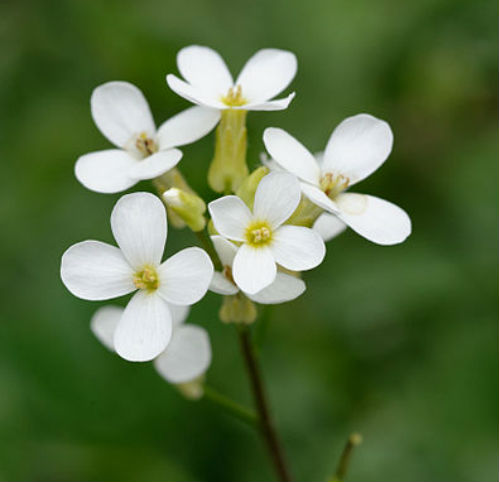
The study was conducted on Arabidopsis, a very close relative of oilseed rape.
The MFT gene stops seeds germinating in the dark or under shady conditions, where their chances of survival would be poor, according to new research from the University of York.
The study, conducted on Arabidopsis, a very close relative of oilseed rape, increases our understanding of one of the most important stages in the life cycle of a plant and may help to improve the seed quality of agricultural crops in the future.
Signals
Scientists have known for some time that two plant hormones play an important role in regulating if and when a seed will germinate - “Abscissic Acid” or ABA blocks germination and “Gibberelins” or GA promotes it.
However, in a breakthrough in our understanding of the mechanism by which these hormones control germination in response to light quality, the researchers have discovered that MFT is the key component that integrates and interprets signals coming from both ABA and GA.
The MFT gene is regulated by light quality and receives signals from both ABA and GA. In dark or shady conditions, it then directs the production of the MFT protein, which regulates germination by switching on a block of genes that prevent growth and switching off another block of genes that promote growth.
Sophisticated mechanism
This prevents a plant from germinating under the wrong conditions such as when there is not enough light to grow.
Professor Ian Graham, corresponding author, from the Centre for Novel Agricultural Products in the Department of Biology at the University of York, said: “This is another great example of how plants have evolved very sophisticated molecular mechanisms to stay in tune with their environment. This allows seeds to survive in the soil for many years so that when the time is right, such as when a tree falls in a forest or soil is turned over, seeds can suddenly spring into action.”
For many plant species the ability of a seed to sense the quality of light can inform it if it is located in direct sunlight, under a canopy of other plants that only allow a certain quality of light to pass through or in the dark, which is often the case when seeds are buried in the soil.
Survival
In wild plant species the ability for seeds to remain dormant even under conditions that would allow them to germinate is important for survival. For crops species, eliminating this dormancy is one of the first traits that has to be dealt with in a plant breeding programme.
Lead author of the work, Dr Fabian Vaistij, from the Department of Biology at the University of York added: “Understanding the molecular genetic basis of how seed germination is controlled will provide new tools to improve seed quality and seedling vigour in developing new crops for the future.”
This work provides some ideas about how light interacts with seeds and germination. Especially where species are known to respond to light during germination. Zoysia turf grass is one of the species that does require light to germinate - if buried, even at shallow depth, germination and subsequent establishment is greatly impaired.
[ adapted from University of York press release 7 August 2018]
Subscribe to:
Posts (Atom)