Showing posts with label Singapore. Show all posts

Friday, March 08, 2019

Future Farming in Singapore. Can it Be Done in Darwin Too?

SINGAPORE - With global warming heralding new threats, resource scarcity will be the new normal.
So the Government is throwing its weight behind efforts to protect and provide for the country's survival - in the areas of water, making the most of waste, food and climate change research - Environment and Water Resources Minister Masagos Zulkifli said on Thursday (March 7).
"Climate change is bringing new and wicked problems," he said in Parliament.
And just like the country's water success story, the same can be done in other areas, through long-term planning decades before a problem surfaces, he said, pointing out that Newater was more than two decades in the making.
"Faced with a challenge, we start small, learn from others, harness technology, invest in R&D. Keep on trying, until we get it right.
"Then we take our solutions and scale up to benefit the whole nation."
In terms of food, this means decreasing the dependence on the global food market, which accounts for over 90 per cent of Singapore's current food supply.
Announcing an ambitious target of producing 30 per cent of the country's food needs by 2030 - or 30 by 30 - Mr Masagos said that this would call for new paradigms in the sector, with a focus on state-of-the-art indoor farms.
They would incorporate climate control and automation, for instance, and in terms of fish - closed containment systems that keep algae blooms and oil spills at bay.
"Farmers of the future will operate computerised control systems in a pleasant environment."
It was time to break away from the "take, make, use and toss" mentality and embrace the circular economy instead, Mr Masagos added.
Promising technologies dealing with waste include Singapore Polytechnic's green chemistry technology to recover precious metals in e-waste, and Nanyang Technological University's method of turning food waste into high-grade fertilisers.
In addition, the National Environment Agency is working on turning incineration ash into construction material, called NEWSand, and has developed draft standards for using treated ash for building roads, for example.
When it comes to climate change, science will be key in guiding policies, he added, with the opportunity for Singapore to be a leader in the tropics, since there is limited knowledge on its effects there.
To this end, there will be more investment to build capability in the Centre for Climate Research Singapore, set up in 2013, and the local scientific community. This year, the centre will embark on the National Sea Level Programme to better understand sea levels around Singapore, so that robust projections and plans can be made for the long term.
Solar power will be stepped up. It could be harnessed at reservoirs, coastal areas and building facades to potentially power 40,000 four-room flats each year, an area half the size of Tampines.
At the same time, the water story is also not over.
The Research Innovation and Enterprise Council has allocated $200 million to national water agency PUB for research, and the Government has posed "Big Hairy Audacious Goals" to the scientists, he said, such as producing desalinated water with much less energy than currently needed.
Already, new technology which could potentially halve the energy required for desalination is set to be scaled up and deployed in the Tuas Desalination plant from 2020.
At the same time, people are saving more water, with domestic consumption falling from 148 litres per person per day in 2016 to 141 litres in 2018, with a target of further shaving it to 130 litres by 2030.
In all, the Government will spend almost $400 million on research and innovation in water, the circular economy, climate change and food, under the Research, Innovation, Enterprise Plan 2020 (RIE2020).
The challenges also bring with them opportunities, Mr Masagos stressed.
Pointing to Singapore's thriving water industry - with over 200 companies and more than 25 R&D centres, he said that investments in the sector in the past decade had created 14,400 good jobs and economic value-add of over $2.2 billion annually.
And plans for the water, food and environmental sectors would open up a variety of exciting opportunities for enterprises and jobs.
"We must do as our forefathers did, stay alert and nimble, and continue to plan and prepare for the long term," he said.
"We have ambitious plans for our water, waste and food sectors, but the road ahead is long and winding. We will persevere, for we are not done building a sustainable Singapore."

Wednesday, July 11, 2018

Will Your Next Tomato Be Grown Indoors by Robots?


If you were inventing the farm today, why would you put it outside, on a giant plot of land?
OK, there’s the sunlight thing, but then you get droughts and frosts and plant-munching insects that have to be battled with harmful pesticides. And because outdoor farms need so much acreage, they’re usually far from most of their customers — which means that by the time a tomato gets to you in a city, it tastes like a baseball.
But now, upstarts in the US such as Bowery Farming, AeroFarms, and Lettuce Networks are doing something different. They’re growing food indoors. They’re using data and artificial intelligence to operate more efficiently than traditional farms. And they’re staying small and close to population centers. The new generation of farming promises to feed more people while doing less environmental damage.
This kind of distributed farming fits with a larger 21st-century movement that venture capitalist Hemant Taneja and I call “unscaling.” We document the economic trend in our book, Unscaled: How AI and a New Generation of Upstarts Are Creating the Economy of the Future.
Massive scale was the goal throughout the 20th century. Mechanization and technologies such as the truck and telephone made it possible. Mass production, mass markets, and economies of scale ruled in every sector. So we ended up with giant companies, huge hospitals, big universities — and corporate mega-farms.
Today, industry after industry is unscaling. The cloud, mobile devices, big data, AI, and new technologies such as blockchain and 3D printing are making it possible to profitably customize products for smaller and smaller niches. Netflix is an unscaled version of mass-market cable networks like HBO, using data to make programs that appeal to specific types of viewers. Airbnb is a distributed hotel company. In an unscaled era, businesses can operate at smaller, more focused levels and beat giant enterprises.
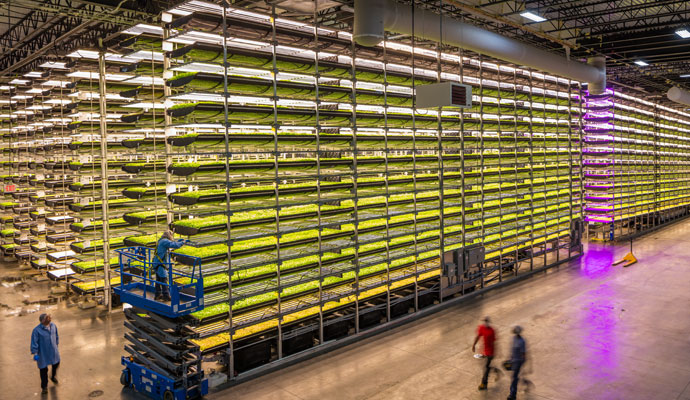
So farms are unscaling, too. Bowery and AeroFarms both operate inside old industrial buildings in New Jersey and are a short drive from New York City. Inside these buildings, LED lights mimic natural sunlight. The crops grow in nutrient-rich water beds on trays stacked floor to ceiling. And sensors constantly monitor the plants and send data back to AI-driven software, which can learn what’s best for the plants and tweak lighting, water, and fertilizer to improve yields. Much of the “farming” is done by robots. “We get productivity hundreds of times greater than a traditional farm,” says AeroFarms CEO David Rosenberg. “And we use less water and no pesticides — because we’re indoors — and can grow 365 days a year.”
These unscaled farms can give consumers a better product than mega-farms, too. Food grown nearby doesn’t need to endure shipping — so it can ripen the way it’s supposed to. In the middle of winter, indoor-grown, local tomatoes will taste like tomatoes. As you can imagine, that’s what consumers prefer.
Since 2013, about US$2 billion has been invested in hundreds of agricultural technology startups, according to CB Insights senior analyst Zoe Leavitt, who spoke about the future of food at a recent Techonomy conference in New York. AeroFarms has raised more than $100 million and sells to Whole Foods and FreshDirect. Boston-based Freight Farms is growing food in container cargo vessels, often selling to restaurants, hotels, and college campus eateries. New York–based BrightFarms says it “finances, designs, builds, and operates” indoor farms close to food retailers and has raised $11 million in funding. Edenworks is operating rooftop greenhouses that grow produce fertilized by ground tilapia and prawns, which are also grown at the mini-farm.
Lettuce Networks is trying another approach. It is using cloud and mobile technology to create a network of urban farms. Founder Yogesh Sharma calls it an Airbnb for farming. The company contracts with owners of small plots throughout a city and installs sensors that can monitor crops and the surrounding environment. Nearby residents can subscribe to the Lettuce service to get food delivered. The system knows what’s being grown all around the city and, from that network, assembles a basket of local produce for delivery. Owners of the plots make some money off their harvest, while subscribers get an assortment of fresh food grown nearby.

Whether unscaled farming is a net economic benefit remains to be seen. It’s a new industry, with techniques and business models that are works in progress. Analyst firm Market Research Future
 notes that urban farms cost a lot to start (a warehouse in New Jersey is more expensive than a plot of land in Saskatchewan) and don’t yet work for a lot of crops, such as corn or bananas. Sunlight is free and sustainable; LED lights require energy. But proponents believe that because these indoor farms are far more productive and are closer to consumers, once there are a lot of them and the techniques and technology get honed, more people will be fed for less cost than ever before.Distributed, indoor, AI-assisted farming should be good news for the environment. Scaled-up farming was the right answer for the past century, feeding a burgeoning population while making food relatively cheap. The percentage of disposable income used for food is lower today than it was in the 1970s, according to Pew Research Center. But by 2050, the planet is projected to have 2.2 billion more people to feed, just as global warming is expected to make weather less predictable and dry up previously fertile regions. If food can be grown indoors, in a cost-effective way, in or near cities, climate will be less of a concern, and far less carbon will be burned moving food thousands of miles via trucks, trains, and ships.
As investment pours in and environmental conditions drive a need for new solutions, unscaled farming looks a lot more like the future of food than does a massive field baking under the sun.
Thoughtful or foolish?
from an article originally written by Kevin Maney in Strategy + Business 

Saturday, October 10, 2015

Drone Delivers Mail in Singapore

As reported from Singapore - drone delivers mail!


Move over carrier pigeons. 

SingPost delivered the mail to Pulau Ubin [ an off shore island near Changi airport] using a drone, The Straits Times has reported. SingPost had help from the IDA to create this drone, and sent over a T-shirt and a letter from Lorong Halus to Pulau Ubin. 

This trial run took five minutes and covered about 2km. 

Friday, August 01, 2014

Panasonic Moves to Grow Vegetables Indoors in Singapore

Panasonic, the Japanese electronics giant, has announced its entry into high tech indoor farming in land-strapped Singapore. 

Panasonic Factory Solutions Asia, a regional subsidiary that provides manufacturing systems, is starting out in the grocery business by supplying the 3 local outlets of Ootoya, a Japanese restaurant chain, using a newly developed vegetable cultivation system.

Panasonic's 248 sq.-metre indoor farm is located in Tuas, an industrial zone in western Singapore, and is the first facility of its kind to be licensed by the government.   Panasonic says the innovative soil-based system employs LED lighting to grow vegetables without pesticides in half the time a traditional farm requires. The system also optimizes other growing conditions, including temperature, humidity and CO2 levels.

The Tuas facility has an initial production capacity of 3.6 tons of vegetables per year, but Panasonic hopes to boost output to 1,000 tons by March 2017 - equivalent to about 5% of Singapore's current vegetable production. [THAT would be quite something!!]

Panasonic can cultivate 10 kinds of vegetable at present, including lettuces, radishes, baby spinach, cherry tomatoes and basil. It is also producing popular Japanese varieties such as ooba (mint), mizuna (potherb mustard) and mitsuba (wild parsley) that are imported from Japan at present. According to Panasonic, its indoor-farmed produce could be half the price of imports. [ THAT is very relevant]

Panasonic is starting off its futuristic grocery business by supplying 3 kinds of vegetables for Ootoya salads, and will add two more next month. Ultimately, it hopes to produce 30 vegetables.

At a press conference on Thursday, Hideki Baba, managing director of Panasonic Factory Solution Asia Pacific, noted that Singapore at present produces only 8% of the vegetables it consumes due to the scarcity of farm land.    "Panasonic hopes our indoor vegetable farm can contribute effectively to the nation's food self-sufficiency levels," said Baba.

Panasonic's future business model for indoor farming will involve franchisees supplying restaurants and commercial grocers. A system for households that wish to self-grow is also being considered, and there are plans to export systems to Indonesia, Thailand and Vietnam.    "With the increase of salary levels and a large number of Japanese restaurants in these countries, we expect the demand for fresh and safe vegetables to grow," said Baba.  

Mostly sourced from a press release on July 31, 2014 9:44 pm JST by Tomomi Kikuchi Nikkei Staff writer 

This is an auspicious move - especially with a soil based system, rather than using hydroponics.  While other parts of the world are also developing similar approaches [ think Detroit in the USA for example] this venture in Singapore aims to offer fresh salad greens in a land poor region.

Could this system be replicated elsewhere?   Like Darwin for example?  And think outside the target of Japanese customers - it seems eminently replicable for many, many vegetables.


UPDATE - It seems many are interested in this concept with both Sharp and Fujitsu also involved in similar ventures - some in Japan, and some in the middle east [ Dubai].

Read more here - https://au.news.yahoo.com/thewest/business/technology/a/24621789/electronics-giant-panasonic-wants-singaporeans-to-eat-its-veg/

Should we see more of these particularly in both hotter and colder regions of the world where vegetables are needed, but sometimes more difficult to grow, especially year round!

Thursday, June 12, 2014

World Record Height Green Wall - NEW in Singapore

Recently I noted a world record green wall in Canada.

Did not last long - a new record holder has emerged with a  new large project in Singapore.

The world's largest vertical garden? It's in Singapore


The world's largest vertical garden is located right here in the Republic: A 24-storey green belt at Tree House condominium in Bukit Timah clinched a Guinness World Record on Wednesday for its sheer size.

Occupying a surface area of 2,289 sq m, the garden is expected to achieve more than $500,000 in energy and water savings a year. Its features include heat-reducing windows and motion sensors at staircases that activate lights automatically.

The vertical garden built by property firm City Developments Limited (CDL) can also reduce the estate's carbon footprint by filtering pollutants and carbon dioxide out of the air. This reduces heat absorption and lowers the energy needed to cool indoor spaces.

Mr Kwek Leng Joo, CDL deputy chairman, said: "With the eco-inspired Tree House, CDL has not only created a place where residents are proud to call home, but more importantly, a green icon which places Singapore on the world map."

Reported on by Audrey Tan in the Straits Times June 12.

- See more at: http://www.straitstimes.com/news/singapore/environment/story/the-worlds-largest-vertical-garden-its-right-here-singapore-2014061 #sthash.gJ6leQpa.dpuf


Tuesday, May 21, 2013

Are All Green Roofs Effective?

Quite a common question and one where there is probably no definitive answer.

It depends.......why is it there, what is it expected to do, what species are present, where is the site [ location /climate] and how it was built.

A recent article in Scientific American online has had a huge response in comments, many debunking the assertion the green roofs don't work, as claimed by the author.

Truly, there is no real evidence presented - either way, in the many words delivered on the topic.

But how can a successful green roof be assessed?

While not an exclusive list consider the following claims that are made.

  • Reduces roof temperatures and thus air conditioning and /or heating loads for the building
  • Produces more oxygen in a city environment
  • Absorbs CO2 and other gases by the plants and even some particulates or metals into the soils
  • Uses rainwater and so reduces stormwater loads in the neighbourhood as well as absorbing materials in the rainwater [gases and particulates]
  • Improves roof aesthetics
  • Costs more to install and maintain
  • May require an additional water source to meet plant needs in periods of water drought
  • May allow food production on the site as a small food garden
  • Must be maintained at some additional cost
This is far from a full list, but indicates that a green roof is not for all.

Careful design can do a lot to improve the situation and allow a green roof to function effectively at minimal costs.  While some push for native species on green roofs, that is not an essential feature by my views.  It has to function at modest cost and inputs, once established.

In the warmer regions, grass can be a useful species.  Yes, it may have to be mown sometimes, but many are tough species, and you can select those with minimal nutrition and mowing needs.

In Darwin there is a great green roof, which many do not even think about - the Speakers Green at Parliament House.  That is built over the roof of the basement car park, and uses zoysia grass - it generally looks fantastic!  This area is highly maintained and used intensively for functions, while being decorative.


In Singapore, the new water facility at Marina Barrage has a  very large green roof - again it is grass!


Some types of green roofs can be identified as intensive or extensive. [ Both examples above are extensive types, although the former could be argued over and is used frequently]. The intensive type often has garden beds, small trees, formal paths and grassed or untended areas with mass plantings as a mixed development and may be used intensively, while extensive green roofs are ones that are sometimes just grassed, or with mostly less tended scrambling plants, less if any in the way of paths and garden beds, and often not greatly used.

The article is worth reading but many comments are very critical of the author, often for failing to really understand the subject.  So yes, there are a range of views.
http://www.scientificamerican.com/article.cfm?id=why-manhattans-green-roofs-dont-work-how-to-fix-them&WT.mc_id=SA_CAT_SP_20130520

In my view the green roof can be a great asset, but need a degree of planning involving several different professional inputs is needed for successful development.


Friday, March 15, 2013

Dwarf Broad Leaf Carpet Grass

Broad leaved carpet grass is a very common turf in tropical Australia, especially in the near all-year round wet zones along the NE coast eg near Cairns or Ingham.

Also sometimes used around Darwin, it is a very shade tolerant turf, and will handle wet, silty soils, provided adequate water is supplied in the dry season.  No irrigaton and it will die out in our region.

But it does grow rapidly, and leaves are quite long, and they can be very susceptible to insect damage, especially army worms, who enjoy the lush growth.

Curiously, there are no cultivars developed - just carpet grass.

However, recently it seems a dwarf variety may have been developed, in of all places, Singapore.

https://florafaunaweb.nparks.gov.sg/Special-Pages/plant-detail.aspx?id=1712#

There is a lot of information and some photos, but no variety name - except they call it Pearl Grass.  It is propagated vegetatively, and has featuered on a green roof project as well as some median strips, where obviously low maintenance is important.

While zoysia is common on golf courses and that is very low growing, and can thrive in both low light and low maintenance conditions, it can be slow to establish from sprigs.

I need to know more about this variety......so more to come.

Thursday, March 14, 2013

Green Roof and Walls


The Elmich Effect -   The Largest Greenwall in the World!!
.


Elmich Australia


Officially the World’s Largest Greenwall Project - Singapore ITE Headquarters & College Central                                                       

Hats off, to our colleagues at Elmich Singapore, who have just completed the largest greenwall installation, in the world. 

Standing at 35m tall and totaling 5,300 m2, Elmich VGM Green Wall modules transformed the campus walls, both internal and external, into facades of living green vegetation, in-line with the college’s Eco-Initiative to create an environment conducive to learning.

The highly engineered Elmich VGM architectural living wall system uses UV-stabilised plastic modules and stainless steel support brackets and pilasters that enable easy mounting and dismounting of VGMs during installation and maintenance.

Topped off with 2400m2 of Extensive Greenroof


2,400 sq m of roof space, over three campus blocks, was 'Greened' using the Elmich Extensive Greenroof system. VersiDrain 25P® drainage and water retention trays were placed directly over the waterproofing and overlaid with a geotextile and a lightweight engineered growing media. Pearl Grass was selected for its heat tolerance and low maintenance and an automated pop-up irrigation system was installed to ensure abundant growth, maximising the benefits of this greenroof.


------

While this is actually part of advertising by Elmich, it does show the fantastic green wall and roof developed for this new building complex  in Singapore.

Even more interesting is the new type of grass used for the roof.

Pearl grass [ their term] is actually a dwarf variety of broad leaved carpet grass [ Axonopus compressus] , with broad leaved carpet grass common as a turf in tropical Australia.

Does it have a place in tropical Australia?  I would think it might.

Tuesday, May 17, 2011

Stormwater Management - Green Roofs Play a Part

The concept of using green roofs has more been around overall city heat mitigation, reduced heat absorption on concrete roofs, more oxygen in the city, even reuse of waste water.

Recent work has indicated that the 'green roof" may be significant in stormwater management, a slightly different outcome than was expected.

While Australia and many other regions do not have a single stormwater and sewer pipe system, some cities do. There the collection of stormwater on green roofs appears to greatly reduce the amount of stormwater entering the sewer system, and thus reduces the potential overflow, quite a problem for these types of systems.

In the areas with separate storm water and sewer disposal systems, it would seem that the collection of especially higher intensity storm rain, the event that often overloads streets and stormwater disposal designs, would also be enhanced, and less stormwater would flow through the system. And, even if it was partially reduced, it would most likely time shift and reduce the major flows, after the rain had flowed down through the green roof and then out down a drainpipe to the ground. The green roof would also assist with removal of pollutants, often in the rain in cities.

More details of the study here -http://www.enn.com/top_stories/article/42701

Green roofs lend themselves well to regions with some regular rainfall, year round. Has not been much development here in the NT, due to our very strongly seasonal rainfall - wet for half the year, generally totally dry for the other half, so plants require watering then.

There is a good example of a green roof in Singapore, at the Botanical Gardens. It seems to work well.