Showing posts with label solar electricity. Show all posts

Friday, June 16, 2017

Renewable Energy Jobs Exceed Fossil Fuel Generation Work

Champions of fossil-fuel generation have long complained that jobs losses have been one of the biggest detriments to the decommissioning of coal-fired power plants. And renewable energy sources do nothing to help replace those jobs.
Not so, according to a panel of experts at the recent Australian Energy Storage Conference and Exhibition held at the International Convention in Sydney. At the Q&A after The Benefits of Microgrids for Urban, Rural and Off-Grid Applications seminar, the question of how many jobs are created by renewables was raised by moderator Mark Higgins, COO of clean energy consultancy Strategen.
“In the United States there is a lot of hand wringing over the loss of jobs in the conventional fossil fuel industry,” said Higgins. “In California this issue is finally starting to come to light where statistics are showing that within the renewable energy industry there are more renewable energy jobs than the entire coal industry in the United States.”
This is backed up by a recent report from the U.S. Department of Energy that shows that solar power employed 43 percent of the electricity sector’s workforce in 2016, while fossil fuels combined accounted for 22 percent.
Almost 374,000 people were employed in solar energy, whereas gas, oil and coal power generation combined had a workforce of slightly more than 187,000.
While offering no hard data to back up his point of view, Michael Ottaviano, CEO of Carnegie Clean Energy, said anecdotal evidence suggested that clean energy job opportunities were on the rise.
“If you think about it, since 2010 we’ve retired about 5000 MW of coal-fired power stations,” said Ottaviano. “We haven’t built any coal-fired power stations in about seven years but we’ve built about 10,000MW of renewable [plant]. In terms of job creation, we’ve created no new jobs in the construction of coal-fired power stations in the last seven years, but an enormous amount of jobs to create 10,000MW of renewables. I think the battery storage space is about to take off so we’ll do something similar. Politically the argument doesn’t get much traction in Australia but it should. We’re hearing a lot even in the Finkler report that came out recently about the need for coal-fired power stations to give three years notice partly to allow people to be retrained. That’s a real problem that needs to be addressed.”
ESS vice president of business development, Bill Sproull, said not only did renewables create jobs, but tended to make them localised, which in a country like Australia, is a good thing for regional economies.
“When I think about renewables and microgrids, it’s really decentralising energy generation and control that’s been prevalent in most of our countries. With that, jobs become very much more local, even down to the community level,” he said.
Another panellist, Giin Sia, the Asia Pacific regional sales director for NEC Energy Solutions, sees nothing but positive outcomes in the near future.
“If I could provide feedback from the rest of the Asia Pacific, [renewable] projects are seen as progressive,” he said, “particularly with an existing structure where there is a big dependence on fossil fuel. When talking to some of the utility companies, as well as governments and ministries, I do not get the impression that energy storage or micro grids are going to take away any jobs at all. In fact, it’s going to be able to put in more jobs, specifically in areas that are not seen as traditional skills.”
Battery energy storage should also contribute to new jobs in renewables in coming years. 
So for all you young and work aspiring people, the renewable energy industry might just be the place to seek and build skills that would translate into jobs......real jobs, particularly in regional cities, where living costs might also be lower than state capital cities. 
 [based on article by Mike Wheeler in PACE magazine, June 2016]

Saturday, September 06, 2014

Renewable Energy Costs Questioned


A recent article in The Economist describes a blog post by Charles Frank of the Brookings Institute in which he questions the  methods that have been used to compare renewable energy sources with more traditional sources like coal, gas and nuclear.

Drawing on the work of Paul Joskow of MIT, Frank claims that the generally accepted levelized cost models, which essentially divide the total lifetime system cost by the total amount of electricity produced, do not adequately discount the value of renewables sources like solar and wind based on their intermittent nature. Joskow’s reasoning is that since these intermittent sources vary their output at different times of the day and the year, that should be reflected in their value, since the demand for, and the price of electricity also varies throughout the day, at least in the commercial market.

So, given that wind, for example, produces electricity mostly at night, when the power is less valuable, that should be reflected in the value of a wind investment. Solar, on the other hand produces mostly at mid-day, when the power is most valuable, so it may be getting short-changed by the levelized cost approach.

Frank started with Joskow’s premise, then went on to perform a detailed analysis of various energy sources, based on avoided emissions and avoided costs, which revealed, he says, that contrary to popular belief, solar and wind are the least cost-effective way of producing low carbon electricity, followed by hydro, nuclear, and finally at the top of the list is combined cycle gas turbine power.

Written from the perspective of building new electric generation capacity, Frank concludes, “Assuming that reductions in carbon dioxide emissions are valued at $50 per metric ton and the price of natural gas is not much greater than $16 per million Btu, the net benefits of new nuclear, hydro, and natural gas combined cycle plants far outweigh the net benefits of new wind or solar plants.”

The problem with an analysis like this is, given the rapidity with which renewable energy costs are dropping, trying to compare them with traditional sources is akin to trying to catch a falling knife. Frank’s data was obsolete by the time the ink dried on the page.  In addition, the analysis is highly sensitive to the eventual market price for carbon, which could swing the results dramatically. Also not considered is the impact of energy storage which could easily neutralize the liabilities that form the basis for Frank’s thesis.

But Amory Lovins, of the Rocky Mountain Institute, has already demonstrated that the perceived need for storage has been overstated. Smart grid and smart grid operators will be able to dynamically reconcile supply with demand far more effectively than originally thought, through what Lovins calls choreography. Yes, wind and sun are intermittent, but they are also fairly predictable. The tools available for and acceptance of demand management (can you wait a few seconds for a spike to pass before your air conditioner kicks in?) are also gaining in importance.

Given the broad coverage this story received, Lovins felt the need to weigh in here with a written rebuttal to correct what he felt were significant errors that led to erroneous conclusions.

Lovins points out that correcting nine of Frank’s incorrect assumptions reverses the conclusion to fall in line with the order that the marketplace has consistently chosen as the best investment for the money: hydro, wind, solar, gas, and nuclear. Says Lovins, Frank assumed the both wind and solar were twice as costly and half as productive as they actually are today. He also assumed gas productivity to be twice what it is and ignored the impacts of both methane leakage (a very serious greenhouse gas contributor) and price volatility. Indeed the climate impact of methane leakage (not to mention the environmental impacts of fracking) is severe enough to have caused some experts to question the value of switching away from coal.

Rounding out the list, are out of date assumptions regarding the construction cost (low by half) and operating cost (low by 80%) of nuclear plants. Frank’s assertion leaned heavily on the premise that a good deal of new generating capacity is needed (which it isn’t), and he did so without taking energy efficiency opportunities into account.

While Frank has brought a fresh analytical slant to this important problem, when applied with the most recent data it produces the same conclusion as the prevailing approach.

In other words, although the variation of the value of electricity produced at different times had not been taken into account by prior analyses, the impact of doing so was not sufficient to change the overall conclusion.

Article by RP Siegel of Justmeans, appearing courtesy 3BL Media.

Friday, June 27, 2014

Australian PV Systems - World Leader on Residential Installation Costs: Lessons For USA

In 2013, the United States installed more solar photovoltaic (PV) capacity than either Germany or Australia for the first time ever. (the U.S. has triple their combined population, so arguably this should have happened long ago…). 

With the decline of feed-in tariffs and other incentives in Germany, it is likely that the U.S. will continue to outpace that country in new PV installations. However, the U.S. continues to lag behind global PV leaders Germany and Australia in another important category: prices for residential systems installations. As of Q2 2013, the average installed residential system price was $4.93/W compared to Germany’s $2.21/W and Australia’s $2.56/W. That needs to change.

Whether you look at U.S. DOE SunShot targets or RMI’s own Reinventing Fire vision, which has the U.S. solar market scaling from 4.5 GW PV installed per year to 20 GW, system costs have to come down to accelerate residential and commercial customer adoption. A new analysis and report from Rocky Mountain Institute (RMI) and Georgia Tech Research Institute (GTRI)—Lessons from Australia: Reducing Solar PV Costs Through Installation Labor Efficiency—identifies opportunities for the U.S. solar market to take important steps in that direction.

Non-hardware costs (permitting/inspection/interconnection (PII), customer acquisition, installation, and margins/overhead) now dominate system prices in the U.S. For sub-10-kW systems, 80 percent of solar system cost decline in the U.S. since 2008 has been due to hardware price reductions. In the U.S., non-hardware costs now account for 70% of system costs. Setting aside margins/overhead, the U.S. spends $1.22/W on PII, customer acquisition, and system installation. PV leaders Germany and Australia, on the other hand, spend just $0.33/W and $0.65/W, respectively. The U.S. clearly can and should pursue significant cost reduction opportunities to eliminate this difference.

RMI and GTRI previously launched a PV installation labor data collection and analysis effort under the SIMPLE BoS project, which investigated differences in non-hardware costs between the U.S. and Germany, including installation labor. 

This 2013 report provided a detailed breakdown of primary drivers of PV installation labor cost differences between the U.S. and Germany. Now, in 2014, RMI and GTRI are following up on that groundbreaking work with further investigation of Australian solar installations.

Australia has emerged as a dominant player in the world residential solar market, with more than 10 percent of households possessing a solar system on the roof and system prices rivaling Germany’s. Even as feed-in tariffs (FITs) have declined, demand in Australia for residential rooftop solar has remained high and costs have continued to decline. Much of this is due to a focus on customer-owned PV, and thus an extremely competitive marketplace around system cost. Both retailers and installers have been forced to lean processes in order to offer lower pricing and gain market share; they rely on high volume rather than high margin to remain profitable. 

According to our on-site analysis, Australian installers are averaging 6.1 labor-hours per kW solar installed, while the U.S. is more than 50 percent higher at 9.4 labor-hours per kW installed. This is similar to averages observed in other industry surveys and studies.


Unlike Germany, Australia does not use motorized lifts, scaffolds, or other advanced installation equipment. Instead, economic incentives drive labor—installers in Australia receive a flat rate per installation, and thus make greater profit by mounting more systems in less time. That Australian installers were able to shift so quickly towards a one-day install as an industry standard indicates that Germany is not an outlier; optimized installations are possible and should be pursued at both the U.S. and international levels.
We noted several factors that may increase efficiency based on observations and analysis of installation practices in Australia, Germany, and the U.S.: 
  • Optimizing the pre-installation process
  • Reducing time spent on base installations, especially for clay-tile roofs
  • Pursuing rail designs that minimize installation labor
  • Reducing the number of meters installed in each electrical system to monitor PV output
  • Viewing the one-day installation goal as an opportunity to reduce time spent on non-production activities such as meals, travel, breaks, setup, and cleanup
These opportunities vary in magnitude, but in combination could have a significant impact on the number of labor-hours/kW U.S. installers typically invest in system installations. We believe installers in the U.S. could approach or go beyond Australian levels of efficiency by pursuing these primary measures, as well as other opportunities that help the industry approach the one-day installation as standard. 

If it can be done in Australia and Germany, there is no reason it cannot be done in the U.S.

We hope this report on Australia, the report on Germany, and all follow-on work under the SIMPLE BoS project will help the U.S. industry continue to reduce solar PV costs and enable the widespread, cost-effective deployment of residential solar PV systems.

Download the report 

Monday, June 23, 2014

Solar Energy Costs Falling Rapidly in Both USA and China - To Equal Coal Prices VERY Soon


China Might Be Winning The Race To Reduce Solar Costs

I did not write most of this material, but the concepts discussed are very relevant for Australia, with major debate now about to commence on removing the Renewable Energy Target and Carbon Tax legislation in Australia.

Are we going in the wrong direction?   This review seems to posit that solar costs will soon equal or be less than energy from the fossil fuel sources [ particularly coal], using PV systems.  This will occur within a few years, and that is well within the planing horizons for new power stations, and also for homeowners to consider the implications for them directly, with self supplied PV power.

Many people, even fanatical advocates of solar power, are unaware just how close we are to reaching a critical milestone in the industry. Within a fairly short space of time, solar generated electricity will be fully cost competitive with coal-powered electricity — at least if the governments of the world’s two largest energy consuming nations have their way.


Both the U.S. and China have a stated goal of reducing the cost of solar generated electricity to that level, and quickly. How they are going about it says a lot about how each economic system works.


In the U.S., despite the complaints of some that a drift toward government control is taking place, private initiative and free markets still rule. The Department of Energy launched the SunShot initiative in 2011, with a stated goal of reducing the cost of solar power to be fully competitive with conventional energy sources by the end of this decade. The program funds grants, incentives and competitions to encourage private sector research that will improve the efficiency and lower the cost of solar energy.


The Chinese, faced with what is in many ways a more urgent need to achieve the same thing, have taken a different approach. In a manner more in keeping with their history and current economic system, they are beating the problem over the head with piles of cash until the desired outcome is achieved. It looks, if this excellent Michael Sankowski piece at Monetary Realism is to be believed, as if they are getting mighty close.


Sankowski maintains that, driven by high levels of pollution and national security concerns, the Chinese government asked a question back in the early 2000s: “How Much Will It Cost To Make Solar Cheaper Than Coal?” The answer was based on Swanson’s Law that states that every doubling of photovoltaic (PV) solar capacity results in a 20 percent reduction in unit cost. Testing that theory, because of low levels of production at that time, would only have cost around $10 billion — a small price to pay for the chance of cheap, clean energy that didn’t rely on importing coal from Australia.


When Swanson’s Law still worked after a couple of doublings of capacity the Chinese government stepped up their efforts. As a result, Suntech now expects the goal to be achieved by 2016, or 2017 at the latest. That’s right: 2016. A couple of years. Of course, Suntech has an interest in exaggerating somewhat, but even so, that is stunningly close.


According to the U.S. Energy Information Administration, coal accounted for 69 percent of China’s energy production as recently as 2011. Cost comparative solar power and a centralized government committed to change will make that number laughable in a few years.


It should be borne in mind that reducing the cost of solar electricity to parity with coal in China is not the same as it is in America, if for no other reason than that electricity in general, and coal-powered electricity in particular, is more expensive in China than in the US.


SunShot, however, has also been successful, and claims a 60 percent reduction in cost since its inception three years ago. Many believe that their stated goal of solar power at $0.06 per kilowatt hour (kWH) is achievable by 2018. Some of that cost reduction is no doubt down to China ramping up capacity at such a rate and flooding the market, but there have been technological advances over that time, as well.

You can argue all day about which approach is correct. History shows us that innovation from the private sector is the most effective, long lasting change agent there is, but the Chinese approach of heavily subsidizing a massive increase in PV production capacity has been effective. Unfair, short sighted and disruptive, maybe, but effective nonetheless.

Command economies may be terrible at some things but when the rapid marshalling of resources is needed to solve a problem they can be very good at doing whatever it takes.


The simple fact is that with both innovation and increased capacity, the cost of solar energy has fallen considerably over the last few years and continues to do so. If, as looks likely, it does become truly cost comparative with coal in the next few years, then the days of cheap, clean, renewable energy dominating the world’s two biggest energy markets may be closer than you think.


Will that apply to Australia as well?  Based on current thinking in this country.........do not hold your breath.  However, it is obvious that with our energy costs from fossil fuel moderately high, it does seem that change might be coming sooner than most people have really thought it would be, here in Australia!


Article by Martin Tillier, first appearing in Oilprice.com.

Monday, May 12, 2014

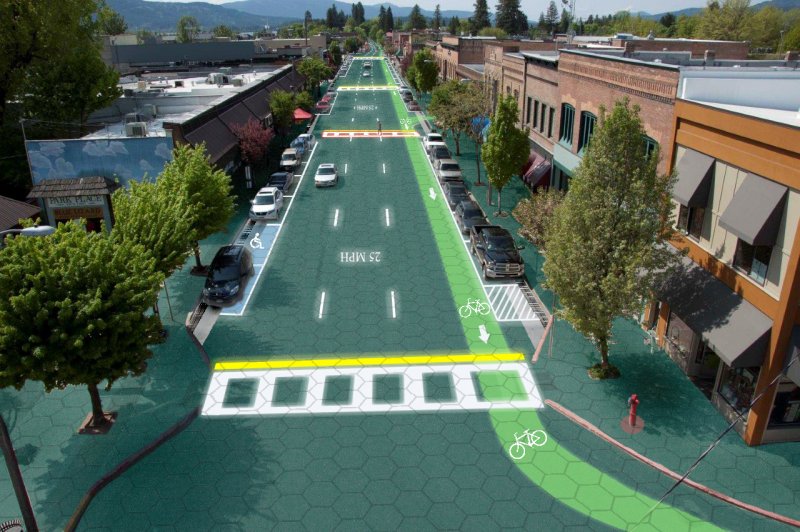
Solar Panels as Roads??

Solar Roadways

Solar panels that you can drive, park, and walk on. They melt snow and... cut greenhouse gases by 75-percent?!!!


Artist's rendition of Sandpoint, Idaho - Home of Solar Roadways
Graphic designed by Sam Cornett                                                 Thanks Sam!


Solar Roadways is a modular paving system of solar panels that can withstand the heaviest of trucks (250,000 pounds). These Solar Road Panels can be installed on roads, parking lots, driveways, sidewalks, bike paths, playgrounds... literally any surface under the sun. They pay for themselves primarily through the generation of electricity, which can power homes and businesses connected via driveways and parking lots. A nationwide system could produce more clean renewable energy than a country uses as a whole.

(http://solarroadways.com/numbers.shtml). They have many other features as well, including: heating elements to stay snow/ice free, LEDs to make road lines and signage, and attached Cable Corridor to store and treat stormwater and provide a "home" for power and data cables. EVs will be able to charge with energy from the sun (instead of fossil fuels) from parking lots and driveways and after a roadway system is in place, mutual induction technology will allow for charging while driving. 

Did you know: 

  • Solar Roadways has received two phases of funding from the U.S. Federal Highway Administration for research and development of a paving system that will pay for itself over its lifespan. We are about to wrap up our Phase II contract (to build a prototype parking lot) and now need to raise funding for production. 

  • Our glass surface has been tested for traction, load testing, and impact resistance testing in civil engineering laboratories around the country, and exceeded all requirements.
  • Solar Roadways is a modular system that will modernize our aging infrastructure with an intelligent system that can become the new Smart Grid. We won the Community Award of $50,000 by getting the most votes in GE's Ecomagination Challenge for "Powering the Grid" in 2010. We had the most votes again in their 2011 Ecomagination Challenge for "Powering the Home".
  • On August 21, 2013, Solar Roadways was selected by their peers as a Finalist in the World Technology Award For Energy, presented in association with TIME, Fortune, CNN, and Science.
  • Solar Roadways was chosen by Google to be one of their Moonshots in May of 2013. 
  • Solar Roadways was chosen as a finalist in the IEEE Ace Awards in 2009 and 2010.
  • Solar Roadways has given presentations around the country including: TEDx Sacramento, Google's Solve for X at Google's NYC Headquarters, NASA, Keynote Speaker for the International Parking Institute's Conference and much more...
  • Solar Roadways is tackling more than solar energy: The FHWA tasked us with addressing  the problem of stormwater. Currently, over 50% of the pollution in U.S. waterways comes from stormwater. We have created a section in our Cable Corridors for storing, treating, and moving stormwater.
  • The implementation of our concept on a grand scale could  create thousands of jobs in the U.S. and around the world. It could allow us all the ability to manufacture our way out of our current economic crisis.
---------------------

This seems like a great idea, as long as costs are reasonable.  A bit like the use of wastewater ponds to install floating solar panels, covered in another recent post.  


Friday, February 14, 2014

World's Largest Solar Power Station Officially Open

Solar power is taking some big steps with the official opening of the 400MW solar power station in the Mojave Desert in the USA.

Read more on the media reports here - http://www.environmental-expert.com//news/huge-thermal-plant-opens-as-solar-industry-grows-412652?utm_source=News_Energy_13022014&utm_medium=email&utm_campaign=newsletter&utm_content=feattextlink

While operating for a few months already, this week was the formal opening.

There are  hundreds of thousands of mirrors into the largest solar power plant of its type in the world, a milestone for a growing industry that is testing the balance between wilderness conservation and the pursuit of green energy across the West.

The Ivanpah Solar Electric Generating System, sprawling across roughly 5 square miles of federal land near the California-Nevada border, formally opened Thursday after years of regulatory and legal tangles ranging from relocating protected tortoises to assessing the impact on Mojave milkweed and other plants.

The $2.2 billion complex of three generating units, owned by NRG Energy Inc., Google Inc. and BrightSource Energy, can produce nearly 400 megawatts - enough power for 140,000 homes. It began making electricity last year.

More large systems are now under development, and these newer ones, along with other large systems around the world will begin to allow a decent system evaluation as they feed electricity into large grids for domestic and industrial use.

Ivanpah Solar Power station


A portent of future energy systems or just a curiosity?

Some authors believe it will take 50 years to switch over, and away from fossil fuels.  These large systems may just show the way.

Saturday, July 13, 2013

Could the NT Develop Industrial Solar Energy Systems on Warehouse Roofs?

Don’t think it’s possible to provide clean and renewable energy that creates jobs and fuels private investment? Think again and then check out CLEAN LA Solar.

A program developed and supported by the Los Angeles Business Council, a coalition of environmental, business, health and research organizations, and the CLEAN LA Coalition, it’s the largest urban rooftop solar program in the nation. Its five-year goal is to power more than 34,000 homes while creating some 4,500 construction, installation, design engineering, maintenance and administrative jobs in Los Angeles.

CLEAN LA Solar allows businesses and commercial property-owners to generate energy for the city’s power grid through rooftop solar panels, and then sell the power to the Department of Water and Power (DWP). This policy is known as a feed-in-tariff (FiT), and is a great way to promote clean, solar energy.

California has a legislative requirement to generate 33 percent of its energy from renewable sources by 2020. Currently, most of L.A.’s renewable power is generated outside the L.A. basin and transmitted inefficiently to customers. By contrast, the CLEAN LA Solar program will provide incentives for clean-energy production within city limits. The result will be more efficient power delivery and a reduction in the city’s reliance on polluting, coal-fired power plants. The FiT also does not require new or upgraded transmission lines.

The goal is to generate 150 megawatts of solar electricity, or enough power for 30,000 homes. The business council hopes to attract investments totaling about $500 million from a group of companies that want to invest in the city’s push to go green. The program’s first project site is an 80-unit apartment building in North Hollywood that went online with 336 250-watt panels (for 84 kW of installed capacity) on June 26.

Solar Provider Group, the international solar firm behind the North Hollywood solar installation, moved its U.S. headquarters to a new office in downtown Los Angeles and is hiring employees. Over the next 18 months, SPG will hire up to 50 additional Los Angeles-based employees in sales, engineering, manufacturing and construction. The company plans to invest up to $50 million in the city by the end of 2016, over the course of the 100 MW program. SPG is also evaluating additional investments elsewhere in California and throughout the U.S.

While the CLEAN LA Solar program gets rolling, a rooftop solar provider is looking at a way to allow customers to be independent from utilities by generating their own power, according to an LA Times article.

Lyndon Rive, chief executive of San Mateo, Calif.-based SolarCity Corp., said in an interview with the paper that his rooftop solar company plans to roll out a system that would allow customers to generate power by solar panels during daylight hours and store the energy in battery packs at night.
These are not academic exercises or something on the drawing board that could happen on a large scale someday. It’s happening right now—a model for all urban areas to note.

 
from http://www.triplepundit.com/2013/07/los-angeles-all-rooftop-solar-panels/
----------------

There are some innovative steps being taken in some overseas locations to really try and move solar power into more mainstream options, as seen by this initiative.  As the costs fall, it definitely makes more sense to consider solar as a sensible option.

For the NT there are a lot of empty roof tops in the industrial areas of Darwin and nearby areas, above businesses that predominantly use electricity during sunshine hours.

It seems a no brainer that there must be development potential there, and it allows small increments of additional energy capacity at modest cost rather than having to opt for large chunks of energy increase at a time, which is how normal utility systems are developed.

Is it financing know how  that is restricting development and would better financing models offer better solutions?  Not my field........but it sure seems odd the NT is not doing more.

Yes, there are some issues with efficiency in crystalline panels in hot weather, of which we have plenty, but alternates are getting better and cheaper all the time.

Is it time for the NT too??