In warmer climates, composting can be enhanced using some insect larvae.
Black Soldier Fly Larvae are excellent assistants in your compost pile. Many people think these strange crawling larvae insects are larval bush flies or similar............well, they do grow into flies, but not those that are nasty. They are a benefit for many smaller compost producers, especially with wetter organic materials, commonly seen in tropical regions.
For an excellent introduction to these creatures and how they might help you in your composting go to:
http://blacksoldierflyblog.com/
Showing posts with label ornamental horticulture. Show all posts
Showing posts with label ornamental horticulture. Show all posts
Thursday, June 25, 2009


Monday, November 24, 2008
Soil Erosion a Threat to Food Production in China
Soil erosion in Australia is a serious issue. The environmental brigade will tell you how dire it is, any where and every where. That is an gross over the top attention grabber, for erosion is a natural process closely associated with geological processes over countless millenia. What we need is a system to minimise that soil loss particularly in the most productive land around Australia, or anywhere else in the world too.
Many will argue that the National Landcare program and the myriad action programs at all levels, now operational for about 25 years, has made significant gains in managing the Australian landscape processes, and reducing erosion. At least we like to think so, but it is probably fair to say some good progress continues to be made. The program has been copied and developed in other countries too - notably The Phillipines and South Africa.
While we in Australia might feel good, it is a timely reminder to consider recent information emerging from China. Things are pretty grim in relation to erosion. Picture the giant erosional gullies of the loess plateau......most people have seen those. But it gets worse.
Over a third of China's land is being scoured by serious erosion that is putting its crops and water supply at risk, a three-year nationwide survey has found.
Soil is being washed and blown away not only in remote rural areas, but near mines, factories and even in cities, the official Xinhua agency cited the country's bio-environment security research team saying.
Each year some 4.5 billion tonnes of soil are lost, threatening the country's ability to feed itself.
If the loss continues at this rate, harvests in China's northeastern breadbasket could fall 40 percent in 50 years, adding to erosion costs estimated at 200 billion yuan ($29 billion) in this decade alone.
"China has a more dire situation than India, Japan, the United States, Australia and many other countries suffering from soil erosion," Xinhua quoted the research team saying.
Beijing has long been worried about the desertification of its northern grasslands, and scaled back logging after rain rushing down denuded mountainsides caused massive flooding along the Yangtze in the late 1990s. But around 1.6 million square km of land are still being degraded by water erosion, with almost every river basin affected. The photo shows erosion and bare soils on the loess plateau in China's North East.

Another 2.0 million square km are under attack from wind, the report said.
The survey was the largest on soil conservation since the Communist Party took control of China in 1949.
If you have been to Beijing, you will certainly have experienced the yellow skies from the soil blowing from the west, that irritates the eyes, common in the late winter and early spring periods. Or the steady soil clouds lifted from bare soils in Outer Mongolia, not even that far from Beijing itself. We most certainly could not get farmers to change their thinking and even consider conservation tillage in projects we worked on in China during the late 1990s.
The following two photos show some of the awesome erosion seen on the loess plateau of China. It can be staggering!


A China with food production problems is worth pondering. Also adds some pondering to be considered along with the analysis on "The Politics of Hunger" in a recent post.
[lower two photos used with permission. Thanks. Copyright- Cathy Dowd]
Many will argue that the National Landcare program and the myriad action programs at all levels, now operational for about 25 years, has made significant gains in managing the Australian landscape processes, and reducing erosion. At least we like to think so, but it is probably fair to say some good progress continues to be made. The program has been copied and developed in other countries too - notably The Phillipines and South Africa.
While we in Australia might feel good, it is a timely reminder to consider recent information emerging from China. Things are pretty grim in relation to erosion. Picture the giant erosional gullies of the loess plateau......most people have seen those. But it gets worse.
Over a third of China's land is being scoured by serious erosion that is putting its crops and water supply at risk, a three-year nationwide survey has found.
Soil is being washed and blown away not only in remote rural areas, but near mines, factories and even in cities, the official Xinhua agency cited the country's bio-environment security research team saying.
Each year some 4.5 billion tonnes of soil are lost, threatening the country's ability to feed itself.
If the loss continues at this rate, harvests in China's northeastern breadbasket could fall 40 percent in 50 years, adding to erosion costs estimated at 200 billion yuan ($29 billion) in this decade alone.
"China has a more dire situation than India, Japan, the United States, Australia and many other countries suffering from soil erosion," Xinhua quoted the research team saying.
Beijing has long been worried about the desertification of its northern grasslands, and scaled back logging after rain rushing down denuded mountainsides caused massive flooding along the Yangtze in the late 1990s. But around 1.6 million square km of land are still being degraded by water erosion, with almost every river basin affected. The photo shows erosion and bare soils on the loess plateau in China's North East.
Another 2.0 million square km are under attack from wind, the report said.
The survey was the largest on soil conservation since the Communist Party took control of China in 1949.
If you have been to Beijing, you will certainly have experienced the yellow skies from the soil blowing from the west, that irritates the eyes, common in the late winter and early spring periods. Or the steady soil clouds lifted from bare soils in Outer Mongolia, not even that far from Beijing itself. We most certainly could not get farmers to change their thinking and even consider conservation tillage in projects we worked on in China during the late 1990s.
The following two photos show some of the awesome erosion seen on the loess plateau of China. It can be staggering!


A China with food production problems is worth pondering. Also adds some pondering to be considered along with the analysis on "The Politics of Hunger" in a recent post.
[lower two photos used with permission. Thanks. Copyright- Cathy Dowd]
Friday, October 10, 2008
KISSS for Green Roof Applications

There is a new product by the KISSS group that is well suited to green roof applications. It is called Ebb and Flow mat
The KISSS Ebb and Flow Mat represents a giant leap forward in green roof technology. The mat is an integrated extensive green roof system that provides not only irrigation, but drainage and root protection. The Ebb and Flow Mat has several advantages over other systems, Most importantly, it is an "active" drainage system that intelligently manages the moisture level of your green roof soils. Additionally, this system is the most cost effective system on the market today.
The KISSS Ebb and Flow System is simple to install and saves a tremendous amount of labour. Additionally, it is easy to work with in the event that a roof leak should occur.
Simply roll out the Ebb and Flow mat onto the roof and overlap the mats as shown below. Finally, install your drainage system. Then you have an active drainage system, irrigation system, and root barrier all in the one system.
The KISSS Ebb and Flow System is simple to install and saves a tremendous amount of labour. Additionally, it is easy to work with in the event that a roof leak should occur.
Simply roll out the Ebb and Flow mat onto the roof and overlap the mats as shown below. Finally, install your drainage system. Then you have an active drainage system, irrigation system, and root barrier all in the one system.

The KISSS Ebb and Flow Advantage
The perfect solution for an extensive green roof on structures that are sensitive to water loading. This system provides an active drainage layer while elimination water holding on structure.
Integrated design and roll out installation reduces labour and eliminates the need for many of the standard components within other green roof systems, making it the lightest and most economical system in the market today.
The system can be manufactured to be compatible with conventional green roof systems and add supplementary drainage, as well as effective irrigation.

Light weight, flexibility, and low cost make it a prefect fit for any retro-fit with a restrictive weight allowance or budget.
Green Roof Frequently Asked Questions
Green Roof Frequently Asked Questions
How does it work?
The KISSS Green Roof product irrigates the soil media above it, and assists in the drainage of the soil to keep it at optimum moisture content. It does this without the soil being saturated, as saturated soil forces out air. Air in the soil media is just as important as water to plants, and especially on a roof where the minimum amount of soil media should be used to minimize the loading on the roof, and maximize the run-off in heavy rainfall. The difference between the KISSS system and other green roof irrigation systems is that it can drain the soil media at a gentle rate, and if the media is drier than the irrigation system, the system will provide more water to the media via capillary action. This keeps the top few centimetres reasonably dry which reduces evaporation and weeds germinating, but keeps the lower layers moist which encourages deeper root growth.
What soil/media can be used?
Plants of any kind can be grown on a green roof and the only limiting factors are enough soil media for support, moisture, air and nutrients. We suggest a light weight media product and there are a few in the market eg CocoEarth media mixed with sands of a particular grade to give stability and hold water and nutrients that are required. These can be provided by the installer.
How durable is the material?
The materials in the KISSS product are not biodegradable. They are synthetics that are made from polyester and polyethylene and do not break down in soil and do not compress easily. The materials are made in such a manner so that the water and nutrients runs along the fibres but do not fill the fibres and only the pore spaces in between the fibres hold the water, soil and nutrients.
What about roots damaging the materials?
The KISSS Green Roof product irrigates the soil media above it, and assists in the drainage of the soil to keep it at optimum moisture content. It does this without the soil being saturated, as saturated soil forces out air. Air in the soil media is just as important as water to plants, and especially on a roof where the minimum amount of soil media should be used to minimize the loading on the roof, and maximize the run-off in heavy rainfall. The difference between the KISSS system and other green roof irrigation systems is that it can drain the soil media at a gentle rate, and if the media is drier than the irrigation system, the system will provide more water to the media via capillary action. This keeps the top few centimetres reasonably dry which reduces evaporation and weeds germinating, but keeps the lower layers moist which encourages deeper root growth.
What soil/media can be used?
Plants of any kind can be grown on a green roof and the only limiting factors are enough soil media for support, moisture, air and nutrients. We suggest a light weight media product and there are a few in the market eg CocoEarth media mixed with sands of a particular grade to give stability and hold water and nutrients that are required. These can be provided by the installer.
How durable is the material?
The materials in the KISSS product are not biodegradable. They are synthetics that are made from polyester and polyethylene and do not break down in soil and do not compress easily. The materials are made in such a manner so that the water and nutrients runs along the fibres but do not fill the fibres and only the pore spaces in between the fibres hold the water, soil and nutrients.
What about roots damaging the materials?
Roots can invade the materials and run between the fibres, but will not penetrate the fibres themselves therefore the fibres still maintain their functions. The drip line that is in the system to supply the water to the geotextiles is encased in the geotextile for protection and also to make sure the water flows uninhibited across the fibres. The system is made to encourage the roots to invade the system to provide a source of water and nutrients and not to just rely on the soil above the system.
Can the system provide nutrients to the soil/media?
Can the system provide nutrients to the soil/media?
Liquid injection can be used with the KISSS system to add nutrients at any time. The benefit of the KISSS system is that the roots are in direct contact with the fibres in the system so that if nutrients are supplied through the water then the roots get access to these in solution immediately, thereby reducing the amount of fertiliser required. Controlled release fertilisers can be used on top of the plant material or soil media and the rainfall and moisture in the atmosphere will make these available over time, but 30% less fertiliser will be required than the rate for potted plants.
What can I grow on the green roof?
What can I grow on the green roof?
You can grow just about anything from lawn to shrubs to small trees to cactus to ferns to veggies for the family and it all depends on what you want and the aspect and climate of your roof. The simplest solution is to just turf your roof and have a veggie patch or flower garden. Small areas can be grown with a simple UV stabilised corflute structure that can be laid out on the mat and filled with media and planted out with whatever you desire.
What if I don’t want a green roof but want to grow my veggies or herbs?
What if I don’t want a green roof but want to grow my veggies or herbs?
KISSS has an answer with the combination of their ebb and flow mat and the veggie box on the mat. This can be planted out with flowers, herbs or veggies. The unit is 4.5m long by 1.2m wide and 200mm high. It can produce a wide range of veggies and herbs for all the family and can sit in the backyard on the ground and be connected to the tap and only requires two irrigation cycles of one hour each per week in summer and once a week in winter. It uses drip technology inside the ebb and flow mat to spread the water to the soil. The Cocoearth media is optional and can also be sent in the mail and you will require 12 blocks for a 4.5m long unit costing $80 plus postage and handling. Nutrients can be added by liquid form or organic fertiliser mixed in by shovel or chemical fertiliser as slow release. The corflute box is UV stabilised and light weight, and the system will last for 7 years under normal sunlight if the materials are not damaged by mechanical means or animals.
For more details see - http://www.kisss.com.au/kisss_ebb_flow_mat/green_roof_applications
For more details see - http://www.kisss.com.au/kisss_ebb_flow_mat/green_roof_applications
Monday, July 07, 2008
Oxygation Improves Sub-surface Drip Irrigation Efficiency
Glasshouse results have been repeated in field trials with oxygation.
We are very pro the concept of subsurface drip irrigation, as there are potential increases in watering efficiency, avoidance of wind which can influence irrigation distribution, opportunities to use recycled effluent - away from contact with people, and opportunities to arrange irrigation scheduling at your most convenient time - baesd on water availabiity and site usage. It has a lot going for it! It can also significantly reduce vandalism on sprinkler systems, often a scourge for operators.
We favour the system developed in Australia [see http://www.kisss.net.au/], which offers improved and more even distribution, especially for open space and or turf areas. We even have a few posts about the system [see posts list]. And there are other supplier systems too, but not as efficient as KISSS.
While we were aware of the potential for using air injection with subsurface irrigation, and there have been some detailed research papers published, the media release [amended slightly] below has confirmed the very real potential for the air injection option in real world situations. Yes......it was on heavy soils, something that is not that common for horticulture and definitely not an ideal soil for well used turf eg ovals, sporting fields. However, extension of the thinking may even allow further reductions in water use on predominantly urban turf areas, if similar results are obtained for lighter soils.
Air injection is not overly expensive, and can be easily installed on existing irrigation systems.
[media release partially sourced from Qld Rural News]
Irrigators may not be familiar with the term "oxygation", but for cotton water use efficiency researcher, Lance Pendergast, it is a sub-surface drip irrigation system that has delivered 12–23pc yield increases.
Mr Pendergast is a Queensland Department of Primary Industries and Fisheries rural water use efficiency development extension officer based at Emerald, and is finalising his PhD research examining the potential for SDI oxygation technology.
The 5.2 hectare sub-surface drip irrigation trial site on Tony Ronnfeldt's Emerald Irrigation Area farm, Nyang, was established seven years ago by the Department of Natural Resources and Water. This project was to evaluate water use efficiency and levels of herbicide, pesticide and fertiliser chemicals in irrigation runoff of SDI compared with conventional furrow irrigation. The site has 12 individually irrigated experimental blocks with SDI lines buried 300mm under the soil surface which are scheduled to deliver the precise volume of water to maintain optimum soil moisture in the crop root zone.
With a question mark over the below-expectation yield performance of cotton crops irrigated by SDI, Mr Pendergast's PhD project was to see if promising glasshouse experimental results using oxygation translated to the field. The trials were overseen by Central Queensland University's Professor David Midmore and have examined the potential benefits of oxygation – a technique that involves entraining air into irrigation water delivered via sub-surface drip lines. "Because of the high moisture holding capacity of the heavy soil, it was determined that the cotton plants were being subjected to episodic water logging events after each irrigation," Mr Pedergast said. "Although each event was short term, the cumulated effect incurred a final yield penalty preventing SDI irrigated cotton from achieving its full potential."
Mr Pendergast began field trialling oxygation technology three years ago using Mazzi injectors that were adjusted to deliver a 12pc air by volume mix into the water lines to alleviate the root zone water-logging. When comparing the crop performance of sub-surface drip between oxygated and non-oxygated blocks, there was a significant yield increase achieved through oxygation for the 2004-05 and 2005-06 trial crops (27pc and 16pc respectively). "The oxygation trials show that we can achieve significant increases in both yield and water use efficiency using this technique," Mr Pendergast said. "When we add up the water saving advantages and improved yield of oxygated sub-surface drip, growers who are prepared to adopt and manage the technology are in a better position to justify the high SDI capital cost of around $3500 to $4500/ha."
Thursday, November 08, 2007
Whitefly Management - An online tool
While the following material has been developed for US use, it has considerable relevance for all of the tropics, including Australia.
On line tools provide a FREE and well documented information source, so get good use from it!
Whiteflies have become a significant pest in north Australia, in recent years, and are difficult to manage.
New Online Help for Managing Whiteflies
USDA-ARS. Washington, D.C. (August 22, 2007)
Tiny, sap-sucking whiteflies--and the diseases they often spread--cause some of the world's worst crop problems and are responsible for enormous losses every year. Now an online resource has been developed to help growers afflicted by the pests.
Agricultural Research Service (ARS) scientists in the agency's Subtropical Insects Research Unit (SIRU), including entomologist Cindy McKenzie--in collaboration with the University of Florida, the University of California, the University of Georgia, Texas A & M University and Cornell University, and endorsed by industry groups such as the Society of American Florists, American Nursery & Landscape Association and the IR-4 Project--have developed a website with extensive information about whitefly management. SIRU is part of ARS' U.S. Horticultural Research Laboratory in Fort Pierce, Fla.
Whiteflies are found throughout the tropics and subtropics, but can be troublesome in greenhouses and other growing environments as well. Both immature and adult stages ingest plant sap and cause damage directly, by feeding and transmitting plant viruses, or indirectly, by excreting a sticky substance called honeydew onto leaves and fruit. Sooty mold fungi colonize the contaminated surfaces, further interfering with photosynthesis and ultimately resulting in reduced quality of fruit and fiber. In addition to ornamentals, whiteflies attack cassava, cotton, sweet potato, legumes and many other vegetables grown in mixed or annual cropping systems.
Called “Management Program for Whiteflies on Propagated Ornamentals With an Emphasis on the Q-biotype," the comprehensive online resource can be accessed at www.mrec.ifas.ufl.edu
Among the many topics covered at the website are the importance of crop hygiene, pre- and post-planting practices and insecticide recommendations. Also stressed is the need to control whiteflies early, before they spread to neighbouring fields.
Proper use of insecticides is important for whitefly management, particularly with respect to avoiding development of insecticide resistance in whiteflies. The online guide recommends that insecticides be rotated between chemical classes and should be applied a minimum of two times, at a five- to seven-day interval, to allow for egg hatch between applications and ensure that adults, nymphs and newly hatched individuals are all killed.
On line tools provide a FREE and well documented information source, so get good use from it!
Whiteflies have become a significant pest in north Australia, in recent years, and are difficult to manage.
New Online Help for Managing Whiteflies
USDA-ARS. Washington, D.C. (August 22, 2007)
Tiny, sap-sucking whiteflies--and the diseases they often spread--cause some of the world's worst crop problems and are responsible for enormous losses every year. Now an online resource has been developed to help growers afflicted by the pests.
Agricultural Research Service (ARS) scientists in the agency's Subtropical Insects Research Unit (SIRU), including entomologist Cindy McKenzie--in collaboration with the University of Florida, the University of California, the University of Georgia, Texas A & M University and Cornell University, and endorsed by industry groups such as the Society of American Florists, American Nursery & Landscape Association and the IR-4 Project--have developed a website with extensive information about whitefly management. SIRU is part of ARS' U.S. Horticultural Research Laboratory in Fort Pierce, Fla.
Whiteflies are found throughout the tropics and subtropics, but can be troublesome in greenhouses and other growing environments as well. Both immature and adult stages ingest plant sap and cause damage directly, by feeding and transmitting plant viruses, or indirectly, by excreting a sticky substance called honeydew onto leaves and fruit. Sooty mold fungi colonize the contaminated surfaces, further interfering with photosynthesis and ultimately resulting in reduced quality of fruit and fiber. In addition to ornamentals, whiteflies attack cassava, cotton, sweet potato, legumes and many other vegetables grown in mixed or annual cropping systems.
Called “Management Program for Whiteflies on Propagated Ornamentals With an Emphasis on the Q-biotype," the comprehensive online resource can be accessed at www.mrec.ifas.ufl.edu
Among the many topics covered at the website are the importance of crop hygiene, pre- and post-planting practices and insecticide recommendations. Also stressed is the need to control whiteflies early, before they spread to neighbouring fields.
Proper use of insecticides is important for whitefly management, particularly with respect to avoiding development of insecticide resistance in whiteflies. The online guide recommends that insecticides be rotated between chemical classes and should be applied a minimum of two times, at a five- to seven-day interval, to allow for egg hatch between applications and ensure that adults, nymphs and newly hatched individuals are all killed.
Monday, May 21, 2007
Red Palm Mite - Watch out Australia!
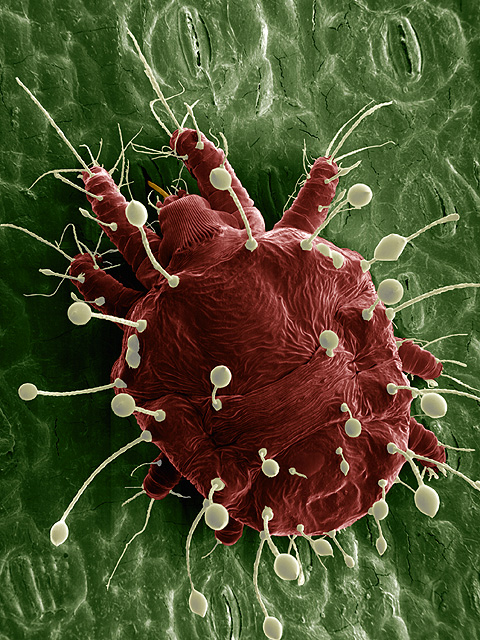
A tiny mite is creating a big stir in the western hemisphere's tropics, ie the Americas.
Scientists with the Agricultural Research Service (ARS) and the Animal and Plant Health Inspection Service (APHIS) have joined a multinational effort to stop the red palm mite, an invasive pest that rides the wind and, until now, was mainly known for attacking coconut palms in the Eastern Hemisphere's tropical and subtropical regions. Wind blown pests are known to arrive in north Australia each year, mainly small insect vectors critically involved in some animal diseases.
According to Ronald Ochoa, a mite expert at the ARS Systematic Entomology Laboratory in Beltsville, Md., the red palm mite has been found in the Caribbean region, including on U.S. soil in Puerto Rico and St. Thomas. The fast spread of this pest, which causes serious leaf damage, constitutes the biggest mite explosion ever observed in the Americas, according to Ochoa. He added that, in Trinidad, he and colleagues estimated there were 30 to 100 million mites per palm.
At stake may be more than just the health of sectors of the ornamental plants industry and the palm trees that are synonymous with the tropical lifestyle. On Dominica, the mite has attacked banana plants, and a grower in Trinidad indicated that he anticipates a 50 percent loss in coconut production on his property, according to Ochoa.
The red palm mite, Raoiella indica, was first described in 1924 in India, and identified in the Western Hemisphere three years ago on Martinique. Its calling cards include yellow-spotted or totally discolored palm leaves, and reddish-brown areas signaling mite clusters. In Australia this pest has been identified as a potential threat for cotton crops, especially close to palms, but the real threat is probably the ornamental palm industry itself, a major ornamental crop across northern Australia, and these palms are used widely in urban landscaping. It is hard to even imagine the overall damage to society across the north if a similar scale of problem to the Caribbean was seen in Australia.
It is probably time that at least in the north of Australia awareness of the problem in the US and Caribbean was made known and information about the pest provided to industry. North Australia already has Palm Leaf Beetle, which causes losses among many palms in the region.
USDA scientists have learned a great deal about the mite since being alerted to its presence by concerned officials representing several Caribbean nations. It's hoped that their studies will help lead to biological and chemical controls and a means of monitoring for new hosts of the mite.
Read more about the American research, an excellent overview of the Western Hemisphere situation, available online at:
http://www.ars.usda.gov/is/AR/archive/may07/island0507.htm
Scientists with the Agricultural Research Service (ARS) and the Animal and Plant Health Inspection Service (APHIS) have joined a multinational effort to stop the red palm mite, an invasive pest that rides the wind and, until now, was mainly known for attacking coconut palms in the Eastern Hemisphere's tropical and subtropical regions. Wind blown pests are known to arrive in north Australia each year, mainly small insect vectors critically involved in some animal diseases.
According to Ronald Ochoa, a mite expert at the ARS Systematic Entomology Laboratory in Beltsville, Md., the red palm mite has been found in the Caribbean region, including on U.S. soil in Puerto Rico and St. Thomas. The fast spread of this pest, which causes serious leaf damage, constitutes the biggest mite explosion ever observed in the Americas, according to Ochoa. He added that, in Trinidad, he and colleagues estimated there were 30 to 100 million mites per palm.
At stake may be more than just the health of sectors of the ornamental plants industry and the palm trees that are synonymous with the tropical lifestyle. On Dominica, the mite has attacked banana plants, and a grower in Trinidad indicated that he anticipates a 50 percent loss in coconut production on his property, according to Ochoa.
The red palm mite, Raoiella indica, was first described in 1924 in India, and identified in the Western Hemisphere three years ago on Martinique. Its calling cards include yellow-spotted or totally discolored palm leaves, and reddish-brown areas signaling mite clusters. In Australia this pest has been identified as a potential threat for cotton crops, especially close to palms, but the real threat is probably the ornamental palm industry itself, a major ornamental crop across northern Australia, and these palms are used widely in urban landscaping. It is hard to even imagine the overall damage to society across the north if a similar scale of problem to the Caribbean was seen in Australia.
It is probably time that at least in the north of Australia awareness of the problem in the US and Caribbean was made known and information about the pest provided to industry. North Australia already has Palm Leaf Beetle, which causes losses among many palms in the region.
USDA scientists have learned a great deal about the mite since being alerted to its presence by concerned officials representing several Caribbean nations. It's hoped that their studies will help lead to biological and chemical controls and a means of monitoring for new hosts of the mite.
Read more about the American research, an excellent overview of the Western Hemisphere situation, available online at:
http://www.ars.usda.gov/is/AR/archive/may07/island0507.htm
Subscribe to:
Posts (Atom)