Showing posts with label quarantine. Show all posts

Thursday, December 19, 2019

Year of Plant Health - 2020


2019 has come to a close with the recent announcement that 2020 will be the International Year of Plant Health.
Protecting the health of our agriculture and environment is the core of our biosecurity efforts in Australia, for both plant and animal  systems.
Many in the Darwin region will be aware of recent plant biosecurity issues covering bananas and citrus over the past few years, and bananas continue to be at the frontline worldwide over Panama disease development and spread especially in South America and Africa and with some issues even in Queensland in Australia over the past few years too.
While there are some very serious biosecurity issues facing Australia and indeed much of the world, in our region the incurable and highly deadly animal disease African Swine Fever is probably front and centre as we approach the end of 2019.
While Australia does remain free of this monumentally serious problem [as at mid-December 2019], other neighbours are no longer free - with Sumatra in Indonesia as well as Timor Leste designated as having the disease.
Recent detections of pork contaminated items at Australian border locations heightens risk for Australia, with an aggressive program of visa cancellations for offenders now the usual penalty for  these people.
This does not lower any need for plant biosecurity awareness, with wooden items a common issue with holiday makers.  There have been some high profile plant quarantine matters dealt with by Australian courts in 2019.
It is not just about the court cases and offenders - it is what can be done by stupidity or sometimes wanton offending here in Australia, and the long term costs of possible clean up, which sometimes may not be feasible.
Think biosecurity - with heightened awareness for plants in 2020.

Monday, October 14, 2013

Freckle Freaks the Banana Industry in the NT


A fungal disease which was found in the Cavendish banana variety in August has become a catalyst to the destruction of banana trees across the Northern Territory.

A $2.8m plan to control the fungus which is known as banana freckle, will be undertaken in an effort to protect the spread of the disease to Queensland where 90 percent of the country's bananas are grown.

Australian Banana Growers Council representative, Doug Phillips said that the disease would cause significant damage to the industry.


This eradication program commenced in the NT last week, with a significant plantation near Batchelor a major loss with many more smaller and domestic crops also affected.  Others have boosted biosecurity to ensure they do not get the disease on their property. 


Tuesday, April 16, 2013

Australia’s Biosecurity – Ultra Important – Giant African Snail


We laugh [or is it cry?] about the cane toad, that attempt at biocontrol that has become the pernicious invader across north Australia, and even more recently into some parts of Sydney.
There are also biosecurity concerns about various ant species, wild Asian honey bees [ potential host for varroa disease of domestic bees] and numerous weed species that can be hitchhikers into north Australia.

Spare a thought for Florida, USA.  Apart from some crazies who released Burmese pythons into the everglades that have now become quite a serious pest there, the current threat is African Giant Snail.


It seems someone has seriously dropped the ball – was thought to have been eradicated in Miami-Dade County where it is now appearing widely, some years ago.  We are talking of over 100,000 of the creatures captured and killed recently – and there seem to be a lot more coming as the weather warms.
This pest would be a serious, serious, serious problem in Australia if it ever got out of biosecurity measures.  A major one of the methods is container hygiene, along with soil freedom and with rigorous in country pre export as well as post entry inspections, hopefully it might remain as “not here”.

There are a few current newspaper and media reports about the Florida situation – be alert, but not alarmed!
http://www.reuters.com/article/2013/04/14/us-usa-florida-snails-idUSBRE93D05620130414

http://miami.cbslocal.com/2011/09/15/giant-african-land-snails-return-to-south-florida/

http://www.freshfromflorida.com/pi/gals/

Any suspected sightings in Australia – get in touch with AQIS.  Better still, take care to avoid soil on equipment and shoes, and never – repeat never, bring snail or snail shells into Australia.  Take care.

Wednesday, January 18, 2012

US Cattle Identification Systems Seen to Be Poor

While the Australian NLIS system is not perfect, it is in place and generally works ok, and is now part of a solution for export of live cattle to Indonesia.

But cattle identification in the US [a serious meat competitor to Australia] has recently been of some concern to researchers.

And the following brief report sums this up nicely -
Economists at Kansas State University have released a study that examined cattle identification (ID) and traceability systems around the world and found that the US lags behind both major beef exporting nations and beef importers in the development and implementation of cattle ID systems, according to Glynn Tonsor, a Kansas State economist involved in the study.

The implications "are particularly troubling," he said.

US cattle prices last year were record high, in large part due to beef exports, but the comparative disadvantage regarding U.S. cattle ID "puts these and future US beef export gains at risk," he said.

Furthermore, U.S. consumers have largely trusted US beef producers and have not pushed the industry to adopt cattle ID, he said, but this may soon change as consumers become increasingly interested in traceability.

The US beef industry would be well served to give implementations in this study "serious thought," Tonsor said, before a lack of ID and traceability costs business at home and abroad.

Source: http://www.feedstuffs.com

There are a few novels that paint a grim picture of the US animal abattoir system and offer some dubious views of the security and integrity of the system. And there have been a few serious issues in relation to meat quality at consumer outlets, especially fast food venues, in recent years in the USA. And remember, the US had meat exports banned to a number of Asian countries for some years over mad cow disease.

As said, NLIS is not absolute, but it generally now works. It seems that all is not well in the US however!!

Friday, September 19, 2008

Would YOU Buy Milk from China? Or Any Food from China?

Credibility comes and so easily goes. It can be destroyed so easily, and even by others.

Business dealings with the Chinse always tend to have overtones of someone on the make. The old “whats in it for me” concept. Or often, how can I make something out of the transaction....even a bit more than the normal. The usual middle man syndrome.

This week the news all over Asia is the story of contaminated Chinese milk products. Not just a bit contaminated with a few E.coli or as sometimes happens, a small piece of glass or metal that came off equipment. No, this time it is a full blown deliberate addition of nothing less than the toxic chemical, melamine.

And the reason? A deliberate attempt it seems to obfuscate the system by boosting milk protein levels with the addition of the melamine. Just to make a lot more money, as milk is sold on protein content.

After all, even China bans melamine in food products, including milk. Companies it seems may not have been testing for the melamine.........but then, did they really expect the middlemen, those who consolidate milk supply from small producers and deliver to the milk processors, would be ADDING a toxic product to help boost protein levels and hence their profits?

This seems to be the story. No doubt there is more to emerge over the next few days and weeks.

Sure, the factories have been caught out big time. And senior people appear to have been suspended or resigned from the factories already.

Consumers are being screwed again over poor products. This time they are killing children, or making them very unwell. Emotive material and there are widely shown images on Asian TV channels.

Westerners might be crowing a little with the range of regulatory checks and balances, and may seem to show the western style checking schemes of both self regulation and an overarching regulatory system of the government in a good light.

There are already some trends towards increased regulation of previously self regulated areas in western societies. Will this trend accelerate?

Experiences in China reinforce a view that while laws may exist, the regulatory framework and an attitude in business / society seem to thumb their noses at their existence, or use corrupt practices to circumvent them. Has this been the case here?

There is a lot at stake...........including the credibility of much of food production and regulation in China. And do not forget, a lot of fresh Chinese products are exported......quite a few shipments get refused entry to countries over food safety already, without much publicity, eg toxic residues in food, high residual agrochemicals. Not to mention the past problems with lead paint on children's toys.

The stakes are high. Not to mention Chinese government credibility. Will the Australian government impose generally tighter regulations for Chinese food imports to Australia for example?

Friday, February 01, 2008

Scientists Call For Urgent Research Into 'Real' Impacts Of Invasive Species

As well as drawing attention to the rising cost of invasive species on a global scale —estimated at US$1.4 trillion in damage — GISP stresses that too much emphasis has been placed on the problems faced by the agricultural sector in developed countries rather than in developing countries and on the “full range of environmental, social and economic costs.” The report also emphasises that due to the lack of knowledge and research available on the severity of individual pests and the options for best controlling them, policy makers are being left in the dark.

Dennis Rangi, Chair of GISP says: “With the increase in global trade, invasive species are gaining more and more prominence around the world. However the level of awareness amongst decision-makers, and in particular those in developing countries is still relatively low.“

He goes on to say that to enable informed policy making on the prevention, eradication and control of invasive species, it is critical that studies are expanded to show the extent of the problem and in particular the impact that these weeds, pests and diseases have on people’s lives. He says “numbers are not enough; decision makers need to know the tangible effects invasive species are having on the individual farmers
and their crops.”

To help address the issues, GISP and one of its lead organisations, CABI, has undertaken a number of case studies of problem invasive species in Africa — a country with a current lack of analysis. As well as highlighting the overall economic damage to the affected countries, the studies show the estimated monetary loss to farmers, the cost of prevention and control and the potential consequences if action is not taken.

CABI is world-renowned for its extensive work in working with countries to help prevent and control invasive species. As well as advising on how to control invasive weeds and pests using a complementary array of pest management approaches, CABI specialises in natural control methods. This focuses on finding and developing natural enemies from the species’ country of origin and introducing them to the environment where it has invaded. One example is the Rastrococcus mealybug which devastated mangoes in West Africa. CABI introduced a highly specific wasp from Asia, which proved extremely effective in controlling the mealybug. Natural control methods for other weed species such as Mikania micrantha and Water Hyacinth have also been successfully used.
Among GISP’s case studies is the Triffid weed (Chromolaena odorata), a plant native to the Americas which has severely impacted natural areas in Africa and reduces crop productivity in agriculture
and grazing. In Ghana the study showed that the weed occupies 59% of all arable lands, and in Ubombo, South Africa it greatly reduces the grazing capacity of animals. Effective control would see an increase in production by 34% and a gain of US$25.6 per hectare for each farmer.

Another example is the Larger Grain Borer which has been recorded in over 18 African countries. The Borer is a major pest of staple food in Africa, especially farm-stored maize and cassava. By studying the Borer, GISP reported that “its impact is greatest in rural, small-holder farming systems where yield losses range from 23-60%.”

Sarah Simons, Global Director of Invasives Species at CABI concludes: “By concentrating on a number of specific problem weeds in Africa, we are able to identify the effects they have on a country’s overall economy and also on the farmers and their families. This sort of information is essential if governments are to understand the extent of the problem and develop effective strategies to tackle them.
The report ”Economic Impacts of Invasive Alien Species: A Global Problem with Local Consequences" is authored by the Global Invasives Species Programme. To read the report in full please go to http://www.cabi.org/files/EZines/E%20Shots/gispeconomicstudies071607.pdf

CABI works with other GISP partners (IUCN and TNC) to extend this research from impacts on agricultural systems to invasions of natural and wild ecosystems and the effects they have on conservation and peoples’ livelihoods – especially in developing countries.

Australia has its share of invasive species - insects, weeds, fish and so on. But at least we have the resources and mostly the finances to attack the problems.

[partially sourced from CABI media report]

Monday, May 21, 2007

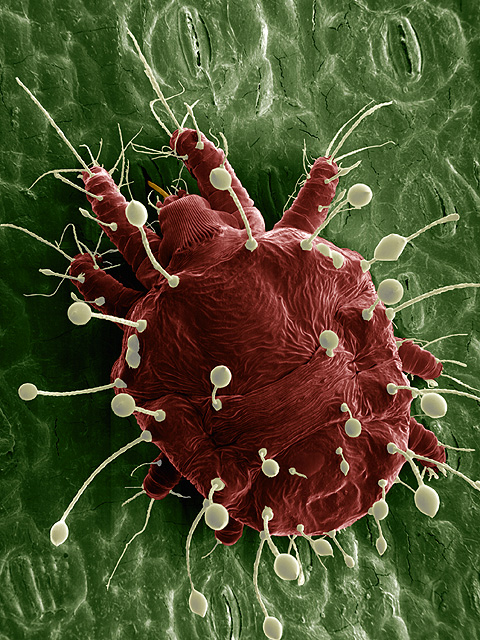
Red Palm Mite - Watch out Australia!


A tiny mite is creating a big stir in the western hemisphere's tropics, ie the Americas.

Scientists with the Agricultural Research Service (ARS) and the Animal and Plant Health Inspection Service (APHIS) have joined a multinational effort to stop the red palm mite, an invasive pest that rides the wind and, until now, was mainly known for attacking coconut palms in the Eastern Hemisphere's tropical and subtropical regions. Wind blown pests are known to arrive in north Australia each year, mainly small insect vectors critically involved in some animal diseases.

According to Ronald Ochoa, a mite expert at the ARS Systematic Entomology Laboratory in Beltsville, Md., the red palm mite has been found in the Caribbean region, including on U.S. soil in Puerto Rico and St. Thomas. The fast spread of this pest, which causes serious leaf damage, constitutes the biggest mite explosion ever observed in the Americas, according to Ochoa. He added that, in Trinidad, he and colleagues estimated there were 30 to 100 million mites per palm.

At stake may be more than just the health of sectors of the ornamental plants industry and the palm trees that are synonymous with the tropical lifestyle. On Dominica, the mite has attacked banana plants, and a grower in Trinidad indicated that he anticipates a 50 percent loss in coconut production on his property, according to Ochoa.

The red palm mite, Raoiella indica, was first described in 1924 in India, and identified in the Western Hemisphere three years ago on Martinique. Its calling cards include yellow-spotted or totally discolored palm leaves, and reddish-brown areas signaling mite clusters. In Australia this pest has been identified as a potential threat for cotton crops, especially close to palms, but the real threat is probably the ornamental palm industry itself, a major ornamental crop across northern Australia, and these palms are used widely in urban landscaping. It is hard to even imagine the overall damage to society across the north if a similar scale of problem to the Caribbean was seen in Australia.

It is probably time that at least in the north of Australia awareness of the problem in the US and Caribbean was made known and information about the pest provided to industry. North Australia already has Palm Leaf Beetle, which causes losses among many palms in the region.

USDA scientists have learned a great deal about the mite since being alerted to its presence by concerned officials representing several Caribbean nations. It's hoped that their studies will help lead to biological and chemical controls and a means of monitoring for new hosts of the mite.

Read more about the American research, an excellent overview of the Western Hemisphere situation, available online at:
http://www.ars.usda.gov/is/AR/archive/may07/island0507.htm

Sunday, March 18, 2007

Javan pond heron visits Darwin


Quite a surprise visitor over the last week, with the sighting of a Javan pond heron in Darwin. This was sighted near Casuarina Beach, a Darwin suburb, in a large stormwater drain. Really caused quite a twitter among twitterers [ those people who MUST see new birds] who have come from all over Australia who check it out. It is presumed to have been blown off course by the strong west and north west air flows of the past few weeks including strong airflows from recent cyclones.


Today is a wet Sunday, so why not see for myself? And yes, located quite easily, and almost no one there either. And I have photos to prove I WAS THERE!

The sighting has made major news items in Darwin [ was it a slow news week.....not sure?], and now seems quite content among the gum leaves.

There are some fantastic images on Google of the Javan pond heron, albeit from within its normal habitat of SE Asia, particularly Indonesia.

But its presence once again also highlights the closeness of north Australia to Asia, and potential vulnerabilities to incursion by pests and diseases of that region. There are sentinel flocks of chickens around the Top End that are regularly checked for antibodies related to some insect borne diseases that are carried on the NW air currents in the wet season. These problems have been known since the mid 1970s, but regular vigilance helps with knowledge and detection. There is a vigorous program within AQIS to manage these risks, for these air borne diseases, as well as plant and animal pests, weeds and diseases.

http://www.abc.net.au/news/items/200703/1873464.htm?darwin news story on the Javan pied heron in Darwin