Showing posts with label pesticides. Show all posts

Friday, November 20, 2015

Bees Decline and Insecticides - Missing Link Discovered?

Bees and pesticides 'missing link' found


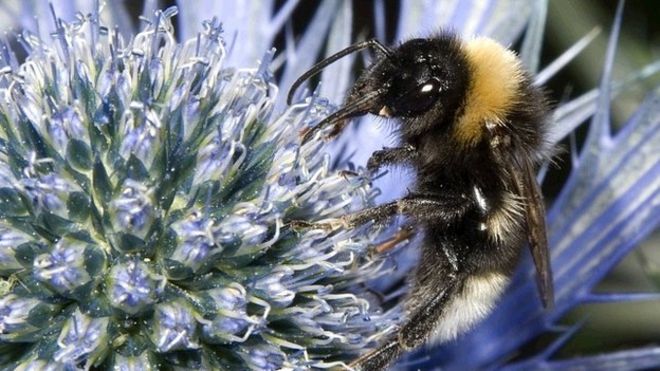
BeeImage copyright PA
Image caption Some scientific studies show that pesticides harm bees

Scientists say they have found the "missing link" in the debate over the risk of pesticides to bees.

French researchers say neonicotinoid pesticides harm individual honeybees, but whole colonies are able to recover in the wild.

This accounts for discrepancies between lab and field studies, they report in Royal Society journal Proceedings B.

A Europe-wide ban on neonicotinoid use on flowering crops is due to be reviewed at the end of the year.  It was introduced two years ago.
The debate over the use of neonics has centred on discrepancies between toxicity assessments in the laboratory, where bees are dosed artificially with insecticide, and the findings of field trials in the countryside.

The big unanswered question is whether harmful effects seen in lab studies occur in real-life conditions and cause population declines.

The new research provides an explanation for the "missing link", say French researchers.

Their monitoring of tagged honeybees in the wild suggests bees foraging around treated crops die off at a faster rate than normal.  However, colonies are able to make up for those dying off by boosting the number of worker bees in the hive.

Lead researcher Dr Mickael Henry of the French National Institute for Agricultural Research, INRA, in Avignon, said the average life expectancy for an individual honeybee foraging on crops treated with neonics is lower than expected.

He told BBC News: "We could find evidence of troubles at the individual scale in the field but these troubles were compensated for by the colonies.  "The population inside the hive was able to compensate for the increased loss of worker honeybees by increasing brood production."
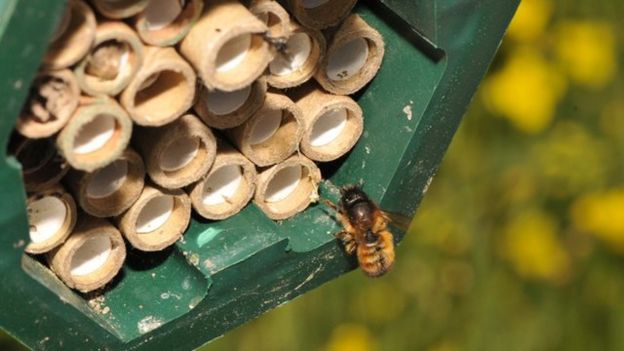

A field study found harmful effects on the solitary beeImage copyright Morgan Boch
Image caption A field study found harmful effects on the solitary bee
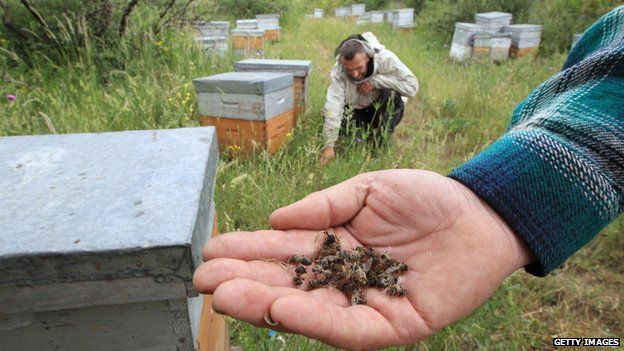
dead beesImage copyright Getty Images
Image caption The decline of bees around the world has increased focus on neonicotinoid chemicals
Dr Scott Hayward of the University of Birmingham, who was not connected with the study, said the work "re-ignites arguments to ban neonics", and similar studies are now needed on other pollinator species.

His comments were echoed by Dr Christopher Connolly of the University of Dundee.  "It is important to remember that all other insect pollinators do not possess the enormous buffering capacity of honeybees and are therefore more acutely at risk to the impact of pesticides," he said.

Dr Peter Campbell of the pesticide manufacturer Syngenta said while the study raised unanswered questions "reassuringly... there were still no effects reported at the colony level".
And Dr Alan Dewar of Dewar Crop Protection Ltd, added: "The conclusions from this work, which are very simple in contrast to the study itself, show that bees, or at least honey bees, can compensate for adverse effects of pesticides in their environment."

Emergency lifting

Bees are in decline in Europe and North America due to a number of factors, including pesticides, habitat loss and diseases.

Neonicotinoids contain synthetic chemicals similar to nicotine, which as a plant toxin is damaging to insects.  In the UK, the government has temporarily lifted a ban on neonicotinoid pesticides in parts of England.  Two neonicotinoid pesticides can be used in four counties on oilseed rape crops following an emergency application by the National Farmers Union.

The Department for Environment, Food and Rural Affairs said the EU Commission had introduced precautionary restrictions on neonicotinoids from December 2013, which the UK had fully implemented.

A spokesman added: "The Government makes decisions on pesticides based on the recommendations of senior scientists and independent experts who have looked at the best available scientific evidence.  "The Commission has now begun a review of the science relating to neonicotinoids and bees, and the UK will contribute fully to this review."
------------------------

This work has certainly shed some real science on how these chemicals interact with bees, but the issue with other pollinators still remains.

I have seen nothing from Australian sources.  Those comments will place some local context on this important issue of bee health.

[ partially sourced from BBC sources on 20 November 2015.]

Friday, September 28, 2012

Silent Spring - 50 Years Old


http://www.abc.net.au/environment/articles/2012/09/25/3596835.htm?WT.svl=featuredSitesScroller

This link takes you to an article especially pertinent today, the 50th anniversary of the publicaton of Silent Spring by Rachel Carson.

Many argue that was the birthday of the modern environment and conservation movement.  The book chronicled the role of DDT in the environment and the damage it was causing from unprincipled use.

DDT is a very effective agrochemical and still has uses today, particularly when impregnated in mosquito bed nets, for malaria control.........it is a great option that really works.  It is just that, in some ways like the use of glyphosate today, DDT was used for everything!  And society did not know enough about the problems that arose until afterwards, and it was hard to get people to listen.

And then came the book Silent Spring.  A slim volume, and I read it, in the mid 1960s studying agrochemical use as an undergraduate in an ag science faculty.  It was a game changer.

It is still in print, and still worth reading if you have not done so before..

It is true to say, the genesis of the environmental movement can be traced to that book release.

Wednesday, January 26, 2011

Dioxin Contamination in Food Scare - Germany

China is often accused of lax process and poor management of industrial food processes. The contaminated milk powder scandal is but part of that.

This time it is Germany......and dioxin.

Same sort of issue, a company in this case it seems, opting for cheap ingredients for formulated animal feeds, with the material not suitable for animal use, but only for industrial use. The animal feeds were then used and the dioxin showed up in eggs, pork, etc.

The contamination is nominally small, really miniscule. But modern analytical techniques can detect very very small levels of some of these toxic products, and dioxin is certainly toxic. German authorities are playing it down, stating that levels are extremely low, and NOT a human health threat.......which is most probably true. But perception is EVERYTHING, and the public is very unhappy over the whole issue.

Food safety is a big issue, and Germany is a big organic market, so there are many consumers if not buying organic foods exclusively, do so at times. This will further inflame emotions over the "factory food" catchcry.

In reality............a shoddy, tawdry manufacturer, who it seems is under big pressure and may become insolvent over the issue.

There are many news items with this one a reasonable overview:

http://www.skynews.com.au/topstories/article.aspx?id=564818&vId=

This will reopen questions about regulation or reregulation of food quality. Yet, in reality the problem WAS detected, and quickly dealt with. There will be recriminations, absolutely no doubt.

Friday, October 22, 2010

Endosulfan Registration Cancelled in Australia

Registration of Endosulfan Cancelled in Australia

The Australian Pesticides and Veterinary Medicines Authority (APVMA) on Tuesday advised that it had cancelled the registration of the insecticide endosulfan.

This decision followed a recent assessment of new information by the Department of Sustainability, Environment, Water, Population and Communities (DSEWPC) that the prolonged use of endosulfan is likely to lead to adverse environmental effects via spray drift and run-off.
A full risk assessment conducted by DSEWPC concluded that these long term risks could not be mitigated through restrictions on use or variations to label instructions.

From 12 October 2010, agricultural products containing endosulfan are no longer registered in Australia. The three current approvals for endosulfan have also been cancelled, and the five products containing the chemical will be phased out over the next two years.

Read the Full Report here.