Showing posts with label food. Show all posts

Friday, March 08, 2019

Future Farming in Singapore. Can it Be Done in Darwin Too?

SINGAPORE - With global warming heralding new threats, resource scarcity will be the new normal.
So the Government is throwing its weight behind efforts to protect and provide for the country's survival - in the areas of water, making the most of waste, food and climate change research - Environment and Water Resources Minister Masagos Zulkifli said on Thursday (March 7).
"Climate change is bringing new and wicked problems," he said in Parliament.
And just like the country's water success story, the same can be done in other areas, through long-term planning decades before a problem surfaces, he said, pointing out that Newater was more than two decades in the making.
"Faced with a challenge, we start small, learn from others, harness technology, invest in R&D. Keep on trying, until we get it right.
"Then we take our solutions and scale up to benefit the whole nation."
In terms of food, this means decreasing the dependence on the global food market, which accounts for over 90 per cent of Singapore's current food supply.
Announcing an ambitious target of producing 30 per cent of the country's food needs by 2030 - or 30 by 30 - Mr Masagos said that this would call for new paradigms in the sector, with a focus on state-of-the-art indoor farms.
They would incorporate climate control and automation, for instance, and in terms of fish - closed containment systems that keep algae blooms and oil spills at bay.
"Farmers of the future will operate computerised control systems in a pleasant environment."
It was time to break away from the "take, make, use and toss" mentality and embrace the circular economy instead, Mr Masagos added.
Promising technologies dealing with waste include Singapore Polytechnic's green chemistry technology to recover precious metals in e-waste, and Nanyang Technological University's method of turning food waste into high-grade fertilisers.
In addition, the National Environment Agency is working on turning incineration ash into construction material, called NEWSand, and has developed draft standards for using treated ash for building roads, for example.
When it comes to climate change, science will be key in guiding policies, he added, with the opportunity for Singapore to be a leader in the tropics, since there is limited knowledge on its effects there.
To this end, there will be more investment to build capability in the Centre for Climate Research Singapore, set up in 2013, and the local scientific community. This year, the centre will embark on the National Sea Level Programme to better understand sea levels around Singapore, so that robust projections and plans can be made for the long term.
Solar power will be stepped up. It could be harnessed at reservoirs, coastal areas and building facades to potentially power 40,000 four-room flats each year, an area half the size of Tampines.
At the same time, the water story is also not over.
The Research Innovation and Enterprise Council has allocated $200 million to national water agency PUB for research, and the Government has posed "Big Hairy Audacious Goals" to the scientists, he said, such as producing desalinated water with much less energy than currently needed.
Already, new technology which could potentially halve the energy required for desalination is set to be scaled up and deployed in the Tuas Desalination plant from 2020.
At the same time, people are saving more water, with domestic consumption falling from 148 litres per person per day in 2016 to 141 litres in 2018, with a target of further shaving it to 130 litres by 2030.
In all, the Government will spend almost $400 million on research and innovation in water, the circular economy, climate change and food, under the Research, Innovation, Enterprise Plan 2020 (RIE2020).
The challenges also bring with them opportunities, Mr Masagos stressed.
Pointing to Singapore's thriving water industry - with over 200 companies and more than 25 R&D centres, he said that investments in the sector in the past decade had created 14,400 good jobs and economic value-add of over $2.2 billion annually.
And plans for the water, food and environmental sectors would open up a variety of exciting opportunities for enterprises and jobs.
"We must do as our forefathers did, stay alert and nimble, and continue to plan and prepare for the long term," he said.
"We have ambitious plans for our water, waste and food sectors, but the road ahead is long and winding. We will persevere, for we are not done building a sustainable Singapore."

Wednesday, July 11, 2018

Will Your Next Tomato Be Grown Indoors by Robots?


If you were inventing the farm today, why would you put it outside, on a giant plot of land?
OK, there’s the sunlight thing, but then you get droughts and frosts and plant-munching insects that have to be battled with harmful pesticides. And because outdoor farms need so much acreage, they’re usually far from most of their customers — which means that by the time a tomato gets to you in a city, it tastes like a baseball.
But now, upstarts in the US such as Bowery Farming, AeroFarms, and Lettuce Networks are doing something different. They’re growing food indoors. They’re using data and artificial intelligence to operate more efficiently than traditional farms. And they’re staying small and close to population centers. The new generation of farming promises to feed more people while doing less environmental damage.
This kind of distributed farming fits with a larger 21st-century movement that venture capitalist Hemant Taneja and I call “unscaling.” We document the economic trend in our book, Unscaled: How AI and a New Generation of Upstarts Are Creating the Economy of the Future.
Massive scale was the goal throughout the 20th century. Mechanization and technologies such as the truck and telephone made it possible. Mass production, mass markets, and economies of scale ruled in every sector. So we ended up with giant companies, huge hospitals, big universities — and corporate mega-farms.
Today, industry after industry is unscaling. The cloud, mobile devices, big data, AI, and new technologies such as blockchain and 3D printing are making it possible to profitably customize products for smaller and smaller niches. Netflix is an unscaled version of mass-market cable networks like HBO, using data to make programs that appeal to specific types of viewers. Airbnb is a distributed hotel company. In an unscaled era, businesses can operate at smaller, more focused levels and beat giant enterprises.
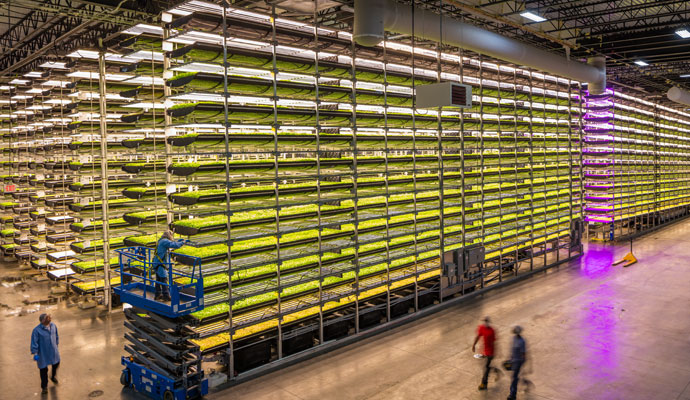
So farms are unscaling, too. Bowery and AeroFarms both operate inside old industrial buildings in New Jersey and are a short drive from New York City. Inside these buildings, LED lights mimic natural sunlight. The crops grow in nutrient-rich water beds on trays stacked floor to ceiling. And sensors constantly monitor the plants and send data back to AI-driven software, which can learn what’s best for the plants and tweak lighting, water, and fertilizer to improve yields. Much of the “farming” is done by robots. “We get productivity hundreds of times greater than a traditional farm,” says AeroFarms CEO David Rosenberg. “And we use less water and no pesticides — because we’re indoors — and can grow 365 days a year.”
These unscaled farms can give consumers a better product than mega-farms, too. Food grown nearby doesn’t need to endure shipping — so it can ripen the way it’s supposed to. In the middle of winter, indoor-grown, local tomatoes will taste like tomatoes. As you can imagine, that’s what consumers prefer.
Since 2013, about US$2 billion has been invested in hundreds of agricultural technology startups, according to CB Insights senior analyst Zoe Leavitt, who spoke about the future of food at a recent Techonomy conference in New York. AeroFarms has raised more than $100 million and sells to Whole Foods and FreshDirect. Boston-based Freight Farms is growing food in container cargo vessels, often selling to restaurants, hotels, and college campus eateries. New York–based BrightFarms says it “finances, designs, builds, and operates” indoor farms close to food retailers and has raised $11 million in funding. Edenworks is operating rooftop greenhouses that grow produce fertilized by ground tilapia and prawns, which are also grown at the mini-farm.
Lettuce Networks is trying another approach. It is using cloud and mobile technology to create a network of urban farms. Founder Yogesh Sharma calls it an Airbnb for farming. The company contracts with owners of small plots throughout a city and installs sensors that can monitor crops and the surrounding environment. Nearby residents can subscribe to the Lettuce service to get food delivered. The system knows what’s being grown all around the city and, from that network, assembles a basket of local produce for delivery. Owners of the plots make some money off their harvest, while subscribers get an assortment of fresh food grown nearby.

Whether unscaled farming is a net economic benefit remains to be seen. It’s a new industry, with techniques and business models that are works in progress. Analyst firm Market Research Future
 notes that urban farms cost a lot to start (a warehouse in New Jersey is more expensive than a plot of land in Saskatchewan) and don’t yet work for a lot of crops, such as corn or bananas. Sunlight is free and sustainable; LED lights require energy. But proponents believe that because these indoor farms are far more productive and are closer to consumers, once there are a lot of them and the techniques and technology get honed, more people will be fed for less cost than ever before.Distributed, indoor, AI-assisted farming should be good news for the environment. Scaled-up farming was the right answer for the past century, feeding a burgeoning population while making food relatively cheap. The percentage of disposable income used for food is lower today than it was in the 1970s, according to Pew Research Center. But by 2050, the planet is projected to have 2.2 billion more people to feed, just as global warming is expected to make weather less predictable and dry up previously fertile regions. If food can be grown indoors, in a cost-effective way, in or near cities, climate will be less of a concern, and far less carbon will be burned moving food thousands of miles via trucks, trains, and ships.
As investment pours in and environmental conditions drive a need for new solutions, unscaled farming looks a lot more like the future of food than does a massive field baking under the sun.
Thoughtful or foolish?
from an article originally written by Kevin Maney in Strategy + Business 

Monday, February 05, 2018

Product Integrity in Agriculture - Better Options

Agriculture in its broadest sense is about producing food, drink, seeds, fibre and other products for consumers.  Australia generally does it well.

Whether it be meat, wine, milk, fibre, cider, fruit or fruit juice, canned tomatoes or dried fruit, vegetables fresh - dried or frozen or any other staple product they are required to be what they say they are.  Product integrity is paramount in market development and maintenance.

It is often taken for granted - or at least has been for many years with Australian products.  They are what they say they are...........or are they?

Recent developments are driving significant improvements, often quite subtle, in developing superior ways to ensure product integrity in Australia's rural products.

Have a look at the following link which covers some of the higher tech options now being used to ensure Australian products are not misrepresented along the chain from producer to user.

https://ia.acs.org.au/article/2018/penfolds-or-benfolds.html?ref=newsletter

This is a sobering reminder that it is critical to protect your product - in essence your intellectual property - along the way to market.

There are some charlatans out there, and sadly it seems that China is a significant country of interest in sabotaging Australian rural products.

Most Australians seem to ignore product protection or at least assume " it will be right" - sadly, not always the case, and where it goes wrong Australia's reputation suffers as well as the company selling the real products.

Be aware that product integrity is everyone's business.

Thursday, June 25, 2015

Food Wastage in the USA is Huge - and Growing!

Americans throw away nearly half of their food every year, waste worth roughly $165 billion annually, according to a study by the Natural Resources Defense Council (NRDC).

The report estimates that the average American family of four ends up throwing away an equivalent of up to $2,275 annually in food. Even worse, there is evidence that there has been a 50 percent jump in U.S. food waste since the 1970s.

It’s especially troubling that at the same time, one in seven Americans, more than 46 million people, including 12 million children, don’t know where their next meal is coming from, according to a study by Feeding America.

Meanwhile, the rest of America continues to throw away unspoiled nutritious food. If we cut our food waste even by a third, there would be enough food for all those people who must rely on food banks and hand-outs to be fully fed.

Why Waste So Much Food?

According to the U.S. Department of Agriculture, a typical American household discards 40 percent of fresh fish, 23 percent of eggs, and 20 percent of milk, in addition to plenty of fruits and veggies. 

This is because consumers buy more than they can eat, so the food goes bad, or our meals are just too big to eat. 

There is also  too much reliance on “sell-by” and “use-by” dates; these are not federally regulated in the US and do not indicate safety, except on certain baby foods. Most foods can be safely consumed well after their use-by dates. (Here’s a guide to help you decipher what those labels mean.)

Restaurant portions are also generally huge, and often not fully consumed. Clearly, these runaway portion sizes in the American food industry exacerbate the waste issue.”From 1982–2002, the average pizza slice grew 70 percent in calories. The average chicken Caesar salad doubled in calories, and the average chocolate chip cookie quadrupled,” the NRDC study reveals

As NPR reports, farming practices are not without some blame for food wastage as they also account for some of the food waste. 

Peter Lehner, from the NRDC, explains that if food isn’t sold to the best buyer, it can end up in a landfill. “anywhere from 1 percent to 30 percent of farmers’ crops don’t make it to market,” says Lehner. “The prices for fresh fruits and vegetables can go up and down quite a bit, and farmers may plant thinking they will get one price, but, by the time harvest comes around, there’s another price, and it’s not even worth it for them to get to the market.”

It is not just the USA though, with a number of other countries also contributors to significant food waste.

Recently one leading tourist hotel in Switzerland [ a country noted for frugal living] has placed notices in the hotel and especially in restaurants to exhort customers to only take what they need from especially buffets and similar openly available food in eateries within the hotel, following very significant amounts of food being left behind after meals.  This has actually seen a very significant reduction in food waste within the hotel.  In their case, it was mostly Asian tourists who were the culprits.

Have a look yourself the next time you are eating out, especially if it is a buffet breakfast or dinner.  Is there significant food left as table waste?  You might be surprised.

We should all be mindful of how much food is wasted and ensure we do our bit to minimise food waste.  It does save money at your home, and helps the environment too.

Thursday, June 19, 2014

Large A$3 million Court Imposed Fine for Coles Supermarkets - Misleading Consumers

Coles supermarkets have received a $3 million fine over selling misleading labelled breads.

This is well documented in the media over the past day or so, with articles here : -

http://www.queenslandcountrylife.com.au/news/agriculture/agribusiness/general-news/coles-guilty-of-false-freshly-baked-claims/2702534.aspx?storypage=0
and here -
http://www.news.com.au/finance/business/coles-found-guilty-of-misleading-customers-over-freshly-baked-bread/story-fnkgdftz-1226958879823

There are many more on line.

One must also be suspicious over many of the claims made by supermarkets about other products.  May not be as misleading as this one, which does seem to be quite dodgy, but are they as potentially as dubious as this issue?

The mislabelled bread issue has been highlighted by ex Victorian Premier Jeff Kennett, a major protagonist against Coles in this action, with his high profile capable of getting action.

Bread is not the only overseas, mostly European bakery products, in Coles.  Often some of these are shown as "fresh" ie thawed, and ready to use, although most are frozen.

Are we likely to see a backlash by consumers over the disappearance of Australian food items off supermarket shelves, often driven by profit margins of the supermarket giants?


Friday, October 18, 2013

Australian Consumers Want Australian Produced Canned Fruit and Frozen Vegetables

In a stunning announcement, Woolworths has admitted that local consumers prefer /want Australian produced frozen vegetables, and that they will now source most if not all product from Australia, and not China as is the case now for many of the lower price items.

They have announced a major, near $17 million contract with Simplot, to source product from their processing plant in Tasmania, a major and possible business saving contract for the company, as well as the supplier growers, which has been discussing shutting down totally in Australia.

Media reports are focussing on the deal to grow and process in Australia, but is not the real issue that maybe, just maybe, that consumers in Australia are beginning to favour the quality, safety, health status and food biosecurity issues related to poorly supervised and often less appropriately produced product from places such as China, where there have been so many food safety alerts over food products?

And is Woolworths now tapping into that concern?  The media report from late yesterday seemed to have more focus on that aspect, yet today there is maybe a bit less emphasis on that aspect.

This is an important deal for Australian vegetable growers, and especially those in Tasmania.  And for whatever reason, Woolworths also deserve some plaudits to "use Australian".  Now lets see how it develops.

It also follows an earlier deal in which Woolworths switched to Australian canned fruit, rather than overseas product and saw a 40% sales rise in the canned fruit product.

See more here - http://www.abc.net.au/news/2013-10-18/simplot-woolworths-deal/5030720

and here - http://www.theaustralian.com.au/business/woolies-imports-freeze-boosts-farmers/story-e6frg8zx-1226741990944


Wednesday, July 04, 2012

Organic Food - A Social Crutch for the Wealthy?

Organic food and organic agriculture will never feed the world, yet adherents in western countries continue to expand.  Or are they?

Recent studies show a connection between organic agriculture and food devotees and altruistic behaviour which may indicate some social and psychological conditions.

Many of the claims made about organic food just do not stack up, especially in relation to freedom from pesticides in comparison to conventionally produced foods.

While the tenor of this recent article is provocative, and probably meant to be that way, it does debunk many claims related to organic production systems, and alludes to the social issues around users of the materials.

Read it yourself, and do not be too indulgent with your food.  A good diet is essential!!

http://qcl.farmonline.com.au/blogs/agribuzz-with-david-leyonhjelm/organic-food-its-a-religion/2611131.aspx?storypage=0


Thursday, March 22, 2012

Resilient Agriculture that is Productive and Sustainable

Agriculture in Africa has long been considered as a real basket case. Production unable to meet societal needs, low productivity of crops, ravaged by pests and diseases, constant drought, flood or pestilence.

That can be changed, and is changing for the better in a number of African countries. Ghana has halved hunger in 2011, well before the goal of 2015, through a postive environment within government as well as adoption of innovation and newer technologies.

In Zambia, conservation technology and use of no-till for cropping has reduced crop water use and yields for maize are now five times the sub-saharan average.

Genetic engineering to improve bananas by developing plant disease resistance in Uganda also seems to offer a path towards major yield improvements and longer life of banana plantations, mostly owned by small land holders.

Also importantly, creation of new and effective grain storage and grain trading systems are leading to better grain trading across Africa and reducing food price volatility.

Improvements in the tropics of the world are critical to improving food security, and better food security also reduces tensions and conflicts.

A lot is founded on agricultural science, some on enabling conditions.........but it is happening.

Resilience in agriculture is critical..........and the gains in productivity need to be sustainable. Some of the system enhancements are making a real improvement, and improvement that will slowly translate into better fed, healthier people. Particularly when you also factor in some of the other improvements across other fields eg into malaria management, control and maybe eradication that can greatly improve the health and working productivity of people.

But the agricultural development is real, and a monster driver of better conditions.

The article below covers this in more detail, but the majority of people in the western countries still think agriculture is a dead end in many parts of the developing world. Not so!

Read more - http://www.scidev.net/en/agriculture-and-environment/opinions/how-to-create-resilient-agriculture-1.html