Showing posts with label rice. Show all posts

Friday, November 08, 2019

Can We Double Sorghum Yield?

Doubling sorghum yields may now seem a pipe dream, but recent genetic research may make that goal a reality.  And reasonably soon as well.

This is especially relevant in tropical regions where achieving high sorghum yields is constrained by less suitable varieties as well as weather conditions.

See below for a recent USDA publicity announcement.

Certainly seems promising.

If combined with genetic work that prolongs production and grain fill during senesence it seems sorghum could get a big yield boost.
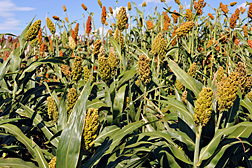
sorghum crop

USDA-ARS and Cold Spring Harbor Laboratory Research Probe Ways to Increase Yields of Sorghum—and Other Crops

By Dennis O'Brien November 6, 2019
Scientists with USDA's Agricultural Research Service (ARS) and Cold Spring Harbor Laboratory (CSHL) are working on field trials and genetic studies that could one day double the yields of sorghum, which is one of the world's most important sources of food, animal feed and biofuel.
 The efforts follow recent discoveries by ARS scientist Zhanguo Xin, who is based in Lubbock, Texas, and Doreen Ware, who is also with ARS and is an adjunct professor at CSHL, showing how a basic genetic change in sorghum can double its yield of grain.
Their findings, spelled out in a series of papers, are based on years of research by scientists with ARS and CSHL that initially focused on a search for the genetic underpinnings of high yielding strains of sorghum that were first developed by Xin at the ARS Cropping Systems Research Laboratory in Lubbock. They also lay out a potential strategy for increasing the yields not only of sorghum but of other grain crops, such as corn, wheat and rice.
Sorghum is drought tolerant, is an important crop for farmers worldwide and increasing production is considered a key to addressing the threat of food shortages in the years ahead with changing climates, growing populations overseas and the loss of arable land in many parts of the world.
Sorghum grain is produced in clusters of flowers and the plant has two types of flowers, one type that produces grain and another that does not. The researchers have shown in a series of published reports that mutating a key gene in sorghum inhibits production of a hormone, known as jasmonic acid, and that plants with reduced levels generate more of the fertile type of flowers -- and more grain.
Their results show that the gene, known as MSD1, is a major regulator of a cascading series of events along a genetic pathway that controls the production of jasmonic acid, particularly during flower development. They identified the role of MSD1 in a paper published last year in Nature Communications. Their subsequent papers in the International Journal of Molecular Sciences show that genes they have identified as MSD2 and MSD3 also play important roles further along in the genetic pathway and that mutating of any one of the three genes causes a similar increase in grain yield. Their most recent paper can be found here.
Xin and his colleagues are conducting field trials to see if the genes they have found could be used by breeders to improve yields in commercial varieties of sorghum.
The Agricultural Research Service is the U.S. Department of Agriculture's chief scientific in-house research agency. Daily, ARS focuses on solutions to agricultural problems affecting America. Each dollar invested in agricultural research results in $20 of economic impact.

Tuesday, November 05, 2019

GM Can Do Wonders with Food Crops

Some recent information provides even more success stories in yield increases in major crops using modern options in genetic modification.

Example 1

New genetically modified corn produces up to 10% more than similar types
Science - 04 November 2019
Researchers have for the first time conclusively shown they can increase corn yields up to 10% by changing a gene that increases plant growth—regardless of whether growing conditions are poor or optimal. …researchers at Corteva Agriscience, a chemical and seed company based in Wilmington, Delaware, decided to look at genes that function like master switches for growth and yield. They picked MADS-box genes, a group common in many plants, before settling on one (zmm28) to alter in corn plants. The researchers tested the enhanced gene’s performance in 48 commercial types of corn, known as hybrids, that are commonly used to feed livestock and found yield increases ranging from 3-10% with the findings published this week in the Proceedings of the National Academy of Sciences.


Example 2.

Researchers Use Gene Modification to Defeat Rice-Killing Disease
Karma Impact - 31 October 2019
Researchers successfully edited the genome of strains of rice grown in Southeast Asia and West Africa to block a pathogen [bacterial blight] that ravages yields of the staple crop, the latest example of gene modification that may reduce hunger throughout the world.Scientists at Manila’s International Rice Research Institute used CRISPR/Cas9 gene editing to prevent rice from expressing genes that serve as Xoo’s point of entry to hijack the plant’s nutrients, according to Nature. The team found that rice plants with these engineered genes were resistant to at least 95 Xoo strains.


Both crops are major food sources world wide, and using GM techniques can add big increases in yield quite quickly.

Another "biggie" is Vitamin A enhanced rice - and Bangladesh seems likely to approve its use very soon.

Example 3

Bangladesh close to releasing Golden Rice
Dhaka Tribune – 28 October 2019
Bangladesh will soon make a decision on the release of Golden Rice. According to the WHO one in every five pre-school children and 23.7% of pregnant women suffer from vitamin A deficiency in Bangladesh. 


Thursday, May 23, 2013

Food Quality and Safety - Luck or Vigilance in Australia?

Australians like to believe we have excellent food quality and safety standards.  That is probably so, although there have been a few incidents in the past, say ten years, over some processed smallgoods in which some people died, and an occassional salmonella issue, particularly with poultry.

Overall mark - a tick.

Yet issues about Chinese food quality and safety continue to make headlines - not only in China but around the world.

Most recent - the issue of cadmium contamination in rice in southern China, which is making headlines this week.  Yesterday, Government officials in southern China sought to calm public ire about toxic substances menacing the region's main food staple, rice, after the city of Guangzhou said that nearly half the rice tested [44%] at restaurants this year had excessive cadmium, a heavy metal that can cause cancer and other illnesses.  Cadmium contamination in the body is one of the reasons why there is a major international recall and removal / replacement issues with a particular hip joint prothesis, so cadmium can be nasty, and high levels potentially fatal. 

Food is an obvious source of all heavy metals in the body, with a lot of historical precedents, as the cause of heavy metal problems in people.  Cadmium is one of those heavy metals, which just continue to accumulate in the body. 

Whie there is heavy industrialisation in China, and air pollution, the source of the cadmium is so far unidentified.

In Australia cadmium in foods is partially regulated through restrictions on the cadmium levels in fertilisers, especially superphosate and related phosphorus fertilisers, which can add cadmium to soils, ultimately reaching the products grown on that soil.

We do take our food for granted, not always realising the long chain of regulatory procedures prior to the consumer using the food products.

There has been a vigorous discussion this week on an Australian agribusiness forum about consumer views on use of Chinese food products imported into Australia.  Think major supermarket chains, frozen vegetables, fresh garlic, and other products.  Consumers in Australia are concerned over the intrinsic quality of imported Chinese food, and according to some views are worried that price which dominates supermarket chain thinking, might be compromising food safety.  It is NOT a xenophobic reaction........but one based on quality as well as a fair go for Australian producers.

Maybe we need to boost testing of imported Chinese food products.

And remember, Chinese consumers are buying Australian food products - think milk, among others, and paying more because we are seen as having clean safe food products.

 
applying superphosate fertiliser to pastures

Friday, April 12, 2013

SRI - System of Rice [or Root] Intensification

Something for nothing? This method of rice growing seems to offer that, with labour replacing other inputs.  Does it work?  It seems to for many, with crop yields substantially increased.

It seems as if yield per plant is once again the driver, and with intensified root proliferation, to extract every last vestige of nutrient and water in the soils.

There is some modern science that supports the concept theory, with microbial activity the driver to extract the nutrients and with organic inputs to create more soil carbon as a significant part of the system.

Whatever, it really has driven some monumental changes in parts of India and other areas and even more recently in Indonesia.

 http://www.guardian.co.uk/global-development/2013/feb/16/india-rice-farmers-revolution

This article is a well put together overview of some of the developments, and there are plenty more to peruse online.  In this article the yield increases are staggeringly large, with world record yields of 22.4 tonnes per hectare!

The concept was started by a Jesuit priest / agronomist in Madagascar, but has spread quite widely.

In Indonesia another aspect has been pushed, which is a curious conundrum.

Us in the developed world seem to be able to afford to pay for organic produce, and some want to exercise that right and use organic produce, with consumers in parts of Europe, Japan  and even China fearful of ordinary produce so will pay big money for organic foods.

Some areas of Indonesia have been cleverly developing export markets for this organic produce side, while also achieving higher yields and lower input costs - a real win for the farmers.  They have achieved organic certified status and are using that to drive better prices and overall much superior returns. More on that story here -
http://www.abc.net.au/news/2013-04-11/revolutionary-rice-farmers-reach-international-markets/4623706
That is a very clever outcome.

While some scientists debate the issue, othes have been strong supporters, including some very senior scientists at major international research institutes.

This is an ongoing debate, and the concept has also been extended to some of the other major food crops.

Some say the labour demands are too high.......but that is often the input most readily available to poorer third world farmers, not cash to buy inputs.  But the yield outcomes seem to apply to local unimproved varieties as well as even advanced GM varieties.

Can this be part of another green revolution in crop yields?


Sunday, August 26, 2012

Gene for Improved Phosphorus Uptake Found


Rice Genes

/top_stories/article/44844Rice is a cereal grain, it is the most important staple food for a large part of the world's human population, especially in Asia and the West Indies.

It is the grain with the second-highest worldwide production, after maize (corn), according to data for 2010. Since a large portion of maize crops are grown for purposes other than human consumption, rice is the most important grain with regard to human nutrition and caloric intake, providing more than one fifth of the calories consumed worldwide by the human species.

  Scientists have now pinpointed a gene that enables rice plants to produce around 20% more grain by increasing uptake of phosphorus, an important, but limited, plant nutrient. The discovery unlocks the potential to improve the food security of rice farmers with the lowest value phosphorus-deficient land allowing them to grow more rice to add to global production, and earn more.
As of 2009 world food consumption of rice was 531,639 thousands metric tons of paddy equivalent , while the far largest consumers were China consuming 156,312 thousands metric tons of paddy equivalent (29.4 % of the world consumption) and India consuming 123,508 thousands metric tons of paddy equivalent (23.3% of the world consumption). Between 1961 and 2002, per capita consumption of rice increased by 40%.

The studied gene — called PSTOL1 which stands for Phosphorus Starvation Tolerance — helps rice grow a larger, better root system and thereby access more phosphorus. Farmers can apply phosphorus fertilizers to increase productivity but on problem soils phosphorus is often locked in the soil and unavailable to plants.

Also, phosphorus fertilizer is often unaffordable to poor farmers. Adding to the problem is that phosphorus is a non-renewable natural resource and rock phosphate reserves — the source of most phosphorus fertilizers — are running out.

“We have now hit the jackpot and found PSTOL1, the major gene responsible for improved phosphorus uptake and understand how it works,”� Heuer (author)said.

According to Dr. Wricha Tyagi at the School of Crop Improvement at the Central Agricultural University in the Indian state of Meghalaya, knowledge of the exact gene will be critical for future breeding programs suited to Eastern and North-Eastern parts of India where rice productivity is less than 40% of the national average due to acidic soil and poor availability of phosphorus.
Dr. Joko Prasetiyono, of the Institute for Agricultural Biotechnology and Genetic Resources Research and Development in Indonesia, is breeding rice plants with the PSTOL1 gene. The plants are not genetically modified just bred using smart modern breeding techniques.

"In field tests in Indonesia and the Philippines, rice with the PSTOL1 gene produced about 20% more grain than rice without the gene," said Heuer. "In our pot experiments," she added, "when we use soil that is really low in phosphorus, we see yield increases of 60% and more, suggesting it will be very effective in soils low in phosphorus such as in upland rice fields that are not irrigated and where farmers are often very poor."

The discovery also demonstrates the importance of conserving the genetic diversity of traditional crop varieties such as Kasalath. IRRI conserves more than 114,000 different types of rice in the International Rice Genebank.

For further information see New Gene.

This is an important advance in crop development as phosphorus is so important in crop development and yield, worldwide.  While phosphorus is not critically in short supply, it is expensive and especially so in less wealthy countries.

I am sure that plant breeders for many other crops will be very interested in incorporating this gene into their crop for evaluation.

It might be a few years before this genetic advance is publicly available but it does seem to augur well for improved crop yields across many crops in future, while reducing costs, and allowing lower quality phosphorus sources.

Friday, July 17, 2009

Salt Tolerant GM Wheat - Paddock Trials in 2010

Researchers expect to have genetically modified salt tolerant cereal lines in the paddock for trials next year, in a big boost for the 70pc of Australian farmers affected by salinity.

A project into salt tolerance, conducted jointly by the University of Adelaide and the Australian Centre for Plant Functional Genomics (ACPFG) has had some promising results.

"I'm excited by what is happening – the preliminary results are looking good, we are confident we will be able to reduce the amount of salt that gets into the plant, which then limits the yield," project leader Professor Mark Tester said. He said there was huge application within the Australian grains industry for salt tolerant lines, with research out of the University of Adelaide showing that 70pc of the nation's grain belt was in some way affected by excess salinity. "We estimate that salinity could be costing up to $200 million annually, working on yield limitations of 10pc across 70pc of the cropping area."

This is a rapid update on the work reported here a few days ago, which really was a scientific report in a world leading journal. This now is real 'on the ground" progress.

While salt trolerance development is somewhat easier in speices such as rice and barley, and excellent progress is already occurring in these species, getting salt tolerance into wheat will be a major achievement.

Somehow I do not expect that the plants will be torn out of the ground. This type of development using GM technology can make a very big difference into crop yields - not by removing all of the 10% yield gap now existing, but maybe around half of that gap.

That will be a big payoff if true!!

media release here - http://www.adelaide.edu.au/lumen/issues/18921/news18944.html