Showing posts with label solar energy. Show all posts

Friday, June 23, 2017

Northern Territory - To Get Australasia 's Biggest Electricity Network Back Up Battery

Northern Territory seeks solution for battery storage

Simon Mackenzie
Vector has won a multi-million-dollar Australian contract to supply the Territory Generation Alice Springs Battery Energy Storage System (BESS) project.
Vector was one of a number of Australian and international firms bidding for the contract that will see it supply Australasia’s largest grid-tied lithium ion battery storage solution to stabilise and enhance generation on the Alice Springs electricity network.
The 5MW battery system will improve reliability on the network while helping smoothly switch energy use between renewable sources and the grid as needed. Vector will be responsible for the design, engineering, construction, and installation of the system and once commissioned, will also be responsible for ongoing maintenance.
Vector Chief Executive, Simon Mackenzie, said this contract further endorses Vector’s strategy and commitment to delivering customers world class sustainable energy solutions.
“It’s not just the technology Vector’s using that is innovative, it is the way we’re tailoring the solutions to meet quite specific and widely varied customer needs that is the game changer,” says Mackenzie. “It’s our mindset that is proving as innovative as the technology we’re using to meet the unique challenges and aspirations of the Alice Springs network.”
“When we complete this contract, Vector will have delivered the two largest grid-tied battery storage projects in Australasia. It’s a great endorsement of our expertise.”
Sort of nice to see the NT in the spotlight for renewable energy - in a positive story!!

Friday, June 16, 2017

Renewable Energy Jobs Exceed Fossil Fuel Generation Work

Champions of fossil-fuel generation have long complained that jobs losses have been one of the biggest detriments to the decommissioning of coal-fired power plants. And renewable energy sources do nothing to help replace those jobs.
Not so, according to a panel of experts at the recent Australian Energy Storage Conference and Exhibition held at the International Convention in Sydney. At the Q&A after The Benefits of Microgrids for Urban, Rural and Off-Grid Applications seminar, the question of how many jobs are created by renewables was raised by moderator Mark Higgins, COO of clean energy consultancy Strategen.
“In the United States there is a lot of hand wringing over the loss of jobs in the conventional fossil fuel industry,” said Higgins. “In California this issue is finally starting to come to light where statistics are showing that within the renewable energy industry there are more renewable energy jobs than the entire coal industry in the United States.”
This is backed up by a recent report from the U.S. Department of Energy that shows that solar power employed 43 percent of the electricity sector’s workforce in 2016, while fossil fuels combined accounted for 22 percent.
Almost 374,000 people were employed in solar energy, whereas gas, oil and coal power generation combined had a workforce of slightly more than 187,000.
While offering no hard data to back up his point of view, Michael Ottaviano, CEO of Carnegie Clean Energy, said anecdotal evidence suggested that clean energy job opportunities were on the rise.
“If you think about it, since 2010 we’ve retired about 5000 MW of coal-fired power stations,” said Ottaviano. “We haven’t built any coal-fired power stations in about seven years but we’ve built about 10,000MW of renewable [plant]. In terms of job creation, we’ve created no new jobs in the construction of coal-fired power stations in the last seven years, but an enormous amount of jobs to create 10,000MW of renewables. I think the battery storage space is about to take off so we’ll do something similar. Politically the argument doesn’t get much traction in Australia but it should. We’re hearing a lot even in the Finkler report that came out recently about the need for coal-fired power stations to give three years notice partly to allow people to be retrained. That’s a real problem that needs to be addressed.”
ESS vice president of business development, Bill Sproull, said not only did renewables create jobs, but tended to make them localised, which in a country like Australia, is a good thing for regional economies.
“When I think about renewables and microgrids, it’s really decentralising energy generation and control that’s been prevalent in most of our countries. With that, jobs become very much more local, even down to the community level,” he said.
Another panellist, Giin Sia, the Asia Pacific regional sales director for NEC Energy Solutions, sees nothing but positive outcomes in the near future.
“If I could provide feedback from the rest of the Asia Pacific, [renewable] projects are seen as progressive,” he said, “particularly with an existing structure where there is a big dependence on fossil fuel. When talking to some of the utility companies, as well as governments and ministries, I do not get the impression that energy storage or micro grids are going to take away any jobs at all. In fact, it’s going to be able to put in more jobs, specifically in areas that are not seen as traditional skills.”
Battery energy storage should also contribute to new jobs in renewables in coming years. 
So for all you young and work aspiring people, the renewable energy industry might just be the place to seek and build skills that would translate into jobs......real jobs, particularly in regional cities, where living costs might also be lower than state capital cities. 
 [based on article by Mike Wheeler in PACE magazine, June 2016]

Monday, July 18, 2016

Solar Pumping for Farm Irrigation

Solar pumping: the economic & enviro rewards


Energy is one of the fastest growing on-farm costs. The CRDC-funded Improving energy efficiency on irrigated cotton farms project found in 2015 that the average direct energy cost was $298 per hectare, with diesel counting for at least 85 percent.

But not for cotton grower Andrew Gill of Narromine.

The installation of a solar diesel hybrid irrigation bore pump on his Central West NSW farm has led to big cuts in fuel costs, greater irrigation efficiencies and a massive reduction in greenhouse gas emissions.
Attracted by the drop in the price of solar panels in recent years and the prospect of the system paying for itself in less than four years, Andrew decided to install a solar diesel hybrid system at one of the pump sites on their Narromine farm at the end of last year.
The move has led to a cut in pumping costs from $76/megalitre to $41/ML and slashed diesel use by between 45,000 and 55,000 litres a year. Over 25 years, that equates to a saving of more than 1 million litres of fuel and a reduction of over 3000 tonnes in carbon emissions.


Learn more about Andrew's system in this CottonInfo case study and in this video. And find out more about how you can improve your on-farm energy efficiency here.
------------------------------

While using solar energy for farm water pumping is not new, nor is this the first ever story on the subject it does highlight that this approach is now effectively MAINSTREAM.

And it can work in many many locations around Australia and the world.

Sure capital cost is an issue so a planned approach to financing is important........but it has a big payoff in cost savings and a feel good outcome too.  And it works........that has to be a critical issue as well in the present time of 2016!

Thursday, December 31, 2015

Australia - A Clean Energy Future?

The following online newspaper article is worth reading, in reference to where Australia may be headed with energy sources.

While the Australian government seems still locked up with coal, many professionals do not share that vision.

The article makes that point strongly and quite clearly - Australia has an emerging future with renewable energy sources.  This is a point previously made in relation to the use of solar energy where a clear case was made that Australia could have a strong base for solar power. [ see earlier posts both recent https://www.blogger.com/blogger.g?blogID=36976850#editor/target=post;postID=9105132780225795741;onPublishedMenu=allposts;onClosedMenu=allposts;postNum=9;src=postname  and over the past 2 years]

What is your view?

http://thenewdaily.com.au/money/2015/12/29/australia-sitting-clean-energy-goldmine/

Sunday, December 07, 2014

New Style Desert Crops Attract Investment Dollars

Sundrop Farms has received a $100 million injection from private equity firm Kohlberg Kravis Roberts (KKR) to aggressively expand its operations growing tomatoes on desert land north of Port Augusta in South Australia using cutting edge solar thermal energy and desalination for heating and cooling greenhouses.

A new 10-year contract, in which supermarket giant Coles buys Sundrop produced tomatoes, was a crucial element in cementing the investment.

Combined with $6 million in funds being tipped in by the South Australian government, as announced by Premier Jay Weatherill on Thursday, Sundrop Farms is set to expand, with up to 300 jobs being created.

The expanded output means Sundrop will be pro­ducing up to 15,000 tonnes of tomatoes, capsicums and other vegetables each year after 2016.

Leighton Holdings will also be a ­beneficiary, because its John Holland subsidiary has been awarded a contract worth $150 million to design and construct a 20-hectare greenhouse facility.

The work will start now and is scheduled for completion in late 2016.

Hundreds of jobs

Mr Weatherill said the State government had provided $6 million from a Regional Development Fund towards the expansion. He said the project would create 100 jobs during construction and about 200 when the expanded operation was up and running.

The Sundrop operation has been successfully trialling its technology on a smaller scale, and is now ready to go ahead with expansion plans.

Mr Weatherill said the contract with Coles to purchase Sundrop's truss tomatoes for the next 10 years and sell them across its national network was vital in securing financing. "The project is the first in SA to in­tegrate, at a commercial scale, leading technologies across solar thermal energy, solar seawater desalination and freshwater neutrality (through) 20 hectares of energy-efficient greenhouses."

The Sundrop operations are about 300 kilometres north of Adelaide, near Port Augusta. The dry climate and the close proximity of the seawaters of the Upper Spencer Gulf are viewed as ideal for the use of the solar thermal technology, which works most efficiently in flat, arid regions close to the ocean and in an area of low humidity.

Leighton chief executive Marcelino Fernandez Verdes said his company had the multidisciplinary skills for the "unique requirements" of the arid environment project.


Coles was a takeover target of KKR in 2006, kicking off a bidding war that was eventually won by Wesfarmers in 2007 for $19 billion.
-------------------

More ideas on expanding the modern concepts for new style agriculture and horticulture.  Will it work?  no one really knows, but they have done the trials and testing, and it seems a solid base.

In agriculture today, technology rules!!  So all you knockers, get with it and introduce some technology ideas if you want to thrive.


Saturday, September 06, 2014

Renewable Energy Costs Questioned


A recent article in The Economist describes a blog post by Charles Frank of the Brookings Institute in which he questions the  methods that have been used to compare renewable energy sources with more traditional sources like coal, gas and nuclear.

Drawing on the work of Paul Joskow of MIT, Frank claims that the generally accepted levelized cost models, which essentially divide the total lifetime system cost by the total amount of electricity produced, do not adequately discount the value of renewables sources like solar and wind based on their intermittent nature. Joskow’s reasoning is that since these intermittent sources vary their output at different times of the day and the year, that should be reflected in their value, since the demand for, and the price of electricity also varies throughout the day, at least in the commercial market.

So, given that wind, for example, produces electricity mostly at night, when the power is less valuable, that should be reflected in the value of a wind investment. Solar, on the other hand produces mostly at mid-day, when the power is most valuable, so it may be getting short-changed by the levelized cost approach.

Frank started with Joskow’s premise, then went on to perform a detailed analysis of various energy sources, based on avoided emissions and avoided costs, which revealed, he says, that contrary to popular belief, solar and wind are the least cost-effective way of producing low carbon electricity, followed by hydro, nuclear, and finally at the top of the list is combined cycle gas turbine power.

Written from the perspective of building new electric generation capacity, Frank concludes, “Assuming that reductions in carbon dioxide emissions are valued at $50 per metric ton and the price of natural gas is not much greater than $16 per million Btu, the net benefits of new nuclear, hydro, and natural gas combined cycle plants far outweigh the net benefits of new wind or solar plants.”

The problem with an analysis like this is, given the rapidity with which renewable energy costs are dropping, trying to compare them with traditional sources is akin to trying to catch a falling knife. Frank’s data was obsolete by the time the ink dried on the page.  In addition, the analysis is highly sensitive to the eventual market price for carbon, which could swing the results dramatically. Also not considered is the impact of energy storage which could easily neutralize the liabilities that form the basis for Frank’s thesis.

But Amory Lovins, of the Rocky Mountain Institute, has already demonstrated that the perceived need for storage has been overstated. Smart grid and smart grid operators will be able to dynamically reconcile supply with demand far more effectively than originally thought, through what Lovins calls choreography. Yes, wind and sun are intermittent, but they are also fairly predictable. The tools available for and acceptance of demand management (can you wait a few seconds for a spike to pass before your air conditioner kicks in?) are also gaining in importance.

Given the broad coverage this story received, Lovins felt the need to weigh in here with a written rebuttal to correct what he felt were significant errors that led to erroneous conclusions.

Lovins points out that correcting nine of Frank’s incorrect assumptions reverses the conclusion to fall in line with the order that the marketplace has consistently chosen as the best investment for the money: hydro, wind, solar, gas, and nuclear. Says Lovins, Frank assumed the both wind and solar were twice as costly and half as productive as they actually are today. He also assumed gas productivity to be twice what it is and ignored the impacts of both methane leakage (a very serious greenhouse gas contributor) and price volatility. Indeed the climate impact of methane leakage (not to mention the environmental impacts of fracking) is severe enough to have caused some experts to question the value of switching away from coal.

Rounding out the list, are out of date assumptions regarding the construction cost (low by half) and operating cost (low by 80%) of nuclear plants. Frank’s assertion leaned heavily on the premise that a good deal of new generating capacity is needed (which it isn’t), and he did so without taking energy efficiency opportunities into account.

While Frank has brought a fresh analytical slant to this important problem, when applied with the most recent data it produces the same conclusion as the prevailing approach.

In other words, although the variation of the value of electricity produced at different times had not been taken into account by prior analyses, the impact of doing so was not sufficient to change the overall conclusion.

Article by RP Siegel of Justmeans, appearing courtesy 3BL Media.

Thursday, July 03, 2014

Why Rush to Repeal Australia's Carbon Laws?

In an op-ed piece published today John Connor of the Climate Institute makes the plea to not rush and repeal Australia's climate management laws.

Full text is here - http://www.abc.net.au/news/2014-07-02/connor-dont-rush-to-repeal-our-effective-carbon-laws/5561638

I somehow think this will fall on deaf ears.......but it is a reasonable proposition!

As he points out, they are actually working.  And the broad swath of society is now more comfortable with the system.  Yes, energy intensive industries - think aluminium smelting - is suffering, but there are also other factors at work here including overall issues about metal demand and labour costs.  Maybe further measures are warranted if it is worthwhile saving.

I have no doubt that if repealed consumers will not get back the so called additional costs incurred because of a carbon tax - we will get diddled - absolutely sure to happen.  And already some commentators are saying maybe only 50% reduction of current energy costs from law repeal.

Australia is progressing well with distributed solar PV rollout around the country, adding to more low carbon energy production.  Fossil fuel generation of power is down, but that is associated with lower demand generally, and a small contribution from distributed power production [ local PV, hydro, wind etc] as well as a better focus on energy efficiency in buildings and similar areas.  These latter changes are still ongoing and offer much more options for reducing energy consumption in buildings especially - a major user of energy. Industry is also reducing water use - and in water there are considerable energy costs associated with distribution and use of that water.  More can be done, I am sure, in these areas.

There is more coming too, as manufacturers are forced or voluntarily, adjust processes to have more efficient appliances eg recent new appliance and air conditioner energy standards in the US and Australia., and as way of example, less energy consumption in newer TV sets.

The real issue may be not their repeal...........but whether there are the numbers to do so in Parliament, whatever!

It will be interesting.  

And - I agree, it is sensible to leave them alone at least for a while as they are working -  and much of the rhetoric coming from the Australian government is muddying the issue - many countries and regions we trade with  are developing systems similar to what we have already.  Why change now?

Monday, June 23, 2014

Solar Energy Costs Falling Rapidly in Both USA and China - To Equal Coal Prices VERY Soon


China Might Be Winning The Race To Reduce Solar Costs

I did not write most of this material, but the concepts discussed are very relevant for Australia, with major debate now about to commence on removing the Renewable Energy Target and Carbon Tax legislation in Australia.

Are we going in the wrong direction?   This review seems to posit that solar costs will soon equal or be less than energy from the fossil fuel sources [ particularly coal], using PV systems.  This will occur within a few years, and that is well within the planing horizons for new power stations, and also for homeowners to consider the implications for them directly, with self supplied PV power.

Many people, even fanatical advocates of solar power, are unaware just how close we are to reaching a critical milestone in the industry. Within a fairly short space of time, solar generated electricity will be fully cost competitive with coal-powered electricity — at least if the governments of the world’s two largest energy consuming nations have their way.


Both the U.S. and China have a stated goal of reducing the cost of solar generated electricity to that level, and quickly. How they are going about it says a lot about how each economic system works.


In the U.S., despite the complaints of some that a drift toward government control is taking place, private initiative and free markets still rule. The Department of Energy launched the SunShot initiative in 2011, with a stated goal of reducing the cost of solar power to be fully competitive with conventional energy sources by the end of this decade. The program funds grants, incentives and competitions to encourage private sector research that will improve the efficiency and lower the cost of solar energy.


The Chinese, faced with what is in many ways a more urgent need to achieve the same thing, have taken a different approach. In a manner more in keeping with their history and current economic system, they are beating the problem over the head with piles of cash until the desired outcome is achieved. It looks, if this excellent Michael Sankowski piece at Monetary Realism is to be believed, as if they are getting mighty close.


Sankowski maintains that, driven by high levels of pollution and national security concerns, the Chinese government asked a question back in the early 2000s: “How Much Will It Cost To Make Solar Cheaper Than Coal?” The answer was based on Swanson’s Law that states that every doubling of photovoltaic (PV) solar capacity results in a 20 percent reduction in unit cost. Testing that theory, because of low levels of production at that time, would only have cost around $10 billion — a small price to pay for the chance of cheap, clean energy that didn’t rely on importing coal from Australia.


When Swanson’s Law still worked after a couple of doublings of capacity the Chinese government stepped up their efforts. As a result, Suntech now expects the goal to be achieved by 2016, or 2017 at the latest. That’s right: 2016. A couple of years. Of course, Suntech has an interest in exaggerating somewhat, but even so, that is stunningly close.


According to the U.S. Energy Information Administration, coal accounted for 69 percent of China’s energy production as recently as 2011. Cost comparative solar power and a centralized government committed to change will make that number laughable in a few years.


It should be borne in mind that reducing the cost of solar electricity to parity with coal in China is not the same as it is in America, if for no other reason than that electricity in general, and coal-powered electricity in particular, is more expensive in China than in the US.


SunShot, however, has also been successful, and claims a 60 percent reduction in cost since its inception three years ago. Many believe that their stated goal of solar power at $0.06 per kilowatt hour (kWH) is achievable by 2018. Some of that cost reduction is no doubt down to China ramping up capacity at such a rate and flooding the market, but there have been technological advances over that time, as well.

You can argue all day about which approach is correct. History shows us that innovation from the private sector is the most effective, long lasting change agent there is, but the Chinese approach of heavily subsidizing a massive increase in PV production capacity has been effective. Unfair, short sighted and disruptive, maybe, but effective nonetheless.

Command economies may be terrible at some things but when the rapid marshalling of resources is needed to solve a problem they can be very good at doing whatever it takes.


The simple fact is that with both innovation and increased capacity, the cost of solar energy has fallen considerably over the last few years and continues to do so. If, as looks likely, it does become truly cost comparative with coal in the next few years, then the days of cheap, clean, renewable energy dominating the world’s two biggest energy markets may be closer than you think.


Will that apply to Australia as well?  Based on current thinking in this country.........do not hold your breath.  However, it is obvious that with our energy costs from fossil fuel moderately high, it does seem that change might be coming sooner than most people have really thought it would be, here in Australia!


Article by Martin Tillier, first appearing in Oilprice.com.

Monday, May 12, 2014

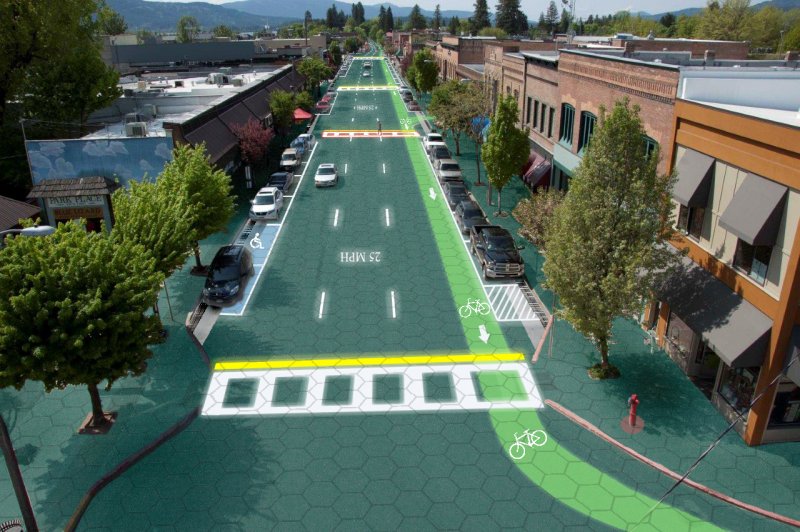
Solar Panels as Roads??

Solar Roadways

Solar panels that you can drive, park, and walk on. They melt snow and... cut greenhouse gases by 75-percent?!!!


Artist's rendition of Sandpoint, Idaho - Home of Solar Roadways
Graphic designed by Sam Cornett                                                 Thanks Sam!


Solar Roadways is a modular paving system of solar panels that can withstand the heaviest of trucks (250,000 pounds). These Solar Road Panels can be installed on roads, parking lots, driveways, sidewalks, bike paths, playgrounds... literally any surface under the sun. They pay for themselves primarily through the generation of electricity, which can power homes and businesses connected via driveways and parking lots. A nationwide system could produce more clean renewable energy than a country uses as a whole.

(http://solarroadways.com/numbers.shtml). They have many other features as well, including: heating elements to stay snow/ice free, LEDs to make road lines and signage, and attached Cable Corridor to store and treat stormwater and provide a "home" for power and data cables. EVs will be able to charge with energy from the sun (instead of fossil fuels) from parking lots and driveways and after a roadway system is in place, mutual induction technology will allow for charging while driving. 

Did you know: 

  • Solar Roadways has received two phases of funding from the U.S. Federal Highway Administration for research and development of a paving system that will pay for itself over its lifespan. We are about to wrap up our Phase II contract (to build a prototype parking lot) and now need to raise funding for production. 

  • Our glass surface has been tested for traction, load testing, and impact resistance testing in civil engineering laboratories around the country, and exceeded all requirements.
  • Solar Roadways is a modular system that will modernize our aging infrastructure with an intelligent system that can become the new Smart Grid. We won the Community Award of $50,000 by getting the most votes in GE's Ecomagination Challenge for "Powering the Grid" in 2010. We had the most votes again in their 2011 Ecomagination Challenge for "Powering the Home".
  • On August 21, 2013, Solar Roadways was selected by their peers as a Finalist in the World Technology Award For Energy, presented in association with TIME, Fortune, CNN, and Science.
  • Solar Roadways was chosen by Google to be one of their Moonshots in May of 2013. 
  • Solar Roadways was chosen as a finalist in the IEEE Ace Awards in 2009 and 2010.
  • Solar Roadways has given presentations around the country including: TEDx Sacramento, Google's Solve for X at Google's NYC Headquarters, NASA, Keynote Speaker for the International Parking Institute's Conference and much more...
  • Solar Roadways is tackling more than solar energy: The FHWA tasked us with addressing  the problem of stormwater. Currently, over 50% of the pollution in U.S. waterways comes from stormwater. We have created a section in our Cable Corridors for storing, treating, and moving stormwater.
  • The implementation of our concept on a grand scale could  create thousands of jobs in the U.S. and around the world. It could allow us all the ability to manufacture our way out of our current economic crisis.
---------------------

This seems like a great idea, as long as costs are reasonable.  A bit like the use of wastewater ponds to install floating solar panels, covered in another recent post.  


Friday, February 14, 2014

World's Largest Solar Power Station Officially Open

Solar power is taking some big steps with the official opening of the 400MW solar power station in the Mojave Desert in the USA.

Read more on the media reports here - http://www.environmental-expert.com//news/huge-thermal-plant-opens-as-solar-industry-grows-412652?utm_source=News_Energy_13022014&utm_medium=email&utm_campaign=newsletter&utm_content=feattextlink

While operating for a few months already, this week was the formal opening.

There are  hundreds of thousands of mirrors into the largest solar power plant of its type in the world, a milestone for a growing industry that is testing the balance between wilderness conservation and the pursuit of green energy across the West.

The Ivanpah Solar Electric Generating System, sprawling across roughly 5 square miles of federal land near the California-Nevada border, formally opened Thursday after years of regulatory and legal tangles ranging from relocating protected tortoises to assessing the impact on Mojave milkweed and other plants.

The $2.2 billion complex of three generating units, owned by NRG Energy Inc., Google Inc. and BrightSource Energy, can produce nearly 400 megawatts - enough power for 140,000 homes. It began making electricity last year.

More large systems are now under development, and these newer ones, along with other large systems around the world will begin to allow a decent system evaluation as they feed electricity into large grids for domestic and industrial use.

Ivanpah Solar Power station


A portent of future energy systems or just a curiosity?

Some authors believe it will take 50 years to switch over, and away from fossil fuels.  These large systems may just show the way.

Friday, August 02, 2013

Renewable Energy, The Philippines and Microgrids

The Philippines government has recently announced they want to convert to renewable power sources over a 10 year period, and be 100% using renewables.

There is some scepticism over the plan, and a recent article seems to be not very positive.
http://www.energynewspremium.net/storyview.asp?storyID=801570666&section=Asia+Watch&sectionsource=s1384047
 
However, the author does not factor in the potential for all renewables in the Philippines - solar, wind, biomass gasification and pyrolysis and ........geothermal.  This latter source could provide baseload power.  Geothermal power is widely used in NZ, and with the Philippines on the Pacific Rim of fire - it is conceivable that it could be a valuable energy source, supplemented by other forms of renewable energy.  It is also a country of islands - where smaller localised supply sources are more useful than large mega energy plants.  The island of Palawan has already commenced some widespread use of renewable energy.

The other concept that might be valuable is the idea of microgrids.  Cuba has moved to use microgrid power, and by so doing has virtually eliminated power outages that were common with the older centralised power generation system.  More on microgrids and the Cuba experience here - http://blog.rmi.org/blog_2013_07_23_microgrids_and_municipalization and here -
http://blog.rmi.org/blog_2013_07_29_learning_from_the_cell_phone_phenomenon  There is also discussion on local sources and community management of demand, especially critical at times with PV sources. See more here  - http://blog.rmi.org/blog_2013_07_31_debunking_renewables_disinformation_campaign


While renewable energy usually gets bad publicity over intermittent production, there are techniques to fix that issue, even without using sophisticated storage, although that approach has a lot of adherents, including the commercial companies developing these systems.  They must be doing it right as a system with molten salt storage has been installed at a large mine in South America.

The move by the Philippines is a bold one.  Could it be a model for others - including Australia?

Saturday, July 13, 2013

Could the NT Develop Industrial Solar Energy Systems on Warehouse Roofs?

Don’t think it’s possible to provide clean and renewable energy that creates jobs and fuels private investment? Think again and then check out CLEAN LA Solar.

A program developed and supported by the Los Angeles Business Council, a coalition of environmental, business, health and research organizations, and the CLEAN LA Coalition, it’s the largest urban rooftop solar program in the nation. Its five-year goal is to power more than 34,000 homes while creating some 4,500 construction, installation, design engineering, maintenance and administrative jobs in Los Angeles.

CLEAN LA Solar allows businesses and commercial property-owners to generate energy for the city’s power grid through rooftop solar panels, and then sell the power to the Department of Water and Power (DWP). This policy is known as a feed-in-tariff (FiT), and is a great way to promote clean, solar energy.

California has a legislative requirement to generate 33 percent of its energy from renewable sources by 2020. Currently, most of L.A.’s renewable power is generated outside the L.A. basin and transmitted inefficiently to customers. By contrast, the CLEAN LA Solar program will provide incentives for clean-energy production within city limits. The result will be more efficient power delivery and a reduction in the city’s reliance on polluting, coal-fired power plants. The FiT also does not require new or upgraded transmission lines.

The goal is to generate 150 megawatts of solar electricity, or enough power for 30,000 homes. The business council hopes to attract investments totaling about $500 million from a group of companies that want to invest in the city’s push to go green. The program’s first project site is an 80-unit apartment building in North Hollywood that went online with 336 250-watt panels (for 84 kW of installed capacity) on June 26.

Solar Provider Group, the international solar firm behind the North Hollywood solar installation, moved its U.S. headquarters to a new office in downtown Los Angeles and is hiring employees. Over the next 18 months, SPG will hire up to 50 additional Los Angeles-based employees in sales, engineering, manufacturing and construction. The company plans to invest up to $50 million in the city by the end of 2016, over the course of the 100 MW program. SPG is also evaluating additional investments elsewhere in California and throughout the U.S.

While the CLEAN LA Solar program gets rolling, a rooftop solar provider is looking at a way to allow customers to be independent from utilities by generating their own power, according to an LA Times article.

Lyndon Rive, chief executive of San Mateo, Calif.-based SolarCity Corp., said in an interview with the paper that his rooftop solar company plans to roll out a system that would allow customers to generate power by solar panels during daylight hours and store the energy in battery packs at night.
These are not academic exercises or something on the drawing board that could happen on a large scale someday. It’s happening right now—a model for all urban areas to note.

 
from http://www.triplepundit.com/2013/07/los-angeles-all-rooftop-solar-panels/
----------------

There are some innovative steps being taken in some overseas locations to really try and move solar power into more mainstream options, as seen by this initiative.  As the costs fall, it definitely makes more sense to consider solar as a sensible option.

For the NT there are a lot of empty roof tops in the industrial areas of Darwin and nearby areas, above businesses that predominantly use electricity during sunshine hours.

It seems a no brainer that there must be development potential there, and it allows small increments of additional energy capacity at modest cost rather than having to opt for large chunks of energy increase at a time, which is how normal utility systems are developed.

Is it financing know how  that is restricting development and would better financing models offer better solutions?  Not my field........but it sure seems odd the NT is not doing more.

Yes, there are some issues with efficiency in crystalline panels in hot weather, of which we have plenty, but alternates are getting better and cheaper all the time.

Is it time for the NT too?? 

Thursday, June 07, 2012

Renewable Energy IS Getting Cheaper

A series of reports published on 6 June 2012 by the International Renewable Energy Association  [IRENA] [See www.irena.org ] shows some detailed figures in the publications about the costs of renewable energy form various sources, and the expected costs over the next few years.

Solar energy in various formats seems to be trending strongly lower in costs, while hydro power is already about the lowest cost around for renewable energy.

Cost of solar has reached very attractive costs for domestic use in a number of countries, with Germany among the lowest cost countries.

The reports are free and easily downloadable from their web site, and provide a fairly non partisan view of renewable energy costs in various forms, covering a rang eof solar types, hydropower, wind energy, biomass and similar.  It is interesting to note that biomass can be an attractive option cost wise in areas where residuals exist and can be converted to energy.  The reports are separate for the various energy forms.


Thursday, September 29, 2011

Should Australia Be Selling the Farm??

Not according to a leading American resources analyst, anyway. And many Australians probably agree.

Leading American investment analyst James Dines has criticised Australia for allowing China to buy large swathes of its natural resources in what he calls "resource imperialism".

Australia was in danger of squandering its "irreplaceable inheritance ... traded for easily printed paper", Mr Dines said.

Mr Dines, the keynote speaker this week at the RIU Victorian Resources Roundup conference, told an audience of mining executives, brokers and investors that the end of capitalism as we knew it had arrived and that we were in the second great economic depression.

His entertaining, if alarming, speech would have prompted mixed feelings among a crowd that included executives with a strong Chinese presence on their share registries.

State-owned Chinese companies are also becoming a major foreign investor in Australia.

Mr Dines, editor of the Dines Letter and author of numerous books, described natural resources, including farmland, as a source of real wealth that should be kept for "your descendants".

By pursuing resource imperialism, China was building stockpiles of commodities well above its immediate needs, such as rare earths - it already produces 97 per cent of the world total - and copper.

The Australian Foreign Investment Review Board blocked a $252 million bid by state-owned China Nonferrous Metal Mining to acquire Australian rare earth miner Lynas in 2009.

So, what is motivating China?

The world's most populous country wants to secure its resource needs for centuries to come.

More in the article here -
http://au.news.yahoo.com/thewest/business/a/-/national/10369499/australia-shouldnt-sell-farm-analyst/

And it is not only Australia.......China [mostly through state owned enterprises - and that is the nub of concerns] is much more active in many less developed countries, especially in Africa and South America, even Afghanistan which seems to have some large mineral deposits that are largely unexplored, and which the Chinese are eyeing off.

Some say they have stuffed their own land for agriculture and horticulture with poor farming practices and pollution and they need to find other soils........to do the same???

Definitely resources imperialism!

Friday, July 22, 2011

Climate Change - Are Renewables Going to Make a Difference


The Dane, Bjorn Lomborg is a well known, and respected climate sceptic.......or he was. I recall reading that he was now accepting of climate change, but the following article does call into question the economic pathways most suitable to achieve a lot' with using renewable energy. Especially the economic policies used to achieve take up of the concepts.


He seriously questions the role that renewable energy systems can play in reducing fossil fuel use, and ultimately carbon emissions. Particularly the economic costs of using renewable energy such as wind and solar. Many others might agree directly with this view, and others strongly support the same general view by suggesting that carbon capture and storage must be made to function, as coal will need to play a role in stationary energy production, including electricity, for many years yet.


Here in Australia, a monster user and producer of coal, there has been a degree of support for the develpment of the zero emissions stationary energy plans developed over the past several years and formalised in a document available here -http://beyondzeroemissions.org/zero-carbon-australia-2020


I would agree they do seem economically and conceptually feasible, but significant changes must be implemented in regard to distribution networks for example. And more investment is now going into that area, but not necessarily to meet this concept plan. Lack of vision is a serious impediment to implementation of this concept. Spain has been investing in base load solar systems successfully, as shown in the photo.


Many would argue that nuclear energy will be needed around the world to meent energy needs. And that is low carbon emissions. Recent events eg Fukishima in Japan, will affect ideas on that too.


The Chinese are moving to develop thorium nuclear reactors. They have several notable features that could lead to wider interest. They do not generally have self sustaining fission- ie need some nuclear fuel to keep them going, and they produce very modest radioactive level and relatively short half life waste products [a strong point]. Curiously, Australia has a lot of thorium resources, and even more curiously it can occur with rare earth minerals and Chinese are investing in some of the mines with rare earth/ thorium resources too. Is this coincidence??


Friday, July 08, 2011

Renewable Energy Gets a Boost in Australia

Announced today, Australia is to get a new major renewable energy entity. The Australian Renewable Energy Authority, ARENA. See the major news channels for more details.

see here - http://www.abc.net.au/news/stories/2011/07/08/3264589.htm

There has also been some very interesting comments on the whole approach, by experienced commentators.

see here - http://www.abc.net.au/unleashed/2787108.html
and here - http://www.electronicsnews.com.au/news/engineer-s-perspective--what-limits-distributed-re?utm_source=20110708&utm_medium=email&utm_campaign=newsletters

These are very early days, but with a carbon price set to be announced in a few days, maybe the wheel is turning a few more cogs.

There are a lot of renewable energy technologies - going far past the wind and solar thinking, to wave and tidal power, into algal biomass for fuels, weed and waste plant biomass for energy, anaerobic digestion, composting and many more.

Watch the performance of the new ARENA with interest. It has a clear mandate - renewable energy.

Thursday, May 26, 2011

Using Carbon Dioxide for Algal Biofuels

It seems that Australia is about to move forward several steps in developing commercial use of waste carbon dioxide.

Origin Energy has announced a new medium scale [a prelude to larger scale use if successful] waste CO2 from its power plant to produce fresh water algae, which it then plans to harvest for potential biofuel production.

More here - http://news.cnet.com/8301-11128_3-20065708-54.html?tag=nl.e797

[ interestingly - reported in US not Australian media]

At about the same time, a leading US saltwater algal producer has announced a scaling up of existing work in the Pilbara region of WA, which uses CO2 from LNG processing as the accelerator of algal growth.

More here -http://au.news.yahoo.com/thewest/business/a/-/wa/9328127/algae-fuel-to-diversify-pilbara/

Both are in regions of Australia with plenty of sunshine, especially in the Pilbara.

Coincidentally, the aviation industry announced this week that they saw biofuel as a suitable fuel, with lowered CO2 emissions overall, as a substitute for existing fossil oil fuels.

Australia does have open spaces and sunshine, but so far a timid set of national and state governments, that seem reluctant to embrace non fossil fuels, although industry does seem more active to use them.

There is a major program in the private sector with wide support across industry and academia to develop base load solar thermal power stations, but so far without major support from government. More details are here -
http://beyondzeroemissions.org/blog/zero-carbon-australia-stationary-energy-plan-nsw-elements-110307

And there is a very comprehensive range of documents that do seem to provide evidence and analysis that would support the plan.

Could Australia prosper on waste carbon............after all, we are the highest per head producer of carbon???

Wednesday, May 18, 2011

Solar Panels with 90% Efficiency - Maybe!

It could be 5 -10 years away for commercial use, but with conversion efficiency of 90% it does sound impressive.

A new concept, so far restricted to lab scale, that could supplant traditional photovoltaics has been announced. The present photovoltaic systems commonly have efficiencies of around 20% and lower in warm climates.

Some fuel oxide fuel cells have around 85% efficiency of energy conversion, which is very high, but they rely on gas as a fuel source [ see www.cfcl.com.au - BluGen systems]. An efficiency of 90% would be stunning for a solar cell.

Read more below.
-------------------------------

AN associate professor in the University of Missouri (MU) Chemical Engineering Department is developing a flexible solar sheet with more than 90 percent efficiency.

If the technology comes good, it could revolutionise the solar energy industry, which is currently at around 20 percent efficiency with production-level photovoltaics. Scientists working in laboratories have thus far managed up to 25 percent efficiency.

According to Patrick Pinhero, the new technology does not utilise the traditional photovoltaic methods of solar collection, due to its inefficiency and failure to capture much of the available solar electromagnetic spectrum.

The device is a thin, mouldable sheet of small antennas called nantenna. These nantenna are currently used to harvest the heat from industrial processes in an energy harvesting application. Pinhero hopes to extend the concept to a direct solar-facing nantenna device which can collect solar irradiation in the near infrared and optical regions of the solar spectrum.

Working with his former team at the Idaho National Laboratory and Garrett Moddel, an electrical engineering professor at the University of Colorado, Pinhero and his team have now developed a way to extract electricity from the collected heat and sunlight using special high-speed electrical circuitry. The team also partnered with Dennis Slafer of MicroContinuum to port the laboratory bench-scale technologies into manufacturable devices that can be inexpensively mass-produced.

The team believes it will have inexpensive prototypes for consumers within five years. As part of a rollout plan, the team is securing funding from the U.S. Department of Energy and private investors.

The second phase features an energy-harvesting device for existing industrial infrastructure, including heat-process factories and solar farms.

Thursday, March 31, 2011

Cheap Distributed Energy for Rural Development

In India, Tata, one of the industrial giants of the country is working through concepts to invest in cheap distributed power supply in rural areas.

The company believes there is a market.......if not today, then soon. And they are positioning themselves to be part of it.


Sure, one thinks of solar powered telephone towers, remembering that the entire microwave repeater system across the north of Australia was run on solar power, and that was 25 years ago. So that is not new.


There are other options too, including local use of biomass produced for fuel such as palm oil, or other crop oils used in small diesel motors to run local cottage industry or produce modest amounts of electricity.


Tata is doing this big time though.


Does their model also offer some hope for many other rural and remote regions across Asia and Africa especially?


Read more here:


http://news.cnet.com/8301-11128_3-20047974-54.html?tag=mncol;mlt_related

Tuesday, March 01, 2011

Clean Technology in Mexico - A Lesson for Australia?

To many Australians, Mexico is not on the business horizon. It might be a fun location to visit......but not for business.

That is a little different in livestock production where there has been a reasonably strong connection between the tropical livestock and pastoral industries for some time. Can Mexico offer some ideas for clean technology devlopment that might be relevant in Australia? They do have a large adjacent market in the US, although some would argue that Australia does have a similar market......the countries of Asia.

Mexico may have a few ideas to also show Australia in relation to development of major initiatives in clean energy including geothermal sources, at least in shallow source areas. Some might counter this and say, so does New Zealand in geothermal sources, with both using hot rocks and steam associated with vulcanism, not a situation seen readily in Australia though.

Mexico has also been ramping up PV use.

http://blog.cleantechies.com/2011/02/28/highlights-cleantech-mexico/

is a recent rticle highlighting developments in clean tech in Mexico.

Could some of this be relevant for Australia?