How much food does your household waste that is prepared and not consumed? How much do you buy and then throw out without using each week? How much is prepared and wasted in restaurants and food halls?
These are serious issues relating to world food availability.
To add to this issue much of this dumped food around the world is then deposited in landfills, to produce methane gas and add to global warming. Relatively modest volumes go into composting or anaerobic digestion and similar options that can allow recycling of the organic residuals and save the mineral components for reuse, in further horticulture and agriculture.
I do not subscribe to the view that organic agriculture will feed the world.........but the addition of carbon to soil via waste recycled organics is a real benefit to all agriculture.
Read the article and media release.
Stop wasting food and ask your local government services to improve their performance.
In Australia a big change is occurring now, and will accelerate under a new carbon emissions scheme. Curiously, waste is included, agriculture and horticulture are not. And we will pay significantly for waste in the carbon emissions scheme.
There are many options available to do better, but often the major supermarkets are not trying too hard. Some are investigating the use of small in-vessel composting systems [ http://www.esplimited.co.nz/], some others are using a Biobin [ see http://www.biobin.net/]. We see the latter as a very useful simple to deply option for many food handling sites, and strongly advocate the former for larger sites such as hotels and resorts. In Australia the coming CPRS will help drive this rethink of practices as waste is included from the beginning.
-----------------------------------------------------
UN calls for food waste revolution
Report calls for global crackdown on food waste and expansion of organic farming to help tackle impending shortages
The world could easily feed its growing population if farmers, businesses and government's simply stepped up efforts to curtail food waste, according to a major new study from the United Nations Environment Programme (UNEP).
The report, which was published at last week's meeting of the UNEP Governing Council in Nairobi, Kenya, warned that without "a green revolution" across the food industry the combination of population growth and climate change will lead to severe food shortages over the coming decades that could see food prices climb by between 30 and 50 per cent.
"We need a Green revolution in a Green Economy but one with a capital G", said UN Under-Secretary-General and UNEP Executive Director Achim Steiner. "We need to deal with not only the way the world produces food but the way it is distributed, sold and consumed, and we need a revolution that can boost yields by working with rather than against nature."
The report, entitled The Environmental Food crises: Environment's role in averting future food crises, calls on food producers, businesses and governments to prioritise efforts to cut food waste as the most effective means of addressing future shortages.
It found that up to 50 per cent of food produced in the US is wasted, while a third of food purchased in the UK is never eaten. Meanwhile, food losses in developing world are similarly high with an estimated 20 to 40 per cent of potential harvests lost as a result of pests and pathogens.
Moreover, 30m tonnes of fish are reportedly discarded at sea each year – enough to sustain a 50 per cent increase in fish farming and aquaculture production, which the UNEP calculates is needed to maintain per capita fish consumption at current levels by 2050 without increasing pressure on an already stressed marine environment.
"Over half of the food produced today is either lost, wasted or discarded as a result of inefficiency in the human-managed food chain," said Steiner. "There is evidence within the report that the world could feed the entire projected population growth alone by becoming more efficient while also ensuring the survival of wild animals, birds and fish on this planet." The report calls for increased investment in agricultural R&D to help reduce waste during the production process, as well as increased efforts from government's to cut consumer food waste.
In addition, to targeting food waste the report calls for an end to agricultural subsidies, curtailing of the practice of using cereals to feed livestock, increased investment in developing second generation biofuels that do not impact on food supplies and improved water management regimes in drought affected areas.
It also calls for wider adoption of organic farming methods, citing a recent report by UNEP and the UN Conference on Trade and Development which studied 114 small-scale farms in 24 African countries and found that yields more than doubled where organic or near organic techniques were used.
"Simply ratcheting up the fertilizer and pesticide-led production methods of the 20th Century is unlikely to address the challenge", says Achim Steiner. "It will increasingly undermine the critical natural inputs and nature-based services for agriculture such as healthy and productive soils, the water and nutrient recycling of forests, and pollinators such as bees and bats."
The report warned that unless its recommendations are adopted up to 25 per cent of the world's food production could be lost by 2050 as a result of " environmental breakdown". For example, it said that the retreat of Himalayan glaciers as a result of climate change could put nearly half of Asia's cereal production at risk, while global water shortages could cut crop yields by 20 per cent.
In related news, UNEP released a second report which found that 40 per cent of civil wars fought since 1990 were a direct result of natural resource shortages, a situation that is likely to worsen as climate change accelerates. It warned that conflicts with a link to natural resources were twice as likely to relapse within five years as conflicts fought for other reasons, and called on the UN to take environmental and resource issues more seriously in its post-conflict planning.
This is very serious stuff ............but is anyone really listening?
The current economic woes around the world really mean all should be reducing wasted food, as a simple economic measure.
But are we?
[partially sourced from Business Green by James Murray 23 Feb 2009]
Thursday, February 26, 2009


Wednesday, February 18, 2009
Tipperary Station Has New Owners
Tipperary Station is one of the iconic large pastoral properties in the Northern Territory, and along with adjacent sister properties Elizabeth Downs and Litchfield [ all operated essentially as a single entity] is well developed and capable of running around 80ooo head of cattle.
The property is about 150km south of Darwin in a seasonally wet dry monsoon area with rainfall of about 1200 - 1500mm across the property, with more near the western coastline. It also has virtually all year round access to the main developed areas closer to the Stuart Highway.
Tieerary was the first of the large properties to be cleared in the late 1960s with over 30oooha cleared for cultivation. Sorghum and other crops have been grown over the years but it is true to say that overall, grain production was not successful on that scale. Some smaller areas have been used for grain and other cultivation since then, and some areas have enormous potential for continued use including irrigation of higher value crops, for example peanuts. Maybe even cotton too.
The buyer is Australia's largest cattle operation......Australian Agricultural Company or AACo, and the seller is Melbourne barrister Alan Myers.

The $105 million purchase of the famed Tipperary Station and Litchfield, as well as 60,000 cattle, will be funded by the sale of three of AACo's properties in Queensland - Clonagh, Kalmeta and Gregory Downs, which together cover 481,000 hectares and come with 62,000 cattle, ands are being sold for $152m.
The complex deal also includes the purchase of 19.9pc of AACo for $90m by Mr Myers, as part of Futuris Corporation’s sale of its 43pc stake in AACo. Futuris, parent company of Elders, will offer its remaining 23pc to the market.
"We have been looking at a number of options for disposal of our stake in AACo as we move Futuris away from passive investments to be fully focussed on being an owner/operator of core businesses in which we have demonstrable skill and market advantage and which match our cash operating earnings objectives," Futuris chief executive Malcolm Jackman said. "In that regard, the sale of a substantial part of our holding in AACo to a committed pastoral investor is an excellent fit with all stakeholders' interests." Futuris also is the principal owner of Elders, the major Australian pastoral supply business.
AACo CEO Stephen Toms said the company, by purchasing Tipperary and Litchfield, was acquiring a valuable and unique aggregation in the Northern Territory with unlimited tenure, excellent access to the Port of Darwin, reliable high rainfall patterns and a substantial infrastructure base.
"We have been conducting due diligence on the aggregation, off and on, over the past two years," Mr Toms said. "The likely trend, over the short to medium term, in consumer sentiment to beef will be toward lower cost products. "AACo needs to respond to that and stratify its sales and production programs for the changing market. "Accordingly the business will adapt its flexible pathway system to be weighted toward less costly grass fed production."
This is an interesting development with an obvious trend seen by a very large operator back towards grass grown and presumably grass finished cattle. The export livestock business is thriving in nortern Australia, with expected numbers exported likely to increase from 600000 head a year in 2008 to over 1.2 million by 2012, according to industry projections. Most go to Indonesia, a short 7-10 day journey, with very very little in the way of transport problems.
It also opens speculation about future development on Tipperary, particularly in relation to cropping and related enterprises including hay production and even expansion of better quality pastures. Other adjacent properties have also been sold to agroforestry companies, so that enterprise would also be an option. And interestingly, the NT government is moving to allow some tenative further clearing in the Daly Basin for agriculture and property development.
The other significant isuse is - if AACo are expanding and want grass fed cattle, presumably for the domestic market too, what will be the situation in relation to an abbattoir locally or will they ship cattle out for slaughter to southern states?
Thursday, February 12, 2009
Are Plastic Bags Important in Waste Management Policy?
Plastic bags and their management have become a symbolic issue in Australian waste management. In doing so, waste management has largely become irrelevant, for it has meant that the large issues are being ignored. We all love to hate industry, those making a living from our waste, but in reality they perform a public good function. Some even argue they could do much better, if allowed to do so.
In northern and north west Australia we have tended to ignore waste issues. Afterall, plenty of space and relatively few people, so waste issues are of modest interest, except in relation to a kerfuffle over nuclear waste, where those emptier spaces around Australia could serve a useful role. And yes, plastic bags are noticeable here too........but that is largely a litter issue, not a major waste problem.
But waste issues are of pressing importance in relation to the coming changes over carbon management. Superior organics management could yield improved outcomes in carbon emissions and capture, while potentially improving agriculture [ see any of the posts on carbon management on this site], and of even greater relevance in a time of reduced jobs.......better waste management could create many new jobs, and these would be permanent ones too. Technology to do this is available right now.
The following article provides a decent overview of some of these issues. Are we focussing on an irrelevant issue in trying to ban plastic bags? I would agree with the author.
---------------------------
Increasingly, the humble plastic bag is being highlighted as “public evil number one” when it comes to waste and the environment. It seems all levels of government have got the demise of plastic bags firmly in their sights. Never was so much effort and political capital spent on such a marginal issue.
Don’t get me wrong – reducing plastic bags as part of a litter management scheme is an important place to start but from a waste management point of view it is symbolic at best. Plastic bags represent just one thousandth of the waste stream or 0.1%. 20,000 tonnes out of a landfill waste stream of 20 million tonnes.
Resource recycling and greenhouse gas emissions must be the waste policy priorities as we move into an era of climate change and a carbon constrained economy.
There is an enormous opportunity for the Australian recycling and waste sector to lead positively from the front on issues of emissions reductions and climate change. A study by Warnken ISE points to the potential to deliver nearly 35 million tonnes of greenhouse gas abatement through innovative resource recovery, organics processing and improved landfill gas capture practices. That adds up to a reduction of nearly 7 percent in Australia’s total greenhouse gas emissions – equal to taking all cars off Australian roads.
Doing so would see investment of around $4 billion in new infrastructure and the creation of 4000 new jobs.
Waste is one of those sectors where there is an alignment of Government policy on climate change and business opportunities for growth and diversification. I’m not advocating we ignore plastic bags but can we also focus on the big issues?
Gas capture from landfills
When organic waste, mainly wood, garden waste and food is disposed to landfill, it generates methane which is a significant greenhouse gas. While on the positive side it is estimated that 70% of household waste is disposed into landfills with gas capture systems, capture inefficiencies taken with the 30% of landfills without capture and importantly the massive amounts of organics sent to Commercial and Inert landfills, amount to a landfill emission profile of 15 million tonnes CO2e/year.
Landfills will always have a role to play in an integrated waste framework so it is important that we get the landfill platform operating with the lowest carbon footprint possible.
The Carbon Pollution Reduction Scheme will go some way to address this by putting a cost on methane emissions from landfill. For the first few years of the scheme the price is likely to be $25-40 /tCO2e. That could see landfill gate prices rise by anywhere from $10-$50 /t of waste across the weighbridge depending on whether the landfill has a gas capture system and the organic loading of the waste.
At a particular carbon pollution price, landfill operators will install new and improved gas capture systems.
Alternatives for organics treatment
At a particular carbon pollution price (taken with rises in landfill levies), waste generators will seek out alternatives to landfill and those alternatives become commercially viable. The main treatment options for organics are “clean stream composting” and “residual processing” through an Advanced Waste Treatment (AWT) plant.
Clean stream composting is widely practiced in Australia and growth in carbon costs (taken with the potential for some form of carbon storage benefit) will see this sector flourish. In 2008 there were 12 “residual processing” AWT plants either operating or under construction across Australia, up from 1 in 1994. AWT has been taken up for different reasons in different states – sometimes government policy and targets driven through regional waste boards (e.g. Perth), sometimes price signals via landfill levies (e.g. Sydney) and sometimes local Councils have taken the lead (and the cost burden) (e.g. Cairns, Port Macquarie, Port Stephens).
More than 30% of Sydney Councils are now using AWT to process their waste. Tenders for the processing of residual/organic waste are expected for another 40% in 2009. By mid 2009 with two new plants coming on stream, NSW will have one of the highest concentrations of AWT’s per head of population in the world, with 7 AWT’s between Coffs Harbour and Campbelltown (3 anaerobic digesters and 4 MBT composters).
Perth is similarly fast tracking towards low emission and high resource recovery options with 4 AWT’s operating or being constructed. Adelaide has Australia’s premier timber treatment technology turning a greenhouse gas liability in landfill, into an alternative fuel source with outstanding greenhouse gas benefits. Melbourne has signaled its intention to start aggressively down the path of 12 new AWT and organics processing facilities.
Resource recovery
The third key action is to rapidly ramp up resource recovery and recycling. Australia recycles only 48% of the total waste stream. Recovering the embodied energy in recycled materials reduces energy consumption in other manufacturing sectors of the economy. But this benefit is given limited recognition by governments.
There is a desperate need for improved infrastructure and programs to support commercial and industrial, construction and residential recycling.
Getting Australia’s recycling rate up toward 70 or 80% will deliver massive greenhouse gas benefits, as well as generally lower costs of production to manufacturers. It will also generate huge numbers of jobs.
If a company was closing up shop today and taking 4000 jobs with it, it would be front page news. But the waste sector can create 4000 new jobs with significant environmental and economic benefits, and at very low cost.
What is required is a change of perspective on the role of waste within a carbon constrained economy. We need to move past old images of the waste sector as garbos in trucks and dumping at the local tip, toward a view of waste as an integrated part of resource reuse in the economy.
Toward an understanding of the role recycling, resource recovery and waste management can have in helping to solve Australia’s (and the world’s) climate change problems.
These are the key issues from a waste policy perspective.
The campaigns for politicians to ban plastic bags are understandable given that plastic bags are such a visible waste stream, but from a strategic waste perspective, a ban on plastic bags is symbolic at best and distracting at worst.
written by Mike Ritchie, President NSW Branch of the Waste Management Association of Australia and General Manager, Marketing & Communications, SITA Environmental Solutions.
----------------------
While these views may be quite in your face and definitely confronting.........they are logical and deserve more thought from the NT and Darwin City politicians.
One of our major issues in the NT is construction and demolition waste, and most goes straight to landfill. Other jurisdictions have made major attempts to reduce and manage that material, but not here. A simple one would be to use all the waste gyprock/ dry wall in the compost. Grind it and add to the green waste, and there is a lot of dry wall wasted!
And in Darwin the MRF avoids many useful grades of plastic - they are banned from recycling, yet are widely reused in many types of new plastic products, even as co-mingled materials.
Can the NT do better than it is now?
Friday, February 06, 2009
Compadre Zoysia - First in the Park Too
In late December The Darwin City Council committed to the establishment of a modest sized park in the Stuart Park area of Darwin with Compadre Zoysia. While the park in Duke street had been talked about for sowing earlier in the year, seed was not available until December to actually sow the area. This late sowing had some issues to be concerned about as it was very close to the monsoon period, and the potential for a major wash out from heavy rain.

The grassed areas of the park were sown just prior to Christmas, 2008, using hydroseeding, with Gimbell's, a locally based experienced contractor from Darwin doing the job. The hydroseeding included a normal mix of shredded paper and tackifiers, along with Compadre seed at recommended rates. A very even cover of hydroseed material was achieved, and germination was quite prompt, with seedlings seen after about seven days, and a good green tinge in about 10-12 days.
The hydroseeding provided some help in preventing erosion and wash outs in a parkland area with a slight slope, although a small area was adversely affected. Some rectification of that was achieved using a compost berm above the area, slowing water flow across the slope, and most of the area now has grass seedlings. Compost berms are excellent in achieving water flow reductions in tropical areas where most of the rain comes from heavy episodic storms that can dump a large volume in a short period. They are not used as regularly as they could be in this region......so that in itself is a big plus.
Germination and emergence continued with regular application of small amounts of additional water by the irrigation system to ensure the surface remained moist in the critical first 3-4 weeks, even though there was regular rain, but not necessarily every day. Some weed control was also carried out by hand to pull small grass weeds, by the parks staff of the Darwin City Council. These weeds were relatively few, but it important to ensure the zoysia seedlings are not swamped by grass weeds in its early stage.
Adequate fertiliser was applied in the first two weeks, and some additional slow release turf fertiliser will be applied to ensure there is adequate nutrition in the establishment phase.
Now, at about seven weeks from sowing the area looks very good. There is a very small wash area, identified above, but considering the heavy and prolonged rainfall over the past seven weeks, the area is in terrific condition after this time. Seedlings are just showing signs of lateral growth and the area would be expected to now develop a strong lateral network and thoroughly bind the topsoil. Thickening of the stand will develop over the next 7-8 weeks, with complete cover probably by about 16 weeks.
This has been a well executed project and shows the potential for Compadre zoysia in urban parks across north Australia, and consolidates the concept of using this variety. Many parks are designed to have shrubs and trees and ultimately, shade. Common options such as couch and even bahia grass, do not tolerate shade well, whereas zoysia will tolerate 50% shade, maybe even more if the turf area is not excessively used. It is also capable of remaining as a good turf surface with reduced irrigation amounts and lower nutrition, particularly in comparison to couch. That ultimately saves local councils quite a lot of money.
So far, so good with this evaluation project. It augers well for the variety. And congratulations to those involved from the Darwin City Council and Gimbells for a job well done.
For more information on Compadre zoysia.............
contact Above Capricorn Technologies office@abovecapricorn.com.au or read more on this blog, or look at other photos.


These two photos show the sown area after about two weeks with an obvious green seedling tinge, and the compost berm used for erosion protection
 < Seedling density at 7 weeks
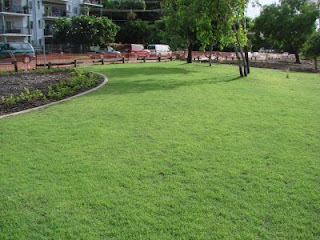
Green parkland appearance at 7 weeks>
It is developing very well, and should be really great in another 7-8 weeks.
Friday, January 23, 2009
Compadre Zoysia - NOW AVAILABLE as SOD in NORTHEN AUSTRALIA
Great news...........our single grower of Zoysia Compadre turf now has a modest amount of quality turf sod available.
The project to develop a viable area of Compadre sod for turf sales has taken longer than expected, after a few minor setbacks, and the development of suitable operational techniques. But the area is likely to expand over the next year to meet projected demands, especially in the new construction market, where Compadre zoysia can be a serious competitor to other vegetatively propagated species in the instant turf market, on both quality and price. The aim is superior quality at a better price. That is very achievable. End users do like what they see.
 Seed sowing will remain a major market, especially for larger areas in both construction projects and new dwellings, but turf sod does have a special niche market in some segments of the new home construction market.
And of course, seed remains an option to sow for an expanded quality sod production area.
In this region especially, the shade tolerance of Compadre zoysia is particularly important, as most new house areas quickly develop shrubs and trees. Most other turf options then fade away in the shaded or semi shaded areas, leaving bare soil, whereas Compadre zoysia continues to thrive in modest shade.
Go for it ...........use Compadre zoysia.
It is a great lawn, low maintenance, low [but not nil] fertiliser option that continues to look good. For best results use a slow release turf type fertiliser 2-3 times in the first year at recommended rates then only once or twice a year, and reduce the rates by about 50%, after that. We recommend Multigreen slow release turf fertiliser[ available from Elders], but other brand options are also suitable. Mow at 25 - 35mm. Mowing frequency would normally be about every 2 weeks in the warmer and wetter half year; every 3-4 weeks in the dry season. Weeds are not usually a major problem but if they do appear, we can assist with cost effective solutions.
Remember.......Compadre zoysia will not normally make your skin itchy, as can happen with most paspalums [bahia grasses]. The ideal turf for a quick game of touch footy for shirtless kids!
Thursday, January 22, 2009
Save Water - Saves Energy Too
A recent report by CSIRO and the Water Services Association of Australia (WSAA) gives a clearer picture of water and energy use in Australia and New Zealand and highlights areas offering potentially significant water and energy savings. The report: Energy Use in the provision and consumption of urban water in Australia and New Zealand, shows a strong nexus between water and energy.
“Ensuring a reliable water supply for our cities into the future will require more energy due to increasing populations and the trend to develop new, more energy-intensive water sources like desalination plants, reuse and more distance sources,” CSIRO scientist and project leader Steven Kenway says. “However, the provision of urban water services uses relatively little energy compared to heating water for residential and non-residential purposes. A 15 per cent reduction in residential hot water use could offset all energy used by water utilities in 2006/07. “Saving hot water represents a real win-win-win: it cuts energy and water use for consumers, reduces energy demand for utilities and helps households and utilities save money on energy and water bills.”
Looking forward to 2030, the project team considered three water consumption scenarios ranging from 150 through to 300 litres per person per day for residential water use, based on a population of 15.8 million for Australia’s major cities, which is currently at 12.5 million.
“Under Australia’s current average consumption, which is 217 litres per person per day, total energy use to provide water could increase by up to 130 per cent above 06/07 use, if a mix of desalination, recycling and new surface water sources is used to meet the expected demand,” Mr Kenway says. "Even with this increase, urban water utilities would only account for 0.3 per cent of the total energy used by Australia’s major cities in 2030.”
WSAA Executive Director, Ross Young, says the scenarios reinforce the need for the water industry to continue to implement energy-saving initiatives, but also to plan water resources with a clear understanding of where energy and water savings can be made most effectively. “The urban water industry will continue substantial initiatives already implemented to generate green energy from biogas and hydro-electricity generators and measures to increase energy efficiency. These initiatives have already delivered substantial energy savings in the urban water industry,” Mr Young says.
“This report demonstrates where the ‘low hanging fruit’ may be in terms of reducing energy use and the greenhouse gas footprint of the urban water industry and households.
“Analysis showed that installing a Water Efficiency and Labelling Standard (WELS) 3-star shower rose would cut by 45 per cent both water and hot-water-system energy consumption in households with high water use,” he says. “Replacing an old WELS 2-star washing machine with a 4-star front loading model would cut energy use by more than half and save 10 kilolitres of water annually, assuming 250 washes a year; 50 per cent of washing on cold-wash cycle and 44.5 kWh/year electrical consumption by pumps and motors.”
Copies of the report are available at:
www.clw.csiro.au/publications/waterforahealthycountry/2008/wfhc-urban-water-energy.pdf
---------------
This has clear implications for many areas of Australia. It is NOW that a change to efficient water heating is needed. Solar, heat exchange systems [especially for hotels, industrial use and large buildings] and even gas are relatively efficient. Much of Australia could benefit by using solar water heating.......and even though some token efforts are being made, it is obvious that more effort is needed.
Capital costs are higher, but with short payback periods solar water heating is a desirable option for almost all of Australia. Yet, builders often pick the cheap and nasty option......in low capital cost options that are not a good choice for the user, over even a few years.
Tuesday, January 20, 2009
Could Farming in the Tropics Promote a Killer Disease?
This is the premise being actively promoted in a new study of the disease meliodosis, based on results from the Northern Territory of Australia. Meliodosis is deadly........without active and well managed treatment you die. At least in the NT, there is a good quota of experience with the disease and mortality rates are now around 20%. Still, that is very high.
The disease also occurs in SE Asia in the tropics - Thailand, Laos, Malaysia etc, and is something to be mindful of when involved in agriculture in these areas.
Read the press release.........
Gardening and farming in the Australian tropics creates an environment "ideal" for the spread of a killer bacteria, a scientist has warned. Darwin-based researchers have worked to identify the soil types favoured by the bug Burkholderia pseudomallei, which is now at the centre of an outbreak of a pneumonia-like illness in the NT capital. Ten people have been infected, and two have died, from the illness Melioidosis since the wet season began late last year.
Dr Mirjam Kaestli says the bacteria was thought to favour damp soil and areas where there was standing water, but her research also found it thriving in household lawns and dry paddocks across rural Darwin. "These findings raise concerns that pseudomallei actually might spread due to the influence of our land management changes," says Dr Kaestli, who is a research fellow at the Tropical & Emerging Infectious Diseases Division at the Menzies School of Health Research. "Residential gardening and farming generates conditions which are ideal for the proliferation of these pseudomallei.
"We primarily found the bacteria in irrigated lawn areas like on residential properties ... also soil disturbance caused by livestock animals seem to increase survival chances for pseudomallei in areas otherwise not favourable."
It is thought the constant aeration of paddock soils from hoofs, along with raised acid levels from urine, encourage the growth of the bacteria.
The Royal Darwin Hospital treats up to 40 cases of melioidosis every wet season and, while it has a 20 per cent mortality rate this has halved over the past 15 years because of improved diagnosis and treatment. It is listed as an emerging disease, with cases rising in Thailand, and Dr Kaestli warns there were concerns the number would also increase in Australia.
Melioidosis cases have been detected as far down the eastern seaboard as Brisbane.
"Because we have seen this association with disturbed soil, and because there are more and more developing of previously undisturbed area, I would not be surprised if we are seeing higher numbers in the future," she said. People with type-2 diabetes, chronic lung and renal disease, heavy alcohol consumers or those who use of immunosuppressant drugs are known to carry an increased risk of contracting Melioidosis. Dr Kaestli said people in the tropical areas should take precautions by wearing shoes when working in the garden, washing their hands later with an anti-bacterial and taking extra care to keep cuts dirt free.
Her study is published in the journal PLoS Neglected Tropical Diseases.
Monday, January 19, 2009
Africa Saved by Organic Food - Really??
In the 1970s and 80s, two well renowned CGIAR Centres - IITA and ICRISAT had major programs originally in India and then in Africa to examine crop production. A focus of much of the work was plant establishment and performance in the heavy but erratic rains of the monsoonal and similar tropical areas. Crucial issues to improved performance and crop yield were the use of soil mulches [often legumes] to reduce erosion and lower soil temperatures to mangeable ranges in which seeds could germinate and establish. Mulch also enabled soil moisture to be retained and thus allowed better establishment. Without satisfactory establishment and early growth, crops would fail to perform.
This system was very successful, and similar modified large scale systems have been developed for the tropics in Australia and Brazil, for example. Part of the Australian system involved a ley farming phase in which tropical pastures were used for animal grazing with the leguminous residuals aiding the next crop establishment, in the manner above.
This is not organic farming, although undoubtedly, using organic residuals over time will build soil carbon and enhance soil quality. In Africa, the tropical soils are often nutrient deficient, and yields are restricted by poor plant nutrition. Finding and adding those plant nutrients at low cost is near impossible, except for very small restricted areas - for example home gardens. Yes, it is undoubtedly true that soil mycorhiza can allow release of nutrients from otherwise non available sources, but the amounts are unlikely to be adequate to completely supply enough to grow good crops.
A new media release by the organic lobby in Australia uses a recent UNEP article that espouses the view that organic agriculture will radically improve African agriculture. Organic agriculture to be the saviour of Africa!
I am not so sure, except for those smaller areas. Yes, some of the soil carbon principles are important. BUT........this is not new for the tropics; it is nearly 40 years of old news, written up and published in eminent journals and as layman's reading, and acted on around the world in the tropics.
Read the media release and the link to the UNEP article.
It's Official: Organic farming provides answers to feeding Africa
A major study by the United Nations Environment Programme (UNEP) concludes organic farming offers Africa the best chance of breaking the long inherent cycle of poverty and malnutrition. (1)
Research conducted by UNEP suggests that organic, small-scale farming can deliver the increased yields which were thought to be the preserve of industrial high-tech farming, in addition to reversing environmental and social damages, leading to greater food security.
The head of the UN's Environment Programme, Achim Steiner, says the report "indicates that the potential contribution of organic farming to feeding the world may be far higher than many had supposed."(1)
Dr. Kristen Lyons is a senior lecturer at the School of Biomolecular and Physical Sciences at Griffith University (QLD) and the director of Mukwano Australia, a non-for-profit group supporting the development of health care services in African organic farming communities.
"Organic agriculture offers an alternative - and sustainable - future for African farmers," says Dr. Lyons. She says the report provides a clear direction for reducing the current crisis in agriculture and food systems in developing countries - organic, all the way. "It demystifies the assumption that genetic engineering and other high-tech approaches to farming are required to feed the world.
"In contrast, it is organic farming systems that have demonstrated the greatest potential to feed the world's one billion starving people, and to ensure the long term sustainability of global food production," she says
The UNEP report proposes that African communities need to look to alternative methods of farming as genetic engineering is prohibitively expensive and therefore out of reach for most African farmers. (1)
Organic farming in Africa has lead to benefits to the natural environment, with the UNEP report showing a 93 per cent of case studies reporting benefits to soil fertility, water supply, flood control and biodiversity. (1)
Also, when sustainable agricultural practices, which covered a variety of systems and crops, were adopted, average crop yields increased by 79 per cent. (1)
Overall, the report found an increase in organic farming in Africa could lead to savings on production costs (due to no expenditure on synthetic inputs), promote economic viability and encourage food self-reliance. (1)
Data: (1) United Nations Conference on Trade and Development United Nations Environment Programme, Report: UNEP-UNCTAD Capacity-building Task Force on Trade, Environment and Development, Organic agriculture and food security in Africa, Unite Nations, New York and Geneva, 2008
[media release by BFA Australia]
-----------------------
Of course this report is in contrast to recent publications about the need to boost food production, and fast in these areas.
The truth probably is somewhere in the middle. But I doubt, given the wide range of problems that interfere with accumulation of quality organic residuals in Africa, that enough can be accumulated to go totally organic. Embracing the work of the 70s and 80s to enhance establishment and reduce erosion is a vital start to improvement. The technology has been around for some time; getting it adopted widely is more difficult, and often social and machinery issues can interfere with adoption of promising technolgies.
BUT....it is not organic farming, as most people would define it.
Monday, January 12, 2009
Oestrogen in the Water
Several years ago we were involved in an environmental report on effluent reuse for Alice Springs in Central Australia. One of the issues highlighted by us was the potential for oestrogens to move through the effluent system and ultimately into the environment - and water - as the effluent was discharged. This issue was not recognised by many then as a significant issue, yet it is becoming much more of a problem.
While this system did not involve effluent reuse for potable water, at least in the short term, there was strong evidence of this problem as a potential issue to be considered. More compelling evidence is now accumulating of a worrisome trend in the western world of increasing amounts of oestrogen accumulating and causing detriment, not only to the environment and animals, but to mankind itself.
When the following article and similar starts to appear in the mainstream press, then it is time to really take note. It is reproduced in its entirety, and was in the Weekend Australian in Australia, January 10, 2009.
It is seriously worth noting.
------------
It's wise to be wary of the pill
Angela Shanahan January 10, 2009
Article from: The Australian
THIS week news of an important report was published in L'Osservatore Romano which, if you will excuse the painful pun, should have been a godsend to eager environmentalists. After all these people are great doomsayers and the contents of the report was the stuff of science fiction horror stories.
According to the International Federation of Catholic Medical Associations, an alarming rise in male infertility in developed nations is possibly caused by the quantities of synthetic female hormones, particularly estrogen, in the food chain and water. These quantities are directly attributable to increased use of the contraceptive pill and hormone replacement therapy.
The original report published in German has been widely publicised but mysteriously, the only response to this terrible scenario, which seems to be with us just as surely as global warming, were a couple of letters in this publication and in The Sydney Morning Herald that could have come straight from a 19th-century Old Bigot's handbook of insults. They hysterically decried the whole thing as a Vatican misogynistic plot. Never mind that it didn't come from the Vatican. But apparently, in some people's minds, any taint of Catholicism is enough to justify screaming "ignorant, stupid, unscientific" and of course predictably "misogyny".
Strange then that in 1998 women's groups and environmentalists formed an alliance in Japan against the legalisation of the contraceptive pill. Apparently some Japanese women and environmentalists, including the Women's Network for Ecology, were worried enough about the effect of introducing synthetic hormones in a country that relies on very intensive agriculture and aquaculture to campaign against its legalisation. That is aside from widespread suspicion among Japanese women that there is a definite link between the use of the pill and breast cancer in their Western sisters.
The evidence that synthetic hormones can have grotesque environmental effects has actually been around for a long time and it is mounting. As long ago as the 1980s, studies were done in the US which showed the effects of estrogen pollution on wildlife, famously alligators in Florida with deformed genitals. But more recently, in February 2008, the University of Cardiff published a study that claimed a link between sexual deformities in birds around sewerage outlets of large British cities and the increased amount of estrogen finding its way into rivers and estuaries.
Recently during research for a story on the viability of using recycled water in Canberra, I came across several papers that pointed to the problem of estrogen in recycled water. Indeed, according to Canberra Hospital professor Peter Collignon, an opponent of recycling sewage water into the potable supply, estrogen can be more of a problem in recycled water than microbes because it cannot be filtered out and we simply do not know how well it breaks down. Just as the Romans drinking from lead cups unwittingly caused infertility in themselves, perhaps we are seeing after 30 years of contraceptive pill use the long-term effects of introducing artificial estrogen into our wider environment. So you see this is not just a preoccupation of the misogynistic old Vatican.
But how can it be misogynistic to point out that artificial hormones can have a bad effect on men as well as women? And who exactly are the misogynists? Is it the people warning of the possible dangers of long-term exposure to artificial estrogen for both sexes, or the hysterical letter writers and doctors who seem to be saying, "There dear, just go ahead and take your pill and everything will be all right?"
As a woman I think Australian women ought to think again about this great biochemical boon to the human race, or perhaps I should say to men. Australian women have one of the highest rates of contraceptive pill use in the world. Most women feel obliged to use it as soon as they become sexually active and the average time women stay on the pill is 10 years. That is 10 years of suppressing one's normal hormonal cycle and replacing it with artificial hormones with all the physical and psychological ramifications, including the decline of libido.
However, even though we have the highest rate of breast cancer in the world, and there is a lot of research pointing to the pill as at least a partially causative factor, many doctors (even some of my own acquaintance) have no compunction in prescribing it to girls who have just reached puberty. In fact one doctor I know told me she feels legally obliged to give it to any sexually active girl, no matter what age. Furthermore, not only is long-term pill use implicated in infertility and sexually transmitted disease, what is worse is it has not prevented our abortion rate from being one of the world's highest.
There are so many reasons for being wary of the contraceptive pill. Why are we not questioning its prevalence?
The reason is, of course, that it is the sacred cow of the sexual revolution. One imaginative letter writer claimed the Catholic view of the pill was that it was "the great Satan", and actually that is not a bad description. It was marketed as an instrument of sexual freedom, and it has provided that, particularly for men. But one might ask if for women it has been the means of sexual liberation or just a way of turning us into empty vessels for sex? Is it like the sexual revolution itself: a pretty and alluring package that turns out to be - for both sexes - like a series of empty boxes, one inside the other. At the end, there is nothing but an empty box.
The environmental effects of the pill on men may in fact gradually reveal the extent of the damage to our whole society, something that Francis Fukuyama points out in his essay, The Great Disruption: that we can't just introduce something such as this for 30 years and not expect unforeseen consequences, moral, social and, of course, physical. But tragically it will be young men and boys who suffer before women will also free themselves of this burden.
----------
There are not many clear references, but the message is quite clear, unambiguous and getting even more so......is mankind killing itself off?
Sunday, January 04, 2009
How Will Food Production Change over the Next 25 Years?
http://news.bbc.co.uk/2/hi/science/nature/7795652.stm
This link will take you to a recent article on food production systems and the cry for a more efficient way of producing food. It is uk centric, but does have some relevance world wide. I am not sure that some of the claims regarding environmental damage and similar issues are as clear cut as the passing remarks indicate.
Cities require huge volumes of food to be transported into and through them. With Asia about to develop even more mega cities [ 9 million and up population], this situation is about to get a lot worse. The sheer logistics of providing food for those cities is mind blowing. If you have ever crossed the causeway between Singapore and Johore Bahru and noted the lines of trucks carrying food, that gives an idea of the logistical problems of feeding a city, in this case Singapore that has effectively outsourced ALL food production.
Two recent Australian ventures are tackling some of these issues by building monstrous greenhouses, for year round production, essentially hydroponically, or close to that by various soilless cultural options. One is in the New England area - 20 ha of tomatoes - year round, and the other announced last week will be on the South Coast near Sydney in an even larger operation through a joint Dutch / Australian venture. These sophisticated growing systems have superior management of water, compost, plants , disease and nutrition and aim to reduce growing costs while enhancing environmental performance. Both rely on Australia's abundant sunshine which allows year round production. Both are on major link roads to metropolitan areas, with excellent transport connections.
Some Australian agricultural science operatives have proposed green roof and wall systems for FOOD production, not just for carbon dioxide capture and heat reduction on the inevitable concrete surface, using a few ornamentals. The food production option has a huge amount of merit, as does the revival of the household veggie patch, which was common in the pre 1970s periods in many suburban yards - world wide.
There is a need to also get real about form and function in the food we choose and eat. It might be nice to consider that every carrot must be equal in size, shape and colour......but does it always matter? In some cases it might....odd shapes can hide disease at times, but in most cases it is IRRELEVANT to taste. Having a few less than perfect forms means far less wastage of produce to meet unrealistic at times consumer demands. Unless they will pay enormous prices - a bit like the high priced "perfect" fruit used for Japanese gifts.
While the article referred to above makes a low key plea for organic production, the reality is that certified organic production will NOT produce enough to feed the masses. A recent article on the "Politics of Food" by an Oxford professor debunks that myth. But we will have to do more with organic residuals - compost manures and related materials, as that is where many of the residual nutrients finish up, and those nutrients can be reused to grow additional food. Getting them back to the production areas is an issue in itself, unless production areas change. In Australia the vineyards have made enormous progress in use of efficient watering systems, organic compost and semi organic production - saving money and doing it better.
On this issue of food availability, it is also noted that the worlds food deficit areas are mostly where the abject poverty and malnutrition occurs. And the Politics of Food book, rightly infers that producing more in those areas, with more science and even a good dose of GM crops, and solving a few conflicts would aid that issue enormously.
Subtly, food production areas are changing in Australia, with poultry production relocating away from outer metropolitan city areas back to rural areas closer to the production areas for grain, and processing is moving too, to where the birds are grown. It is cheaper to produce both eggs and poultry in those areas close to grain areas and move the finished product. Moreover, the residuals are being used on land around the poultry production areas to grow hay and other crops. Sensible thinking.
We in Australia do not have the monster cities of Europe, Asia or the Americas, and suitable agricultural land is reasonably available, except that many of the great horticultural areas with good soils close to major cities are being converted to land for houses. That has been happening for many years. And it may not be stoppable. In Australia availability of water may be an issue, although treated effluent is potentially suitable for some horticultural uses eg open space irrigation, even to be able to free better water for food production. Do you realise that Sydney, developed when a single use of stored dam water was acceptable, places about 90% of the cities effluent into the adjacent ocean, although that is being reduced - albeit quite slowly.
But we as a society need to think through these type of choices. If regular food production is forced further away from consumers, will it be come too expensive? You cannot grow mangoes in Melbourne; they will always need to be transported from production areas in the tropics. That inherently makes them costly in Melbourne.
As more Australians live in the tropics however, a diet change to locally grown produce might be a good option. That might mean asian vegetables - and some are very good- rather than the usual temperate peas, parsnips and potatoes. And all of the last three will always be imported to the Australian tropics - we do not have a highland area nearby to grow them although some may argue the Atherton Tableland might fit - but not really high enough.
Think of your choices......
Friday, January 02, 2009
Milk Company Manager in Court
While now many months after the events in late 2008, a recent short newspaper article indicated that the woman who was the Managing Director of Sanlu - the major milk company involved in the problems - has been in court.
Information available so far indicates she knew of the problem several months before advice went to the Chinese government.
There is potential for her to be executed if found guilty.
That will not bring back the dead children, however.
Information available so far indicates she knew of the problem several months before advice went to the Chinese government.
There is potential for her to be executed if found guilty.
That will not bring back the dead children, however.
Wednesday, December 31, 2008
Turf Laying - Tips and Tricks
Laying turf is not all that difficult. As in most things, some reasonable preparations make the experience more pleasant. Lifting and moving the rolls of sod is heavy work, but it can pay off handsomely.....instant lawn!
A good friable, ripped or cultivated sub grade or base, covered by a modest amount of a clean, weed free sandy topsoil are prime ingredients. Locally, coarse sand is a preferred option based on cost and availability and most importantly.......it does generally come free of weeds. However, any sandy topsoil can be used effectively. Turf grows best in the medium and longer term on a sandy soil. It compacts less and allows higher infiltration. At least 50mm is needed. Avoid heavier clay or silty soils. They can be very hard when drier.
Have the area graded to the desired level - even by hand is satisfactory. Place a good NPK mixed fertiliser on the topsoil, ie below the turf sod. Plan for the finished height to be at or slightly below any hard surfaces such as paths.
Lay out the turf rolls and open them out. Make sure they are tightly butted together, along and between the row. Cut and trim the turf around objects. It gets tricky when odd shaped areas are involved, so have a plan to allow for those issues. You can work across the turf as you lay the area, and I prefer to use a plank on the area if you are moving turf rolls into place by wheelbarrow. This option reduces the chance of any indentations developing.
Thoroughly roll the area with a moderate weight roller to ensure good contact between the turf and the topsoil, then water thoroughly. A quick light weight roll the next day is often worthwhile to ensure close contact between sod and topsoil after the area has settled a little.
Keep the area well watered for at least 7-14 days, depending on the weather. This is absolutely vital in warmer areas, and may mean irrigation several times a day, particularly in daylight hours for a few days. In warm weather root development is usually very quick if water is readily available......fine roots extending into the topsoil are seen within a few days. That is what you want.....they are searching for water and nutrients, and these roots will quickly anchor the sod.
What you do not want is something like this situation below, seen recently on a major unit development. The turf was probably laid before Christmas..........and ignored. Turf can be tough and recover, but at least give it a fair chance of surviving. Turf sod is more expensive, and laying turf correctly will protect your investment in an instant lawn.

I guess these areas were not watered after laying the turf..........plus a few other issues too!


Monday, December 15, 2008
Humour Time over Greenhouse Emissions
The time has come to lighten up on the discussion about Greenhouse Gases. And nothing more appropriate than on 15 December, the day Australia will announce the form of the Australian Greenhouse Gas Reduction Scheme or Emmission Trading Scheme [ETS].
What's the betting that it pleases few. Seems that is the way it goes these days.
So................................
What's the betting that it pleases few. Seems that is the way it goes these days.
So................................

At least there is a laugh in it, at last.
Tuesday, December 09, 2008
Compadre Seeded Zoysia - Excellent Performance in Tough Tropical Conditions
Compadre zoysia was the recent choice by a Darwin landscape architecture firm for a tough assignment.........the surrounds to a large major roundabout in Darwin.
This area is at the entrance to the new Waterfront precinct, and will be a prominently noted feature as one drives into the area.
 The earlier post showed the area after about 8 weeks. There had been issues about over-irrigation, and weeds were a significant issue which the contractor was unable to adequately manage. Our company provided asistance in managing and eliminating the weeds, and correcting the irrigation timing and volumes that have helped rescue the site.
The areas have also been mowed regularly, but probably not as low as desirable partly due to the type of larger mower used, and partly due to surface irregularities. A number of sections of the area were damaged by heavy vehicles overriding the curb and damaging the turf.
Over the past month as the weather warmed, and irrigaton has been reduced [ yes- reduced, now relying almost entirely on rainfall] the turf has responded vigorously.
The photos are at approximately 16 weeks after establishment, which was slow, as when established it was still cool at night. There has been little change in turf quality over the past 4 weeks, but the weeds are now very much reduced......regular mowing is very useful to beat the weeds.
It looks terrific! If Compadre can do as well as this in a difficult site, with poor subgrades and a shallow topsoil, it CAN do it for your site - home, oval, open space. And at a lower cost than sod.

REMEMBER - seed is currently in very short supply until mid 2009. A modest quantity is still available through Above Capricorn Technologies..........send us an e-mail for a price.
This area is at the entrance to the new Waterfront precinct, and will be a prominently noted feature as one drives into the area.
 The earlier post showed the area after about 8 weeks. There had been issues about over-irrigation, and weeds were a significant issue which the contractor was unable to adequately manage. Our company provided asistance in managing and eliminating the weeds, and correcting the irrigation timing and volumes that have helped rescue the site.
The areas have also been mowed regularly, but probably not as low as desirable partly due to the type of larger mower used, and partly due to surface irregularities. A number of sections of the area were damaged by heavy vehicles overriding the curb and damaging the turf.
Over the past month as the weather warmed, and irrigaton has been reduced [ yes- reduced, now relying almost entirely on rainfall] the turf has responded vigorously.
The photos are at approximately 16 weeks after establishment, which was slow, as when established it was still cool at night. There has been little change in turf quality over the past 4 weeks, but the weeds are now very much reduced......regular mowing is very useful to beat the weeds.
It looks terrific! If Compadre can do as well as this in a difficult site, with poor subgrades and a shallow topsoil, it CAN do it for your site - home, oval, open space. And at a lower cost than sod.
REMEMBER - seed is currently in very short supply until mid 2009. A modest quantity is still available through Above Capricorn Technologies..........send us an e-mail for a price.
Tuesday, December 02, 2008
Zoysia matrella - Maybe Still the Best Turf for the Tropics
Zoysia matrella has been around quite a long time as a premier turf in the tropics. Available only in vegetative material, and often more expensive due to slower growth on turf farms. This alone sometimes puts potential users off, and they switch to another turf type.
Using a zoysia matrella turf will save you money. Slightly more expensive to install initially, whether as turf sod, plugs or as sprigs, the savings accrue once it is installed. Less mowing, fewer disease issues, lower fertiliser needs, lower irrigation demands [ not the lowest, but near the lowest] are some of the tangible factors that swing the balance towards this type of turf, and in fact, most of the zoysia varieties. Some of the less tangible factors are noted below as well.
The preferred mowing option is to use a cylinder mower - it gives the best result. An ordinary rotary mower is satisfactory, particularly if not cut at a low height, and many homeowners use that type, as well as many commercial operators. Most commercial hire companies have verticutters or dethatchers for hire.
Relatively few varieties are available and one that is still among the better types is the interspeciifc hybrid commonly known as Emerald. It is a fine leaved, dense turf, and resistant to weed invasion once a dense cover is established.
The form available in Darwin is close to Emerald, but never verified as to what if any variety, although it has been around the region for at least close to 50 years. It is highly shade tolerant, especially if you leave the turf a little higher, is not itchy when sitting on the turf or children rolling or playing on the area without a shirt on, or playing rugby. Very wear resistant too. And with modern slow release fertilisers, thatch is considerably reduced.
Thatch control is an ongoing management requirement. But on a very high profile public area in Darwin where we are advisors, the area which is well fertilised, is only dethatched at most once a year, and was not done at all for the first 6-7 years. Regular dethatching does help improve performance in all zoysias, and removes the puffiness.
 The following photos are actually at our home, with the turf a bit longer than normal, but hey...........it has not been mown for about six months! Yes......definitely overdue, especially for someone working in the turf industry.
It is a great turf option.

Thursday, November 27, 2008
Soil Carbon Reality Check
Following up from the previous post, there has been additional material form the recent Soil Carbon conference in Australia, that does offer some sort of a reality check. Nothing that cannot be factored into the equation, but that does need some thinking about.
The message from high-profile scientists Dr Jeff Baldock and Professor Peter Grace was clear: soil carbon is intrinsically valuable, but on current understanding it seems unlikely to yield a meaningful return to farmers in a carbon trading scheme.
Dr Baldock, a leading CSIRO soil scientist, and Prof. Grace, a climate change specialist at the Queensland University of Technology, offered a contrary point of view against the prevailing mood of optimism at last week's Carbon Coalition's Carbon Farming Conference in Orange, NSW.
Prof. Grace observed that soil carbon will be traded under a scheme that also accounts for emissions—and right now, the farming ledger balances out with carbon inputs/outputs firmly in the red. He showed modelling of emissions from a 400 hectare Darling Downs farm, with 300ha of crop, 12ha of trees, and some cattle, which collectively resulted in 416 tonnes of carbon dioxide equivalents (CO2e) per year.
As a rule of thumb, mainstream science considers soil carbon sequestration potential in the more fertile, high-rainfall parts of eastern Australia to be around 500 kilograms per hectare per year.
The reality might be considerably less.
"You can't just sell the carbon," Prof. Grace said. "You have to look at the whole farming system and your profitability. A whole farming systems approach is essential—all gases have to be taken into account."
Carbon isn't just carbon, Dr Baldock told the conference, and the type of carbon a soil contains determines whether the carbon has a role in a trading scheme. At one end of the scale is the "labile" carbon pooled in plant residue and fragmented organic matter, which is quickly cycled and lost back to the atmosphere; at the other end is humus and charcoal, which lock away carbon and other nutrients. "We can induce big variations in the carbon across various pools by changing farm management," Dr Baldock said.
The challenge for farmers looking to rebuild their carbon is ensuring that it is rebuilt in the right pools.
In an modelling example shown by Dr Baldock, 18 years of soil carbon rundown under one farming practice was rebuilt in 10 years by another farming practice—but the carbon lost was largely humus, and the carbon that was rebuilt was in more labile pools. Dr Baldock also noted that building carbon requires nutrient, which comes at a cost.
While carbon has been run down on most Australian farms, in decomposing it released other nutrients like nitrogen and phosphorus, which masked the detrimental effects of carbon loss. In an example, a soil that started with a carbon content of 3pc was progressively run down to 1pc carbon.
The nitrogen released as the carbon decomposed came to 2.8t/ha.
"I can turn this on its head," Dr Baldock said. "If I want to build carbon from 1pc to 3pc, I have to find nitrogen."
Soil organic matter has a consistent carbon-to-nitrogen ratio, which depends on the parent material. As the amount of carbon grows, so must the amount of nitrogen to ensure the ratio is maintained.
"That nitrogen can come from legumes, it doesn't have to come from bag fertiliser. "The important message to take away is that to build carbon, you have to supply nutrients. You can’t build one without the other."
Dr Baldock suggested that carbon trading would not be a natural fit for all farmers.
Deciding to build carbon, and keep it there under contract, would demand changes in production systems. Before making the change, farmers would have to consider their profitability, and their willingness to incur the liability of contracted carbon that might compromise their flexibility to change production systems in response to new circumstances.
"There's potential there, but there's a lot of bits and pieces we need to put together before we can decide whether it's appropriate for a given landowner."
However, Dr Baldock and Prof. Grace agreed that increased soil carbon was a highly desirable objective in itself for any farming system.
"Soil carbon is the key to long-term profitability," Prof. Grace said. "If you've got it, that's your superannuation."
So the options seem to be to add long term source materials - products such as agrichar and similar but in the short term cycling materials suxh as those from crop residues. This issue does have a lot to work through yet, although one message does seem very clear.........increase your soil carbon!
[partially sourced from Matt Cawood report - Queensland Country Life]
Wednesday, November 26, 2008
The True Value of Soil Carbon
Carbon trading systems must be careful not to undervalue soil carbon, according to a leading soil scientist, because the true productivity value of soil carbon to farmers may be hundreds of dollars per tonne.
Dr Rattan Lal, a professor and director of the Carbon Management & Sequestration Center at Ohio State University, was a keynote speaker at last week's Carbon Farming Conference in Orange, NSW, hosted by the Carbon Coalition. He indicated that in order to commoditise carbon, a realistic value must be established that reflects its value to farmers and society.
When Dr Lal looked at humus, of which carbon is the main component, and teased out the nutrients and water typically held within a kilogram of humus, he arrived a value of US$250 a tonne on today’s prices. BUT…..initial estimates of carbon's starting value under the Australian Carbon Pollution Reduction Scheme (CPRS) are around $20 per tonne. That is a big disparity!

Farmers, and society at large, also benefit from the fact that soils with high levels of organic carbon (humus, as shown in the photo) are resistant to erosion, deliver less pollution to waterways, biodegrade chemical pollutants and buffer climatic extremes.
"Whether the trading process can provide farmers with all of that value remains to be seen, but undervaluing a resource can lead to its abuse " Dr Lal told the conference via an internet video link.
If soil carbon ultimately earns a high price, it raises questions about the value and use of crop residues that contribute to soil carbon formation. Cellulosic ethanol plants that will draw on crop residues are being built in the United States, and the technology is under discussion in Australia.
However, Dr Lal observed that the world's estimated four billion tonnes of annual crop residues should play an important part on the farming process. In Dr Lal's estimation, those global residues contain 30 million tonnes of nitrogen, 3.5mt of phosphorus and 47mt of potassium—and crop residue contains about 40pc carbon.
His initial studies were mainly concerned with conservation tillage and use of crop residues for erosion management in the tropics. Attempting to increase the cover component of the Universal Soil Loss Equation, in effect, and improving establishment. It worked! But the use of residues also improved the soil carbon levels, in the medium and longer term. That improves soil quality.
With residue left in the field rather than removed, soil carbon levels were 0.2pc higher, soil pH was 5.1 under residue and 4.6 without, and that corn yields on a field sown into residue were 2.7t per hectare compared to 1.5t/ha in a bare field. This data is based on studies of crop residues in a Nigerian corn system. Soil quality is significantly influenced by residue retention. There are also additional studies from both temperate and tropical areas that draw the same conclusions.
Dr Lal has also extrapolated how improving soil carbon might affect food security for the 854 million people currently considered "food insecure". In 2000, the global food deficit was considered to be 13 million tonnes; by 2010, this will have risen to 22 mt, mostly in sub-Saharan Africa. By increasing soil carbon levels in the 532 million hectares of agricultural soils in developing countries by a modest one tonne per hectare per year, Dr Lal calculated an extra 30-50mt of food could be produced per year.
This is a potent message and adds to increasing pressure to better use the millions of kilograms disposed of as recycled organic material in Australia each year. While there are some logistical issues in returning this material to rural areas for use, they need adressing to ensure the material is used effectively.
Soil carbon is vital.......ensure there is more of it!
Monday, November 24, 2008
Soil Erosion a Threat to Food Production in China
Soil erosion in Australia is a serious issue. The environmental brigade will tell you how dire it is, any where and every where. That is an gross over the top attention grabber, for erosion is a natural process closely associated with geological processes over countless millenia. What we need is a system to minimise that soil loss particularly in the most productive land around Australia, or anywhere else in the world too.
Many will argue that the National Landcare program and the myriad action programs at all levels, now operational for about 25 years, has made significant gains in managing the Australian landscape processes, and reducing erosion. At least we like to think so, but it is probably fair to say some good progress continues to be made. The program has been copied and developed in other countries too - notably The Phillipines and South Africa.
While we in Australia might feel good, it is a timely reminder to consider recent information emerging from China. Things are pretty grim in relation to erosion. Picture the giant erosional gullies of the loess plateau......most people have seen those. But it gets worse.
Over a third of China's land is being scoured by serious erosion that is putting its crops and water supply at risk, a three-year nationwide survey has found.
Soil is being washed and blown away not only in remote rural areas, but near mines, factories and even in cities, the official Xinhua agency cited the country's bio-environment security research team saying.
Each year some 4.5 billion tonnes of soil are lost, threatening the country's ability to feed itself.
If the loss continues at this rate, harvests in China's northeastern breadbasket could fall 40 percent in 50 years, adding to erosion costs estimated at 200 billion yuan ($29 billion) in this decade alone.
"China has a more dire situation than India, Japan, the United States, Australia and many other countries suffering from soil erosion," Xinhua quoted the research team saying.
Beijing has long been worried about the desertification of its northern grasslands, and scaled back logging after rain rushing down denuded mountainsides caused massive flooding along the Yangtze in the late 1990s. But around 1.6 million square km of land are still being degraded by water erosion, with almost every river basin affected. The photo shows erosion and bare soils on the loess plateau in China's North East.

Another 2.0 million square km are under attack from wind, the report said.
The survey was the largest on soil conservation since the Communist Party took control of China in 1949.
If you have been to Beijing, you will certainly have experienced the yellow skies from the soil blowing from the west, that irritates the eyes, common in the late winter and early spring periods. Or the steady soil clouds lifted from bare soils in Outer Mongolia, not even that far from Beijing itself. We most certainly could not get farmers to change their thinking and even consider conservation tillage in projects we worked on in China during the late 1990s.
The following two photos show some of the awesome erosion seen on the loess plateau of China. It can be staggering!


A China with food production problems is worth pondering. Also adds some pondering to be considered along with the analysis on "The Politics of Hunger" in a recent post.
[lower two photos used with permission. Thanks. Copyright- Cathy Dowd]
Many will argue that the National Landcare program and the myriad action programs at all levels, now operational for about 25 years, has made significant gains in managing the Australian landscape processes, and reducing erosion. At least we like to think so, but it is probably fair to say some good progress continues to be made. The program has been copied and developed in other countries too - notably The Phillipines and South Africa.
While we in Australia might feel good, it is a timely reminder to consider recent information emerging from China. Things are pretty grim in relation to erosion. Picture the giant erosional gullies of the loess plateau......most people have seen those. But it gets worse.
Over a third of China's land is being scoured by serious erosion that is putting its crops and water supply at risk, a three-year nationwide survey has found.
Soil is being washed and blown away not only in remote rural areas, but near mines, factories and even in cities, the official Xinhua agency cited the country's bio-environment security research team saying.
Each year some 4.5 billion tonnes of soil are lost, threatening the country's ability to feed itself.
If the loss continues at this rate, harvests in China's northeastern breadbasket could fall 40 percent in 50 years, adding to erosion costs estimated at 200 billion yuan ($29 billion) in this decade alone.
"China has a more dire situation than India, Japan, the United States, Australia and many other countries suffering from soil erosion," Xinhua quoted the research team saying.
Beijing has long been worried about the desertification of its northern grasslands, and scaled back logging after rain rushing down denuded mountainsides caused massive flooding along the Yangtze in the late 1990s. But around 1.6 million square km of land are still being degraded by water erosion, with almost every river basin affected. The photo shows erosion and bare soils on the loess plateau in China's North East.
Another 2.0 million square km are under attack from wind, the report said.
The survey was the largest on soil conservation since the Communist Party took control of China in 1949.
If you have been to Beijing, you will certainly have experienced the yellow skies from the soil blowing from the west, that irritates the eyes, common in the late winter and early spring periods. Or the steady soil clouds lifted from bare soils in Outer Mongolia, not even that far from Beijing itself. We most certainly could not get farmers to change their thinking and even consider conservation tillage in projects we worked on in China during the late 1990s.
The following two photos show some of the awesome erosion seen on the loess plateau of China. It can be staggering!


A China with food production problems is worth pondering. Also adds some pondering to be considered along with the analysis on "The Politics of Hunger" in a recent post.
[lower two photos used with permission. Thanks. Copyright- Cathy Dowd]
Subscribe to:
Posts (Atom)