The US government is offering a new idea -- so here's a safety tip from your government: Trash those unwanted prescription drugs with kitty litter or coffee grounds to keep them from falling into the wrong hands -- and mouths.
New federal prescription drug disposal guidelines recommend mixing unused, unneeded or expired drugs with undesirable substances -- like cat litter or coffee grounds -- and tossing them in the trash in nondescript containers. Doing so should curb prescription drug abuse and protect lakes and streams from contamination, the White House and government health and environment officials said.
"Following these new guidelines will protect our nation's waterways and keep pharmaceuticals out of the hands of potential abusers," Environmental Protection Agency administrator Stephen L. Johnson said Wednesday.
Drugs should be flushed down the toilet only if the label says it's safe to do so, according to the guidelines. Some pharmacies also collect drugs for safe disposal. The government warned that abuse of prescription drugs is increasingly common among teens and young adults. Often those drugs are taken from the medicine cabinets of relatives or friends.
While flushing drugs down the toilet can stem that sort of abuse, it also can create environmental problems.
Recent U.S. Geological Survey studies have shown that a wide range of pharmaceuticals and other compounds survive wastewater treatment and later are discharged into lakes, streams and other bodies of water across North America. The USGS research found antidepressants and their byproducts, for example, are being released into the environment at concentrations that may affect aquatic life. As well as these products, it is also common that birth control prescription drugs can be flushed, or disposed of via the sewer system, as well as oestrogen enhanced urine, affecting the quality of wastewater, and there are some research studies that see this as a serious issue, due to environmental persistence of the chemicals . These results mirror similar results from Europe, and could be expected in some areas of Australia.
Be safe................do not flush old drugs down the loo........mix with an absorbent [ that is a critical issue] and into the garbage can, and ultimately the landfill. there are even some studies that say....save your urine too [ another story, another day] for the garden!
------
White House prescription drug abuse information: http://www.whitehousedrugpolicy.gov/drugfact/prescr--drg--abuse.html
Friday, February 23, 2007


Friday, February 16, 2007
Slowdown tropical turf growth and save money
While many turf managers might remember the old growth regulators..........when they wore off, the grass then grew rapidly and caught up.........some newer products are very important to cost effectively manage turf growth and sward structure.
Probably most important among them is Primo [ trinexapac-ethyl] which is sold in several forms world wide, but only as a liquid, Primo Maxx in Australia.
With grasses growing VERY rapidly in the wet and hot months in the tropics, it is possible to use one or several sprays with Primo to improve growth management. Rates that can effectively provide 4-6 weeks growth reduction are economic, with possibilities of eliminating up to four or more weekly mowings, or if mowing is required for other reasons, the clippings can be markedly reduced. Primo is most effective if cutting height is low, rather than medium or high, and mowing one week after a spray also seems to offer improvements. Technique would seem to be:
1. Allow some leaf regrowth - 2-4 days
2. Spray
4. Mow again after approx 7 days
It must be said that best results come from areas with a reasonably uniform single species turf, so often some effort into weed management is required. Rates vary depending on the turf species, with couch and zoysia requiring much less than Bahia or carpet grass.
Several factors in the sward are affected, with height reduction accompanied by a more prostrate and denser appearance common plus improved root density and growth. This can improve nutrient uptake. Often a slightly darker green appearance is seen as well. As importantly, seedhead suppression is common, and as seedheads often drive the need to mow because of appearance, this alone can be a real winner.
Mowing in wet, boggy conditions is damaging to the turf and unpleasant for staff........using a product such as Primo allows a lot more management options, and can save $$.
We have had over 12 years experience with this growth regulator and can offer management assistance to implement a cost effective program.
Contact office@abovecapricorn.com.au or phone 08 8948 1894
Tuesday, February 13, 2007
Is your dam water valuable?
Is your dam water valuable?..... Stop it evaporating, before you use it with one of several new products that finally seem to be showing some cost effectiveness in open water storage.
The products are generally suitable for both domestic [including public utilities dams] and stock / irrigation water, in both large and small areas.
Aquatain is a silicon based product that is a silicone liquid and applied initially, then around every 2 weeks as a small top up, but this is partially weather dependent, while the other product Watersavr is a powder, normally applied daily. Aquatain forms a thin silicone layer on the surface, effectively preventing evaporation while the Watersavr also forms a monomer layer which binds at the surface that can break and reform.
Results from both indicate some real $$ savings in evaporated water from storage areas, with figures from Aquatain showing a gain of about 8 times the cost for the application. This will also be dependent on the value of the water saved, or the cost of replacing it, for example if used domestically and water needed to be carted in, as is the case in some areas of southern Australia.
While this is the wet season and water is plentiful, it is not always that way by August or October. These products may or may not be cost effective in the NT, as our water costs are rarely as high as many other areas. But they will be an option to ensure water lasts a bit longer in a paddock dam and that might just ensure better feed utilisation in the paddock.
Details of both products are on the internet at the following links:
Aquatain
http://www.ultimatefertilisers.com.au/Aquatain.pdf
Watersavr
http://www.flexiblesolutions.com/products/watersavr/effectiveness_tests.shtml
As agricultural advisors we can assist you with developing a sensible water management program with either product.
GM crops - new studies
Impacts of GM/GE Crops Assessed
~~~~~~~~~~~~~~~~~~~~~~~~~~~~~~~
Two recent in-depth studies broadly assess the impacts to date of genetically modified/engineered crops: the first, from Switzerland, takes an ecological perspective, while the second considers the approaches of economic studies of GE crops as conducted in developing economies.
The Swiss Expert Committee for Biosafety commissioned a far reaching, science-based study that resulted in a comprehensive paper published in late 2006 examining and documenting "Ecological Impacts of Genetically Modified Crops, Experiences from Ten Years of Experimental Field Research and Commercial Cultivation."
Authors O. Sanvido, _et al_, primarily utilized peer-reviewed materials from scientific sources in an effort to address questions about GM crop impacts and effects on non-target organisms, soil ecosystems, gene flow from GM crops to wild relatives, GM crop invasiveness, impacts on management on pest organisms, and ecological benefits of GM crop cultivation.
Overall, the study concluded that available data do not provide any scientific evidence for harm to the environment attributable to commercial cultivation of GM crops. A minority of the Committee dissented from the study's conclusion.
Additionally, the study's authors state that, "the real choice is between GM crops and current conventional pest .... management practices, all possibly having positive and negative outcomes," and that a truly precautionary policy requires comparing "the risk of adopting a technology against the risk of not adopting it."
The 108-page document can be freely downloaded as a PDF file from http://www.agbios.com/docroot/articles/06-346-001.pdf or ordered from:
ART, Reckenholzstr. 191, CH-8046 Zurich, SWITZERLAND.
The second large study, also published in late 2006, is "Parables:
Applied Economics Literature About the Impact of Genetically Engineered Crop Varieties in Developing Economies." This work undertook an analysis of the methods employed to arrive at economic findings, as the methods themselves are clearly seen as influencing factors.
Published by the International Food Policy Research Institute
(IFPRI) as EPT discussion paper 158, the study concluded that, "findings of current case studies should not be generalized to other locations, crops, and traits" due to the relative short time frame of most analyses. Authors M. Smale, _et al_ note that "any particular variety, even if widely adapted, will perform with considerable variation across location and time."
The 102-page study concludes that, "the net economic impact of new crop varieties on society is not easily measured" in that no single method can sufficiently measure change, particularly where so many markets, production environments, and policies can dramatically shift from one year to the next.
Institutional and social contexts of technology introduction, the authors note, often have greater significance on impact direction and magnitude than the technology itself. Future studies on technology impact need to more critically assess effects in terms of labor, health, environment, equity, and poverty, the study's authors assert.
At http://www.ifpri.org/divs/eptd/dp/eptdp158.asp download the full study, or order a copy from: IFPRI, 2033 K St., NW, Washington, DC 20006-1002, USA. Fax: 1-202-467-4439. Phone: 1-202-862-5600.
Both studies are a cold, factual examination of the issues and worth a read - skeptics and believers alike!
Tuesday, February 06, 2007
Carpet grass control - Monument does work - maybe

Monument herbicide has been used - probably for the first time in the NT - as a control option for sedges, carpet grass and annual grasses - on the main oval of a private school, and it has been very successful, so far.
Conditions for spraying were excellent, about 48 hours after mowing, with good soil moisture, and about 48 hours between spraying and first rain. The Monument was followed up by a DSMA spray in about 12 days. After three weeks carpet grass control was over 85%, although some was suppressed rather than killed outright. What remained was a few plants in formerly large patches, suitable for spot spraying or sprayed with a overall spray of further DSMA in a few weeks. Almost all sedges, annual grasses and many other perennial grasses including Chrysopogon acidulatus have been mostly eliminated. A follow up is often used, but may not be needed.
Because of the regular emergence of Mullumbimby couch, almost all year round, periodic use of DSMA will be needed to continue to reduce infestations to a lowered level, and so this will also continue to provide a good option to further reduce the carpet grass "spots" remaining, and any remnant grasses. Hopefully this will be able to be discontinued by the early dry season.
So........Monument may be a good option. Trials locally [ see photo - 8DAT showing the damage to narrow leaf carpet grass, the yellowish patch] have been impressive as a single pass option for weedy grasses in couch, as well as sedges. Locally, it is true that sedges tend to emerge most months of the year on irrigated areas, although peaking in the wet season. Get those wet season weeds, and big improvements can be made to reduce sedge levels, as there is much less emergence after April.
While not a perfect solution, using Monument has made a fantastic improvement to carpet grass in couch on this oval!
UPDATE - 24 February 2012
Carpet grass is Axonopus compressus or broad leaved carpet grass; narrow leaf carpet grass is Axonopus affinis just to ensure readers understand the issue.
Many curators / superintendents in north Australia still use glyphosate as a solution; metsulfuron may also be useful, especially on couch which is very tolerant of higher rates. It is a REAL issue in the wet tropical regions and especially broad leaved carpet grass thrives in wet soil / higher rain conditions, so better controlled irrigation management at a lower but adequate level can be part of the holistic management needed to get it under contol.
Wednesday, January 24, 2007
New and Old Herbicides - Tropical Turf
At last...............two new herbicides are available for use in tropical turf areas, especially zoysia turf. They may need to be purchased directly from national suppliers, as unlikely to be stocked in the NT.
The first is Drive - quinclorac is the active ingredient. Been around for a while, starting life as a crop herbicide with the name Facet. Active as both pre and post emergent, so will knock off emerged weeds and add a follow on pre-emerge control. Great for many annual grasses, and a few perennials too. Relatively few trials in the tropics of Australia, but some coming soon. Expect will be useful to control Bahia grass in both couch and zoysia, annual grasses and some hard to manage grass weeds. Will NOT control carpet grass.....period! Currently it is expensive, and in my opinion, very overpriced for an old product. BUT.......for some needs it is a great product and very effective. Has a lot of potential for widespread use in both zoysia and couch areas.
Next is Monument - a sulfonyl urea - and also reasonably pricey, but with the advantage of controlling both sedges and annual grasses in one package, it may be a suitable option. Work locally so far, shows fair results for carpet grass, with medium term suppression and some kill only, but excellent results for sedges and annual grasses. Rates are low - medium, depending on required outcomes, with higher rates required for grasses. Seems promising for tropical Australia.
Old herbicides do not get the advertising $$ once they are out of patent, but they can be effective. The products DSMA and MSMA are still effective for grass weed management in couch ovals or sporting arenas. BUT they need repeated applications, and unfortunately in the tropics it is never cool enough or [ for an oval] dry enough to fully eliminate the grass weeds it seems. They are also relatively poor options for carpet grass control, as they just cannot do the job!
Others though such as diuron and some of the triazenes can be a useful tool, at suitable rates. Be careful though, as some turf species do not tolerate these products.
Asulox will control carpet grass, but rates for use in turf are still to be worked out. It is a sugarcane product and known to have some potential. High rates will kill turf........it will be a balancing act to get rates correct. Currently Asulox is not registered for turf use
Ronstar - oxadiazon - is a very useful but expensive product for weed management while establishing couch or zoysia. Can be effective in Bahia grass, where grass contol options are more limited. Another oldie, but still goodie! Pity prices are still toooooooo high!
A good source of information is www.pestgenie.com.au . A great Australian web site focussing on agrochemicals for the Australian rural scene.
Take care with all agrochemicals and watch out for rain. Remember that in many areas, a good ally is the Met Bureau web site and the local radar. Quickly spots any likely storm clouds. For the Darwin area the link is www.bom.gov.au/weather/nt and go to radar image. Similar links are available in many other areas.
Tuesday, January 09, 2007
Marrara Football Stadium - Home for NT Football with Zoysia Turf


Partially completed in December 2006 - grandstand and main pitch plus an aerial view [ from Steve Allen] in late November 2006.
Football in the Northern Territory is finally getting it’s own home ground!
Football NT has been working with the NT Government over a number of years to develop the funding and concept for a specific football facility. As elsewhere in Australia, Northern Territory football has a huge junior playing base, and has sought to develop high quality playing facilities. The main stadium in the Marrara sporting precinct – Marrara Oval – already has a superb ‘Legend” couch domed oval, perched water table profile, playing surface. This facility has hosted international daylight cricket and AFL games in both daylight and at night, and is leased to AFLNT for the local Australian Rules competition. This precludes regular use by soccer, although with corporate boxes, extensive media facilities and an international grade playing surface, it still may be used for major matches by football.
The new football facility to meet a regional demand, will initially comprise two full size pitches [and enough space for additional satellite pitches over the next few years], plus a large covered grandstand with the usual facilities below the seating decks for team dressing rooms, officials facilities, some administration areas and refreshment facilities, rest rooms etc. There is also development of car parking, access and fencing. The main pitch is lit to enable night matches.
The one thousand seat grandstand will have a translucent roof, an unusual option, to reduce shading of the grass on the pitch. The two main pitches are oriented north-south which avoids most issues with unsighting of players due to the sun. The main pitch is also protected from the setting sun in the west by the bulk of the grandstand. This N-S orientation in the low latitude tropics [where the sun travels overhead from tropic to tropic] avoids issues of shade affecting grass growth, as there are no structures north or south of the grassed areas. There are raised areas around the pitches giving good viewing for non grandstand spectators.
The concept of the pitches are that they will allow soccer play within about an hour following a major storm event of 100mm of rain falling within one hour, rather than allowing play under virtually all conditions. In relation to the historical storm frequency locally in Darwin, this effectively means that only the very heaviest storm events would delay any match.
The pitches are designed as sand profiles, with a 300mm profile depth over a 4-6mm angular gravel underlay of 75mm deep. Below that are a series of gravel lined 150mm wide and 300mm deep slot drains with 100mm diameter agricultural drainage pipe cores. The drains were cut into the laterite surface, and link into a much larger drainage system of both pipes and gravel drains. Extensive investigations on the characteristics of the local sand sources were carried out during the design phase, to ensure suitable profile characteristics. Darwin is isolated, and does not have the luxury of access to high quality quartz sand, making the development of the profile more difficult than usual. To complicate the issue, major sand suppliers [normally supplying the construction industry] radically modified production processes between design and construction phases of the project. This caused further extensive sand testing and profile adjustment during the construction phase to ensure a suitable sand structure of the profile, to meet infiltration, particle size and performance criteria. The final profile design has been a blended mix of 90% coarse and 10% fine sand, and adjusted with 12% cocopeat to provide adequate moisture capacity, while still allowing a high infiltration rate. The need to hold moisture in the profile is an absolute must – with daily evaporation rates of 7-10mm per day common for 9-10 months of the year, except the cooler months of June and July.
Sand was blended off site, kept damp and laid with low profile flotation tyre construction machinery over the gravel layer. The sand profile was kept to a low 1% final slope to each side, from a central midline along the long dimension, a flatter surface better suited to soccer than the usual domed multi- purpose oval. Micro laser technology was used to fix the final grades.
To provide initial stability, and after the sand was laid, a fibre matrix was blended into the top 150mm of the profile. This was considered a desirable option with a high percentage of the softer, coarse sand in the profile to ensure infiltration in heavy rain, for what is essentially a soccer playing surface, requiring a degree of ball bounce not commonly needed for most other football oval surfaces.
The turf is zoysia……….
The turf species for top line ovals in the low latitude tropics has traditionally been couch grass. It is not always the best option agronomically with couch often suffering from poor performance due to low light levels in wet, overcast conditions, and slow regrowth in the shorter cooler days of the dry, cool season. The majority of FIFA World Cup 2002 pitches in Korea / Japan were seeded zoysia turf, and intensive development of zoysia turf for horse racing and golf in Singapore as well as the major National Stadium in Vientiane, Laos which are all zoysia, influenced the thinking that a seeded zoysia would be cost effective and successful, and the original choice was to seed “Compadre” [formerly Companion] zoysia. It is believed that this would be the first significant zoysia turf pitch development on a stadium in Australia.
During construction, the builder sought a change to a vegetative zoysia variety, and the pitches were eventually sprigged with “Empire” zoysia, at considerable extra cost, in comparison to a seeded zoysia, although the argument was made that development of the surface may be quicker. Full surface development to playing condition is expected to take 12 – 16 weeks from establishment.
Sprigging was a major exercise, and completed on both pitches in December 2006. November and December in Darwin in 2006 were both dry and hot, without much rain until late December 2006, which brought lower temperatures and a relief from the difficult high temperature establishment conditions. The sprigged grass was slowly greening up by January 2007.
Irrigation is using overhead pop up sprinklers, and unfortunately will have to be with potable water from the main Darwin supply. This is likely to be a problematical issue, especially the cost, as all other stadia in the precinct currently use low cost recycled effluent, supplied via a dedicated system to the precinct area from local effluent treatment ponds. However the holding dam cannot adequately cope with the additional demand and so the new soccer pitches had to be reluctantly designed with using a potable supply for dry season irrigation. Using recycled effluent may be feasible in future years.
The facility will be operated by Football NT and first major events on the playing surface are expected to be the soccer matches of the Arafura Games in early May 2007. The NT Football Association hopes the modern facility can attract teams for national tournaments and acclimatization training, while allowing development of local soccer on a first class, purpose built, soccer pitch.
Project details
Project tendered cost - $6.55 million, but final cost likely to be greater
Builder – Sitzler Brothers , Darwin
Architect – Jackman Gooden Architects, Darwin
Landscape Architects – Clouston and Associates, Darwin
Irrigation – Allied Irrigation, Pslmerston
Pitch Designer – Above Capricorn Technologies – Agricultural & Environmental, Darwin
Landscape Contractor – Paradise Landscaping, Berrimah, NT using specific sub-contractors Maneuver Mow for profile development; Evergreen Turf for the fibre matrix.
Saturday, December 30, 2006
Empire zoysia can look great

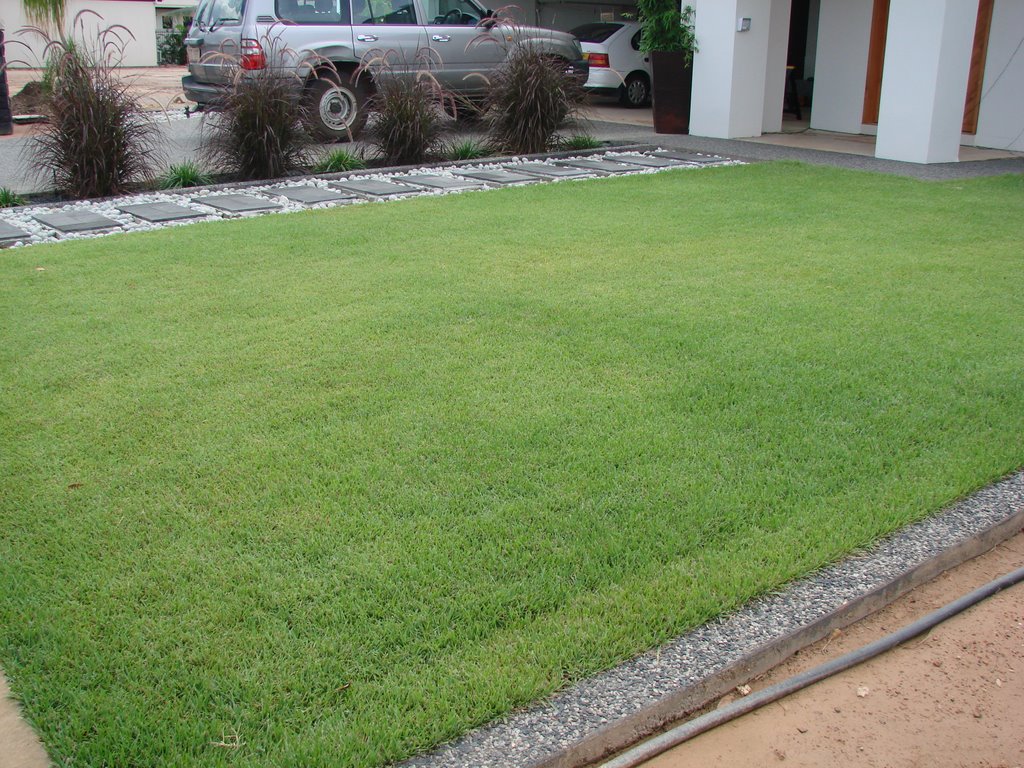
Empire zoysia turf sod can be used to create a fantastic impression at a new house. The photos say it all........ with the before and after appearance!
After is........well, two months after..... the turf was laid.
This is in a new surburban development in Darwin, and has not had any setbacks since the turf was laid. A sand profile, modified with cocopeat was used as the "soil", over the very poor subsoil base seen above on the left..
Modified sand has both advantages and disadvantages, with the major disadvantage being that initially, it is absolutely devoid of any nutrients, and also has little to allow nutrients to cling to and avoid being flushed through. The addition of cocopeat helps that issue and also provides additional moisture storage. But the advantages far outweigh all those isuses, which are easily controlled.
The big advantage is that almost always, sand is free of weeds......so use a clean turf and it will stay that way! As well, over time, sand does not compact. That usually means that there will not be root development problems, dry spots, hard bare areas etc. Sand is also very porous, allows rapid infiltration of moisture, holds quite a lot of water in the profile, and over time as roots develop, moisture capacity will improve too, due to the organic matter from roots and decaying plant leaves.
Too often so called topsoil available for purchase contains a lot of fine silt and clay particles. These settle, clump together and the profile is very hard, resistant to the entry of moisture and of low water capacity. Sand will be a better option for the growth of a great turf. Especially all of the zoysia varieties.........sand is the best option!
Thursday, December 21, 2006
NT Now Has Top Quality Fertiliser and Plant Nutrition Support
Agsafe the national registered training organisation for rural industries has recently issued a Fertcare Level C certificate to Mr Peter Harrison of Above Capricorn Technologies, Darwin following his successful completion of the training program and exams for this course.
The Fertcare program is designed to lift the skills and knowledge of all individuals involved in the supply and distribution of fertilizers and to assist in optimising environmental stewardship, occupational health and safety, food safety and agricultural profitability.
Mr Harrison’s training was specifically designed to meet the needs of agricultural advisors and crop and pasture nutrition advisers and consultants who are providing detailed plant nutrition advice based on soil and plant testing to the agricultural and horticultural industries
Using the latest adult learning methods, the Fertcare training received by Peter Harrison delivered leading-edge information, support and practical advice to improve professional competencies for advisors and covers detailed and complex knowledge of:
environmental issues, particularly in relation to fertilisers and fertiliser management;
fertiliser environmental stewardship review methodology (FESR);
food safety issues;
soil and tissue sampling;
the regulatory framework and label requirements; and
an awareness of OH&S and stewardship issues in transport, storage, handling and application of fertilisers.
Fertcare training is underpinned by eco-efficiency principles and informs participants on the proper use of fertilisers and soil ameliorant products to achieve optimum agricultural production together with effective practices for improved environmental outcomes.
The formal training is used together with the assessment and recognition of prior competency which includes the assessment of competency in;
soil, nutrient and fertiliser knowledge; and
systematic development of interpretation and
recommendations based on sound science.
The Fertcare Accreditation Level C is seen as a basic requirement for qualified professionals that provide professional advice and support in plant nutrition and fertiliser use in the rural industries across rural Australia, and has been a sought after qualification in other jurisdictions around Australia. Ask your fertiliser supplier or advisor – are you qualified?
Peter Harrison from Above Capricorn Technologies provides independent advice and can assist in developing a sound program for crops on your property. Contact him by phone 89481894 or e-mail to - office@abovecapricorn.com.au .
Sunday, December 10, 2006
Compadre zoysia - the new name for zoysia, variety Companion

The holder of the PVR for Companion zoysia has changed the variety name for this outstanding seed sown zoysia line. The material will now be called cv Compadre.
Same stuff, new name........same great turf.
The variety has done very well in tropical Australia, and is also used in the SW and SE of the US as well in many other tropical areas - Asia and especially S America.
Just remember............Compadre...........your close friend, a great companion lawn on your property!
From www.seedquest.com
Patten Seed Company's hybrid zoysiagrass 'Companion' renamed 'Compadre'
Lakeland, GeorgiaJuly 21, 2006
What once was your “Companion” zoysiagrass lawn just became your “Compadre™” lawn. Patten Seed Company, owners of the brand, has announced that the improved hybrid zoysiagrass formerly known as “Companion,” will henceforth be known as Compadre in all marketing and product descriptions.
“Recent investigation by our trademark attorneys revealed that the name ‘Companion’ had been used in commerce prior to our use. That made it necessary for us to change the name,” explained Ben Copeland, president of Patten Seed Company. “We believe ‘Compadre’ keeps the same general meaning and reflects the intent the breeder of this selection. ‘Compadre’ is a variety that was intended to be paired with a cool season grass like tall fescue to create a year round green lawn”
Compadre is a two parent cross of Zoysia japonica selections made by the late Jack Murray at the USDA turfgrass station in Beltsville, MD. It is similar to Meyer zoysia (also a Zoysia japonica) in color, texture and density.
Seed Research of Oregon has been successfully marketing Companion zoysiagrass around the world on an exclusive basis since 2000. The company will continue to market Compadre and to build on the momentum Companion sales have enjoyed worldwide.
According to Copeland, Compadre is ideal for use on golf courses, residential and commercial landscapes, roadsides and other sites that require low maintenance. It will flourish from the northern transition zone of the US south and in similar climates around the world.
“Compadre is a rugged performer, making it one of the more environmentally friendly turf grasses because it requires fewer pesticide applications as well as less water and nutrition than cool season grasses grown in the same climates,” added Copeland.
Peter H
A great zoysia turf by seed?.........YES you can!


Most zoysia lawns are laid with turf sod or sometimes by sprigging or plugs. It can be expensive, and even with plugs, a bit slow. Yes, full turfing gives you an instant lawn , but it still needs a few weeks to develop roots and tie itself into the soil. Many people are put off by the cost, and full turfing is relatively expensive.
There is another option........use seed! Yes.....the excellent zoysia turf variety Compadre is a seeded type that can be sown, as seed. Saves money, and can give you lawn cover in about 12 - 14 weeks. There have now been a few areas sown in the Darwin region and they look great. The photos tell a good story.............
The turf is slow to germinate and establish, and it is VERY important that adequate water is provided in the first few weeks.........and not to excess.
We recommend use of low volume sprinklers eg Challenger Mk2 low pressure sprinklers that deliver a few mm per hour. They are inexpensive and can be set up on a low cost 12 mm pvc line that can then be used as drip line in the garden. Or......use a soaker hose. In hot weather, you might even need to run the system for 6-8 hours per day in the first 2-3 weeks, or use a timer in bursts of 1 hour every two hours, to keep the surface moist. After the first 3 weeks, irrigation can be reduced, but keep the new area moist to about 100mm.
After establishment, the turf needs about one half of daily evaporation, say 3-4 mm per day in 2-3 deep irrigations per week, less in the cooler months.
Using Compadre seed will give a great lawn, that will pay off in less mowing, less fertiliser needs and a beautiful appearance.....and it is shade tolerant too.
Call us for more information and your source of seed.
Peter H
Monday, November 27, 2006
Recycling - myth and reality
As part of our work we often see material on recycling and resource recovery. Planet Ark have recently released a report that tries to show the truth about these issues.
Visit the following site www.planetark.org.au and look for the report: "Recycling Myths: Sorting Fact from Fiction"
Peter H
Visit the following site www.planetark.org.au and look for the report: "Recycling Myths: Sorting Fact from Fiction"
Peter H
Tuesday, November 14, 2006
Is carpet grass a weed in your lawn?
Often carpet grass is used as a turf - it is well suited to shaded areas, for example. But more commonly, it appears as a weed in high quality turf areas where removal can be difficult.
Nominally, MSMA and DSMA are used for many grasses as post emergence herbicides. But with carpet grass, it seems as if there is relatively little effect, as it quickly regrows from rhizomes. It is worse in the warmer regions as carpet grass can grow quite quickly, even after spraying.
What is your experience? Is there a reasonable solution that can provide cost effective control of both narrow and broad leaved carpet grass?
Comments welcome.
Monday, November 06, 2006
Typical lawn grub damage

The damage was done quickly and very decisively - lawn grubs can do this level of damage in a few days.
The area is now recovering, albeit slowly!
Saturday, November 04, 2006
Improve your turf
Using compost is a great way to help your lawn. It adds organic matter, is suitable for fixing minor imperfections in levels, greatly enhances soil microbiological activity which may reduce plant diseases, and even sequestrates carbon [ and that is being VERY environmentally friendly] and usually the organics come from locally recycled materials. Probably the most important attribute is that the organic mater added to the turf can reduce the need for bag fertiliser, and improve water holding capacity thus reducing water use.
Current evaporation in Darwin is 7 - 10mm per day [November] so storing any rain that falls to reduce that evaporation alone is a great benefit.
Important - do not add too much at once, 5-7 mm is enough, and level it out with a rake and leveller, water into the surface. Use fine screened compost, not the coarse mulch!!
And remember........keeping the lawn slightly longer and allowing it to dry out before re-irrigating will improve water use efficiency during this pre wet season. That applies to ANY lawn.

Turf Damage in the Pre -wet Season!
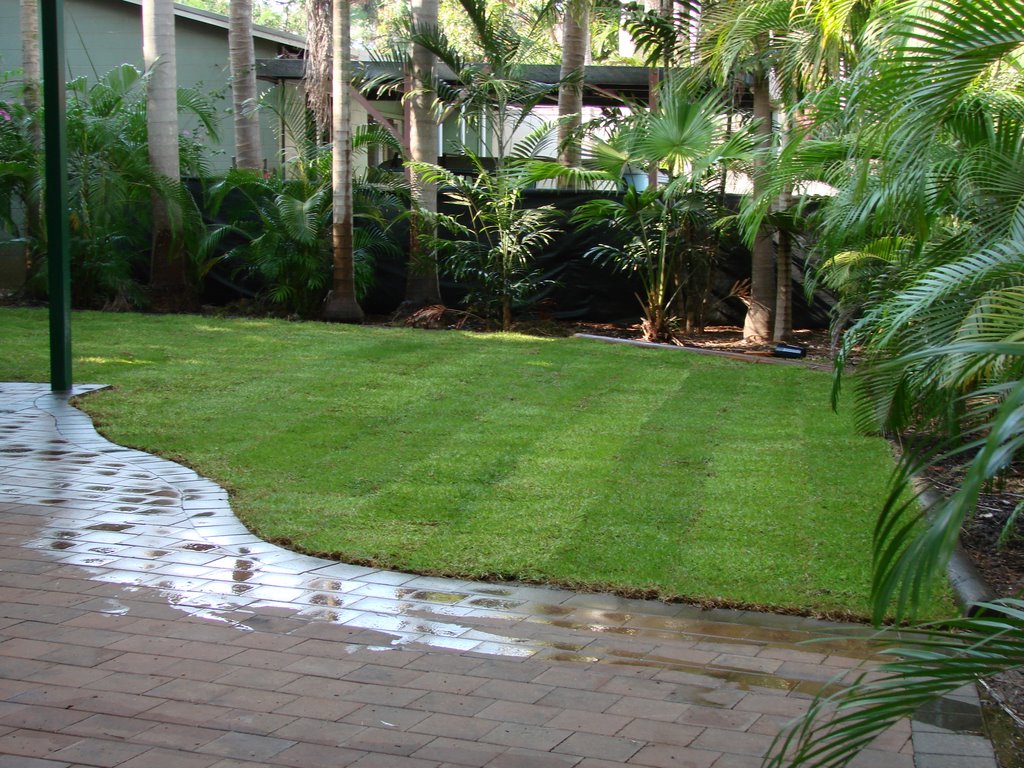
Recently we installed a new turf area using Empire zoysia. This is a very good turf, well suited to tropical Australia.
All the normal agronomic practices were carried out and the turf laid, fertiliser added, and all went well for about 4 weeks. Then disaster..........the client freaked out, and when we saw it we did too........The culprit? Army worm and sod web worm damage, and was it massive. Over half the area - 40sq m - seriously damaged in less than a week.
However, a quick investigation found the little grubs, and there were a lot!!!!! Spraying had to be done, to institute rapid control, and yes it all did work out, with the lawn now, a week later, showing good recovery.
It is a while since the damage caused was so great on any area we manage - switching to slow release nitrogen fertiliser is a prudent move to help manage this problem. All our clients have this practice recommended as part of our management protocols supplied with a new turf area. But in this case, readily available nitrogen was used, as part of the starter fertiliser NPK mix. And it seems as if it was part of the problem.
Moral - take care of the turf NOW when lawn grubs can be present; and act quickly to spray them with a suitable insecticide - and remember too with lawn grubs, it is best to spray in the evening when they are active.
This photo was what it looked like before the lawngrubs invaded.
Who we are and what we do
Above Capricorn Technologies
Agricultural & Environmental Consultants
ABN 73 215 304 514
PO Box 736 Nightcliff NT 0814 Australia
Telephone: 61 8 8948 1894 Facsimile: 61 8 8948 3894
E-mail: abovecapricorn@yahoo.com.au
Products and Services
· General agricultural and environmental consulting services; crop, seed and pasture agronomy services, agricultural management software / training/ support services and agricultural investment analysis
· Land management – land surface management including stormwater, range management, pastoral land development, weed management and control systems and plans, pasture / livestock / crop management
· Irrigation, water and soil moisture management systems
· Tropical turf development, agronomy and management – sporting ovals, recreational areas, golf courses, sports turf
· Organic waste management and compost production, effluent / biosolids management/ reuse, waste and wastewater management systems and services
· Erosion management and rehabilitation, sediment planning and control
· Soil and water bioengineering, including vetiver grass services / management
· Mine site and disturbed land revegetation and rehabilitation
· Contaminated land assessment and rehabilitation, bioremediation and phytoremediation
· Seed supply [incl native spp], production and technology, seed industry development
· Agricultural development and planning in the tropics
Operating since 1994, we are a Darwin based, growing enterprise focussing on agricultural, turf and environmental related opportunities in the tropics. Recent business includes a US$5m agriculture, turf and land development project in China, a recently completed phase of revegetation and land rehabilitation at a major new mine in Indonesia [for a US company, value >US$1m]. Both of these have been in conjunction with another small Australian company. Existing consultancy activities in the mining and agricultural sectors in the Philippines and Laos, and ongoing agricultural R & D in Thailand. Other recent projects have been bioremediation of pesticides in Kakadu National Park; water and waste management on Australia's offshore islands; greenwaste and organic resource management for compost and as a biomass fuel; crop production R & D.
Activities focus on R & D and consulting in agriculture, horticulture [tropical fruits, dates, grapes], livestock production, turf [including sports turf and golf course development, agronomy and management], soil and water bioengineering, effluent and biosolids management and reuse [particularly for agriculture / horticulture], bioremediation and phytoremediation, organic waste management and composting, erosion control, revegetation and landscape rehabilitation, land management, plant materials utilisation and development incl plant variety registration, seed science and seed industry development, seed production, irrigation. We can also supply innovative technology and products for these sectors including a range of erosion and sediment control products, advanced wastewater and stormwater systems, soil moisture measurement equipment, agrochemicals and turf management products, waste handling [incl medical] and compost systems.
The company has a strong science base and focuses on a holistic approach to problem solving. Our operational focus is northern Australia in both wet and arid areas, and into tropical regions of Africa, Asia and South America. We hold professional indemnity insurance. We have strong alliances with a number of other medium sized operators within Australia.
Registered professional member, Australian Institute of Agricultural Science and Technology
Certified Professional Agriculturist
Member International Erosion Control Association
Certified Professional in Erosion and Sediment Control [pending]
Contact: Peter G Harrison CPAg BScAgr MAIAST MIECA
Subscribe to:
Posts (Atom)